M3U IPTV USA Guide 2026 | Setup, Benefits & Streaming Tips
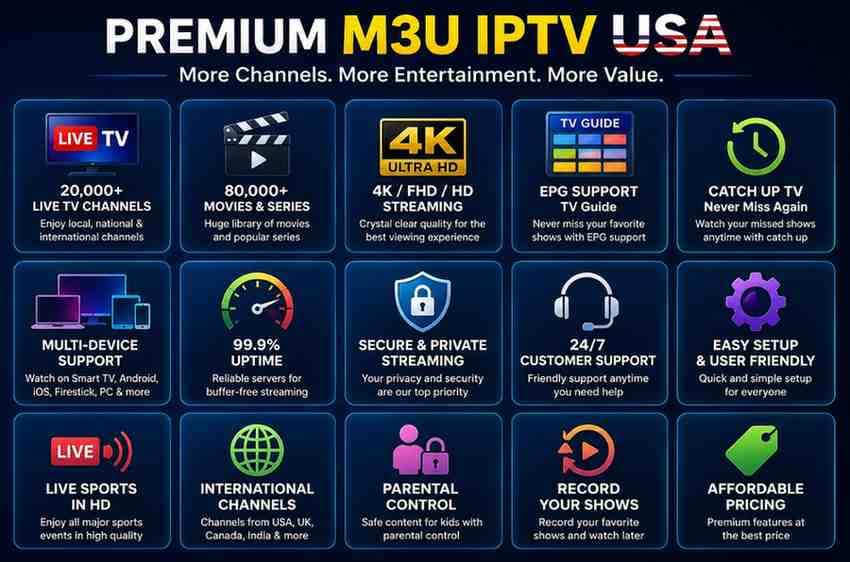
Discover everything about M3U IPTV USA, including setup, compatibility, streaming tips, security, legal considerations, and expert advice for 2026.
🚀 Start Streaming Smarter Today
🚀 Start Streaming Smarter Today
M3U IPTV USA: The Ultimate Guide for Better Streaming in 2026
Traditional cable television is steadily losing its appeal across the United States. Rising subscription costs, limited customization, long-term contracts, and the growing demand for flexible entertainment have encouraged millions of viewers to explore internet-based television solutions. Among the most discussed technologies today is m3u iptv usa, a streaming method that allows compatible applications to organize and play television channels, movies, and video-on-demand libraries through an M3U playlist.
Unlike conventional broadcasting systems that rely on satellite dishes or cable infrastructure, M3U IPTV uses internet connectivity to deliver media content directly to supported devices. This approach gives viewers greater flexibility, allowing them to enjoy entertainment on Smart TVs, streaming devices, smartphones, tablets, laptops, and desktop computers from virtually anywhere with a stable internet connection.
However, many beginners misunderstand what M3U actually is. An M3U file is not a television service by itself. Instead, it functions as a playlist that contains links pointing compatible IPTV players toward streaming sources. Think of it as a digital directory that helps IPTV applications organize available channels and media into an easy-to-use interface.
Understanding this distinction is essential because countless online articles confuse playlists with IPTV services, making it difficult for beginners to understand how the technology truly works. This guide focuses on providing accurate, practical, and beginner-friendly information that explains the technology without unnecessary complexity.
Whether you're completely new to IPTV or looking to improve your streaming experience, this guide covers everything from basic concepts and device compatibility to internet requirements, streaming optimization, security practices, troubleshooting techniques, and future trends shaping the IPTV industry in 2026.
By the end of this article, you'll understand not only how m3u iptv usa works but also how to enjoy a smoother, safer, and higher-quality streaming experience.
What is M3U IPTV USA?
The term m3u iptv usa refers to using an M3U playlist format with IPTV-compatible applications to stream television content over the internet for viewers located in the United States.
An M3U playlist is essentially a text-based file that stores streaming URLs along with information such as:
Channel names
TV categories
Logos
Streaming addresses
Electronic Program Guide (EPG) references
Group titles
Media metadata
Instead of manually entering every streaming link, IPTV players automatically read the playlist and display channels in a television-style interface.
This creates an experience similar to traditional cable television while offering significantly greater flexibility.
A typical IPTV application loads an M3U playlist and presents organized sections such as:
News
Sports
Entertainment
Kids
Movies
Documentaries
International Channels
Lifestyle
Music
Local Content
The result is a familiar viewing experience without requiring traditional broadcasting hardware.
Why Is M3U IPTV Becoming So Popular in the USA?
Over the past several years, American households have dramatically changed the way they consume television content.
Several factors contribute to the increasing popularity of m3u iptv usa.
1. Flexible Viewing Experience
Modern viewers no longer want to watch television according to fixed schedules.
They prefer choosing:
What to watch
When to watch
Which device to use
Where to stream
IPTV supports this flexibility far better than traditional cable systems.
2. Multi-Device Compatibility
Unlike conventional cable boxes, IPTV playlists can often be accessed using numerous compatible devices.
Popular options include:
Android TV
Google TV
Amazon Fire TV
Firestick
Apple TV
Windows PC
macOS
Android smartphones
iPhone
iPad
Linux
Smart TVs
Streaming boxes
This versatility makes IPTV attractive for families with multiple viewing preferences.
3. Internet Infrastructure Has Improved
One major reason IPTV adoption has accelerated is the availability of faster broadband connections throughout many parts of the United States.
Today, households commonly have:
Fiber Internet
Cable Internet
5G Home Internet
High-Speed Wi-Fi 6
Gigabit Connections
These improvements support smooth HD, Full HD, and even 4K streaming when properly configured.
4. Personalized Entertainment
Instead of paying for large channel bundles, users increasingly prefer customized entertainment experiences that match their interests.
Examples include:
Sports lovers
Movie enthusiasts
News followers
International communities
Language-specific programming
Educational content
Children's programming
This personalization continues driving IPTV adoption.
Understanding How M3U IPTV Works
Many beginners assume IPTV is complicated.
In reality, the process is surprisingly straightforward.
The streaming workflow generally follows these steps:
Step 1
The IPTV application opens.
Step 2
An M3U playlist is imported.
Step 3
The player reads playlist information.
Step 4
Channels are organized automatically.
Step 5
The viewer selects a channel.
Step 6
The player connects to the streaming source.
Step 7
Video begins playing over the internet.
This process usually takes only a few seconds on a reliable internet connection.
What Makes an M3U Playlist Different?
An M3U playlist acts more like a digital map than a streaming service itself.
Instead of storing video files, it stores references that direct compatible IPTV applications toward available media streams.
A typical playlist may include:
Channel titles
Logos
Categories
Stream URLs
EPG information
Language identifiers
Resolution details
Group organization
Because playlists are lightweight text files, they load quickly and remain compatible with numerous IPTV applications.
📺 Explore Better IPTV Now
Common Features Found in Modern M3U IPTV Players
Today's IPTV applications offer far more than simple channel playback.
Popular features include:
Electronic Program Guide (EPG)
Displays current and upcoming television schedules.
Favorites
Create personalized channel lists.
Search
Locate channels instantly.
Catch-Up Support
Watch recently aired programs if supported.
Multi-Screen Viewing
Watch multiple channels simultaneously on supported applications.
Recording Options
Some IPTV players allow recording supported streams for later viewing.
Subtitle Support
Improve accessibility with multilingual subtitles.
External Player Integration
Some applications allow playback through advanced media players for enhanced performance.
Who Uses M3U IPTV USA?
The audience has expanded significantly over recent years.
Common users include:
Families
Students
Remote workers
Travelers
Sports fans
Movie lovers
International viewers
Expats
Tech enthusiasts
Smart home users
Its broad compatibility makes IPTV suitable for a wide range of viewing preferences.
Key Advantages of M3U IPTV USA
Compared to older television technologies, M3U IPTV offers several practical benefits.
Easy Setup
Most IPTV players require only a playlist import before channels become available.
Device Flexibility
Watch content across multiple compatible devices without relying on a single television.
Organized Interface
Channels are typically grouped into logical categories for easier navigation.
Portable Viewing
Enjoy content wherever a stable internet connection is available.
Continuous Innovation
Modern IPTV applications frequently introduce improvements such as AI-powered recommendations, cloud synchronization, advanced search tools, and enhanced user interfaces.
How to Choose a Reliable M3U IPTV Service
One of the biggest mistakes new users make is assuming that every IPTV provider offers the same experience. In reality, the quality of an IPTV service depends on several factors, including server stability, playlist management, customer support, and compatibility with different devices.
Instead of focusing only on price, it's better to evaluate the overall streaming experience. A slightly more expensive service with reliable performance often delivers much greater value than a cheaper option that suffers from constant interruptions.
Before choosing any service, consider these important factors:
1. Server Stability
Reliable IPTV services maintain high-performance servers that minimize buffering and downtime.
Look for providers that offer:
High uptime
Fast channel loading
Stable live TV streams
Consistent playback during peak hours
Frequent outages can quickly turn an enjoyable viewing experience into a frustrating one.
2. Playlist Updates
Television channels change over time. Reliable providers regularly update their M3U playlists to remove inactive streams and add new channels.
Regular updates help ensure:
Working channel links
Improved organization
Better playback quality
Accurate Electronic Program Guides (EPG)
3. Device Compatibility
A quality IPTV service should work across multiple platforms, allowing users to switch between devices without learning a new interface each time.
Popular compatible platforms include:
Android TV
Google TV
Amazon Fire TV
Firestick
Apple TV
Windows
macOS
Linux
Android smartphones
iPhone
iPad
Smart TVs
Cross-platform support provides greater flexibility for households with different devices.
4. Customer Support
Even experienced users occasionally encounter technical issues. Responsive customer support can make setup and troubleshooting much easier.
Helpful providers often offer:
Setup guides
Frequently Asked Questions
Live chat
Email support
Installation tutorials
5. EPG Support
Electronic Program Guides enhance the viewing experience by displaying current and upcoming programs.
An updated EPG allows users to:
Browse schedules
Plan viewing
Navigate channels more efficiently
Best Devices for M3U IPTV USA
One reason m3u iptv usa has become so popular is its flexibility. Instead of requiring proprietary hardware, IPTV works with many everyday devices.
Below are some of the most common options.
Smart TVs
Modern Smart TVs provide a convenient way to stream IPTV directly without additional hardware in many cases.
Benefits include:
Large display
Simple remote control navigation
Easy application installation
Comfortable viewing experience
Amazon Fire TV Stick
The Fire TV Stick has become one of the most popular IPTV streaming devices due to its affordability and ease of use.
Advantages include:
Portable
Easy installation
Smooth interface
Voice remote support
Android TV Boxes
Android TV devices provide extensive customization and broad compatibility with IPTV applications.
They are especially useful for users who want:
Advanced settings
External media players
Expanded storage
Flexible customization
Smartphones and Tablets
Mobile devices offer entertainment wherever an internet connection is available.
Benefits include:
Travel-friendly
Portable
Touchscreen navigation
Quick playlist management
Desktop and Laptop Computers
Many users prefer watching IPTV on larger monitors while working or studying.
Desktop playback often provides:
Better multitasking
Larger display
Keyboard shortcuts
Improved playlist management
💥 Start Your IPTV Journey
Step-by-Step Guide to Setting Up M3U IPTV
Although different IPTV applications have slightly different interfaces, the setup process follows a similar pattern.
Step 1: Install an IPTV Player
Download and install a compatible IPTV player on your preferred device.
Choose a player that supports:
M3U playlists
EPG integration
Favorites
Search functionality
Step 2: Add Your Playlist
Most applications allow users to import playlists in one of two ways:
Upload an M3U file
Enter an M3U URL
Once imported, the player scans the playlist and organizes available channels.
Step 3: Load the Channel List
After importing the playlist, the application processes channel information.
Depending on playlist size, this may take a few seconds.
Step 4: Organize Favorites
Many IPTV players allow users to create personalized channel collections.
Examples include:
Sports
Movies
Kids
News
Local favorites
This reduces browsing time.
Step 5: Connect an EPG
Adding an Electronic Program Guide improves navigation by displaying television schedules.
A synchronized EPG allows viewers to see:
Current programs
Upcoming broadcasts
Program durations
Channel information
Step 6: Adjust Video Settings
For the best experience:
Enable hardware decoding (if available)
Select automatic resolution
Optimize buffer settings
Enable adaptive streaming when supported
Why Buffering Happens
Buffering is one of the most common IPTV complaints.
Fortunately, it often results from issues that users can improve.
Common causes include:
Slow Internet
Insufficient bandwidth prevents continuous playback.
Weak Wi-Fi Signal
Distance from the router may reduce connection quality.
Network Congestion
Streaming during peak internet usage hours may affect performance.
Device Limitations
Older streaming devices may struggle with higher-resolution content.
Outdated IPTV Applications
Older software versions sometimes contain bugs affecting playback.
Tips to Reduce Buffering
For smoother streaming:
Restart your router regularly.
Use a wired Ethernet connection when possible.
Keep IPTV apps updated.
Close unused background applications.
Avoid downloading large files while streaming.
Place your Wi-Fi router in a central location.
Upgrade to a faster internet plan if necessary.
Restart your streaming device periodically.
These small adjustments often improve streaming stability significantly.
Features Many Users Overlook
Many IPTV applications include powerful features that users never activate.
Favorites List
Creating favorites allows quick access to frequently watched channels.
Search Function
Rather than scrolling through hundreds of channels, search tools locate content instantly.
Multi-Screen Viewing
Some IPTV players support viewing multiple live channels simultaneously.
This feature is particularly useful during major sporting events.
Recording
Supported applications may allow users to record compatible streams for later viewing.
Parental Controls
Families can restrict access to selected content using built-in parental settings.
Subtitle Options
Many IPTV players support subtitles in multiple languages, improving accessibility.
Optimizing Your IPTV Experience
Getting the most from m3u iptv usa isn't just about having a fast internet connection. A few simple optimizations can make a noticeable difference.
Keep Software Updated
Application updates often include:
Performance improvements
Security patches
Bug fixes
New features
Restart Devices Occasionally
Long streaming sessions can consume system memory.
A quick restart helps maintain consistent performance.
Organize Your Playlists
Large playlists with thousands of channels can feel overwhelming.
Grouping favorites by category makes navigation faster and more enjoyable.
Use Quality Networking Equipment
Modern routers with dual-band or Wi-Fi 6 support generally provide more stable streaming than older hardware.
Monitor Storage Space
Devices with very little available storage may become sluggish over time.
Removing unused apps and temporary files helps maintain responsiveness.
Common Mistakes Beginners Should Avoid
Even experienced streamers can overlook simple issues. Avoid these common mistakes:
Importing outdated playlists
Ignoring software updates
Using unstable public Wi-Fi
Running too many apps in the background
Expecting 4K playback on slow internet
Forgetting to back up playlist settings
Skipping EPG configuration
Using low-quality networking equipment
Avoiding these pitfalls can greatly improve your streaming experience.
Conclusion
The way people watch television in the United States has changed dramatically over the past decade, and m3u iptv usa has become an important part of this transformation. Instead of relying solely on traditional cable or satellite services, many viewers now prefer the flexibility of internet-based streaming that allows them to enjoy content on multiple devices, from Smart TVs and streaming sticks to smartphones, tablets, and computers.
Understanding how M3U playlists work is the first step toward building a better streaming experience. An M3U playlist is simply a file that organizes streaming sources, while a compatible IPTV player handles playback and channel management. Choosing a reliable service, maintaining a stable internet connection, keeping your IPTV application updated, and following good security practices can significantly improve streaming quality and reduce common issues such as buffering or playback interruptions.
As streaming technology continues to evolve, IPTV is expected to benefit from faster internet speeds, smarter video compression, cloud-based features, AI-powered recommendations, and broader device compatibility. These innovations will make the viewing experience even smoother and more personalized for users across the USA.
At the same time, users should always stream responsibly. Selecting trustworthy providers, protecting personal information, using secure networks, and understanding the legal regulations in their region are essential steps toward a safe and enjoyable IPTV experience.
Whether you're just getting started or looking to optimize your current setup, m3u iptv usa offers a flexible and modern way to access entertainment. By following the tips and best practices shared in this guide, you can create a reliable streaming setup that delivers excellent performance, convenience, and an improved viewing experience for years to come.
📲 Stream Anytime, Anywhere Today
Frequently Asked Questions (FAQs)
1. What is M3U IPTV USA?
M3U IPTV USA refers to using an M3U playlist with a compatible IPTV player to stream television content over the internet on supported devices in the United States.
2. Is an M3U file the same as an IPTV subscription?
No. An M3U file is simply a playlist that contains streaming information. It is not an IPTV service by itself.
3. Which devices support M3U IPTV?
Most modern devices support M3U IPTV, including:
Smart TVs
Android TV
Google TV
Amazon Fire TV Stick
Apple TV
Windows PCs
macOS
Android phones
iPhones
Tablets
4. What internet speed is recommended for IPTV?
For the best experience:
SD: 5 Mbps
HD: 10 Mbps
Full HD: 20 Mbps
4K UHD: 35 Mbps or higher
Faster speeds are recommended for multiple simultaneous streams.
5. Why does IPTV buffering happen?
Buffering can occur because of slow internet speeds, weak Wi-Fi signals, network congestion, outdated apps, overloaded devices, or issues with the streaming source.
6. Can I use M3U IPTV on multiple devices?
Many IPTV services allow multiple compatible devices, but the number of simultaneous connections depends on your provider's terms.
7. What is an EPG in IPTV?
An Electronic Program Guide (EPG) displays television schedules, current programs, and upcoming broadcasts, making it easier to browse channels.
8. Can I organize my favorite channels?
Yes. Most IPTV players allow users to create favorite lists for quick and convenient access.
9. How often should an M3U playlist be updated?
Reliable providers update playlists regularly to maintain working links, improve stability, and add or remove channels as needed.
10. Is IPTV compatible with Smart TVs?
Yes. Many Smart TVs support IPTV applications that can import M3U playlists directly.
11. What causes channels to stop working?
Common reasons include outdated playlists, temporary server issues, internet connectivity problems, or changes to streaming sources.
12. Can IPTV stream 4K content?
Yes, provided that the content is available, your device supports 4K playback, and your internet connection is fast enough.
13. Is Wi-Fi or Ethernet better for IPTV?
A wired Ethernet connection generally provides more stable performance and lower latency than Wi-Fi, especially for HD and 4K streaming.
14. How can I improve IPTV streaming quality?
Use a fast internet connection, keep your IPTV app updated, restart your router regularly, use quality networking equipment, and close unnecessary background applications.
15. Can I use subtitles with IPTV?
Many IPTV players support subtitle files and multiple language options, depending on the available content.
16. What should I do if my playlist won't load?
Check your internet connection, verify the playlist URL or file, restart the IPTV application, and ensure the playlist is still active.
17. Are all IPTV players the same?
No. Different IPTV players offer different features such as EPG support, recording, parental controls, favorites, multi-screen viewing, and customizable interfaces.
18. Can IPTV work while traveling?
Yes. If you have a compatible device and a reliable internet connection, you can often access your IPTV setup while traveling, subject to your provider's policies and applicable laws.
19. What should I consider before choosing an IPTV provider?
Look for server stability, playlist updates, device compatibility, responsive customer support, EPG availability, and a strong reputation for reliability.
20. Is M3U IPTV the future of television?
Internet-based streaming continues to grow as more people seek flexible viewing options. As broadband speeds improve and streaming technology advances, IPTV is expected to remain an important part of the future digital entertainment landscape.

