Mandated Tech Upgrades Are the Best Market Signal. RFID, DPP, and the Quiet Deadline Every Product Founder Should Know
Mandated Tech Upgrades Are the Best Market Signal. RFID, DPP, and the Quiet Deadline Every Product Founder Should Know.
There is a pattern I keep coming back to every time I look at where durable software businesses get built.
It is not around the flashiest new technology. It is not even around the biggest markets. It is around mandated change. When a government, a regulator, or a dominant retailer forces an entire industry to upgrade how it operates by a fixed deadline, a very specific kind of opportunity opens. The demand is not optional. The timeline is not negotiable. And most of the companies affected have no idea where to start.
GDPR created a compliance tooling market overnight. PCI DSS did the same for payment security software. Right now, quietly, the same thing is happening in physical supply chains. And almost nobody in this community is paying attention to it.
The Signal Nobody Here Is Talking About
Here is what is converging right now.
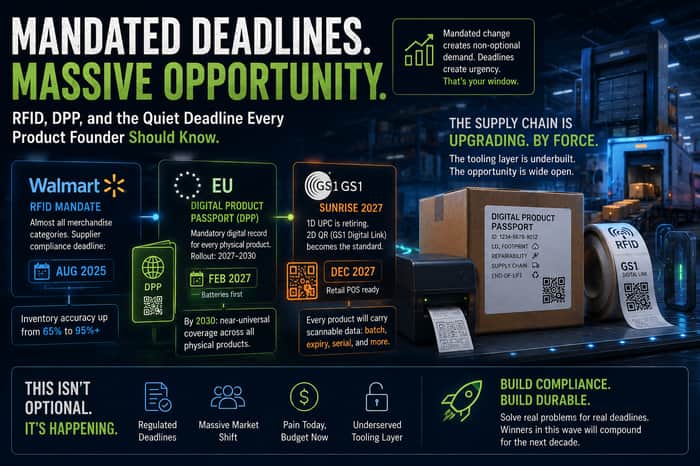
Walmart, the world's largest retailer, has expanded its RFID mandate to cover almost all merchandise categories sold in its stores and distribution centers, with a compliance deadline of August 2025. Every supplier that wants to keep selling at Walmart has to tag its products with RFID, manage the encoding, and integrate with Walmart's inventory systems. Not eventually. Now. And RFID adoption has pushed Walmart's inventory accuracy from the industry average of 65% to over 95%, which means every other major retailer is watching and following suit. Lowe's, Macy's, Nordstrom, Target, Costco all have their own mandates expanding in parallel.
At the same time, the EU has mandated the Digital Product Passport under the Ecodesign for Sustainable Products Regulation. Starting in 2027 and rolling through 2030, every physical product sold in the EU will need a digital record containing its material composition, carbon footprint, repairability score, supply chain origin, and end-of-life information, accessible via a scannable identifier on the label. Batteries come first in February 2027. Textiles, electronics, furniture, and metals follow. By 2030, the plan is near-universal coverage across all physical consumer and industrial products.
And GS1, the body that manages global product identification standards, is retiring the traditional 1D UPC barcode. GS1 Sunrise 2027 requires all retail point-of-sale systems worldwide to be ready to read 2D barcodes, with products expected to carry GS1 Digital Link encoded QR codes that store batch numbers, expiry dates, serial identifiers, and URLs alongside standard product identification. The 1D barcode that has been on every product since the 1970s has an expiry date.
These three things are not coincidences. They are a forced, simultaneous infrastructure upgrade across the entire physical product supply chain. And the tooling layer to support it is massively underdeveloped.
Why Mandated Upgrades Are a Better Signal Than Market Demand
Most market opportunities are uncertain. You are guessing at whether people want the thing, whether they will pay for it, whether the timing is right. You are reading signals and trying to extrapolate.
Mandated upgrades are different. The demand is already confirmed. The timeline is fixed. The pain is real and immediate. The buyer is not choosing whether to upgrade. They are choosing who to hire to help them do it.
Startups that treat compliance as a strategic asset rather than a burden can differentiate themselves, gain investor trust, and unlock new market opportunities. The key phrase is "strategic asset." The companies that understood GDPR early did not just survive compliance. They built products that turned it into a sales advantage. The same playbook is available here.
The RFID software and services market is projected to more than triple between 2025 and 2030, growing from $294 million to $1.1 billion at a CAGR of 28%, according to ABI Research. Suppliers in this space are reporting more demand in the past 6 to 12 months than in the previous 10 years combined. That is not organic growth. That is mandate-driven demand coming off the sidelines all at once.
The Compliance Layer Is Surprisingly Thin
Here is where it gets interesting for builders.
The hardware side of RFID is reasonably mature. Tags are cheap, readers are commodity, the physics work. But the software layer that sits between the hardware and the business operations, which handles label design, RFID encoding, GS1 standard compliance, ERP integration, and regulatory readiness, is still fragmented and largely enterprise-priced.
Most small and mid-sized suppliers facing the Walmart mandate or prepping for DPP compliance have three options right now. They can pay an enterprise vendor a lot of money. They can try to hack it together themselves using tools not designed for RFID compliance. Or they can find a specialist solution that actually fits their situation.
Option three is where the gap is. RAIN RFID labeling compliance is one of those areas that looks simple from the outside until you are actually trying to meet a major retailer's encoding requirements. The encoding schemes matter. The GS1 standards matter. Getting it wrong means your tags fail at the retailer's readers, which means your shipment gets rejected, which means you do not get paid. The compliance requirements are specific, the consequences are immediate, and most suppliers are discovering this for the first time.
The same dynamic will play out at a much larger scale as DPP requirements kick in. The product passport is not just a QR code. It is a structured data record with specific field requirements, a unique product identifier that links to a verified data source, and an obligation to maintain that data for at least 10 years after the product is placed on the market. Someone needs to build the tooling to manage that. Someone needs to help manufacturers understand what data they need, where it lives in their supply chain, and how to structure it to meet the GS1 Digital Link specifications that DPP compliance runs on.
What the Opportunity Actually Looks Like
Let me be concrete about where the gaps are, because "RFID software" is not a product. These are actual workflow problems that are currently being solved badly or not at all.
Label design and encoding management for compliance. Most manufacturers use generic design tools that were not built for RFID. Getting a label that encodes correctly to GS1 EPC++ standards, prints reliably at high volume, and can be updated when standards change is a real workflow. GS1's new EPC++ and ISO BD encoding schemes now allow encoding web URLs directly into RFID tag memory, which is exactly the kind of technical shift that breaks existing setups and creates tool-switching moments.
DPP data collection and structuring. The Digital Product Passport requires manufacturers to gather data from across their supply chain: material composition from tier-2 and tier-3 suppliers, carbon footprint calculations, repairability scoring. First passport creation takes 4 to 8 weeks for a manufacturer with complete documentation. Supplier data collection for carbon footprint and recycled content requires 3 to 6 months minimum. Most manufacturers do not have complete documentation. Helping them collect, structure, and maintain that data is a recurring workflow, not a one-time project.
ERP and WMS integration. RFID data needs to flow into existing inventory, warehouse, and enterprise systems. Most SMB suppliers do not have IT teams to build those integrations. They need something that connects without a six-month implementation. This is a classic integration layer opportunity.
Compliance monitoring and change management. Standards change. Retailer requirements update. DPP delegated acts will be issued by product category between now and 2028, each adding new field requirements. The companies that got their RFID setup working for the Walmart 2022 mandate are now finding out their encoding needs to be updated for 2025 requirements. This is a monitoring and alerting problem, not just a one-time implementation problem.
The GS1 Sunrise 2027 Wildcard
The barcode transition is the one that will affect the most businesses and is currently the least understood.
GS1 Sunrise 2027 marks a global transition from 1D UPC barcodes to 2D barcodes like QR codes, requiring all retail POS systems to be capable of reading 2D barcodes by the end of 2027. For brands and manufacturers, that means updating packaging to include 2D barcodes with GS1 Digital Link encoding. For software tools that generate labels, print barcodes, or manage product data, it means supporting an entirely different encoding format.
The scope is almost incomprehensible. Every physical product with a retail barcode, which is essentially everything on every shelf in every store in the world, needs to transition. The tooling market for this is barely formed. Most brands are just starting to understand what it means for them.
European buyers are already asking for DPP roadmaps in their procurement processes. Suppliers that cannot show they are preparing are being cut from supplier lists before the regulation even fully kicks in. The demand is not waiting for 2030.
The Indie Builder Angle
I want to be honest about where the opportunity sits, because "build RFID software" is not the pitch.
The companies that will win in this space are not trying to compete with the enterprise supply chain platforms. They are building narrow, deep tools that solve specific workflow problems for specific buyer types.
A label compliance tool for Walmart suppliers that handles RAIN RFID encoding, generates the required EPC data, and validates against current retailer specifications. A DPP data collection workflow that helps mid-market manufacturers gather supplier data and generate compliant product passport records. An integration connector that pulls RFID scan data into Shopify or Cin7 or QuickBooks without a custom dev project. A monitoring dashboard that tracks retailer mandate changes and flags when a supplier's setup needs to be updated.
None of these require building a supply chain platform. They require understanding one specific compliance workflow deeply enough to automate it for people who currently solve it with spreadsheets and emails and expensive consultants.
That is exactly the playbook that worked for GDPR-era compliance tools. It is working now for DORA compliance tooling in fintech. And it is available in physical supply chains for whoever moves early enough to become the default before the enterprise vendors get there.
The deadlines are fixed. The buyers are motivated. The tooling gap is real. That is about as clean a market signal as you are going to find.
