Manual Vs Automation Testing: A Comparative Analysis

Imagine that you are baking a cake. You can do everything the hard way, manually: measuring flour, mixing batter, preheating the oven just right, or you can use a smart kitchen device that measures, mixes, and bakes for you with one touch of a button. Both are capable of making a great cake, but both have control, labor, and consistency sacrifices.
Software testing operates similarly. Manual vs automation testing is a choice between using hands-on work or a machine's efficiency. Some tests are done manually, depending on human sense and observation, while others are automated, driven by scripts and tools. In this blog, we will discuss manual vs automation testing thoroughly, where each shines, their limitations, and how to determine the proper balance for your project.
What is Manual Testing?
Manual testing is the process of executing test cases manually with no automation tool. Testers simulate end-user actions by directly interacting with the app, looking for bugs, UI inconsistencies, and unanticipated behavior.

For example, a QA engineer manually testing an online shopping website would manually add items to a shopping cart, apply discount codes, and check that the checkout sum is accurate.\
Manual testing benefits are that it is easy to be altered and flexible with changes, making it suitable for usability and exploratory testing. It doesn't require any specific programmatic skills. Manual testing is slow for repeated testing, prone to error with the human factor, and is not easily scalable.
What is Automation Testing?
Automation testing is dependent on tools and scripts to run pre-written test cases automatically. Such a method is better in the case of repetitive, high-frequency, or performance tests.\
For example, hundreds of tests can be run overnight after a new build by an automated regression suite — something that would take days to do manually.
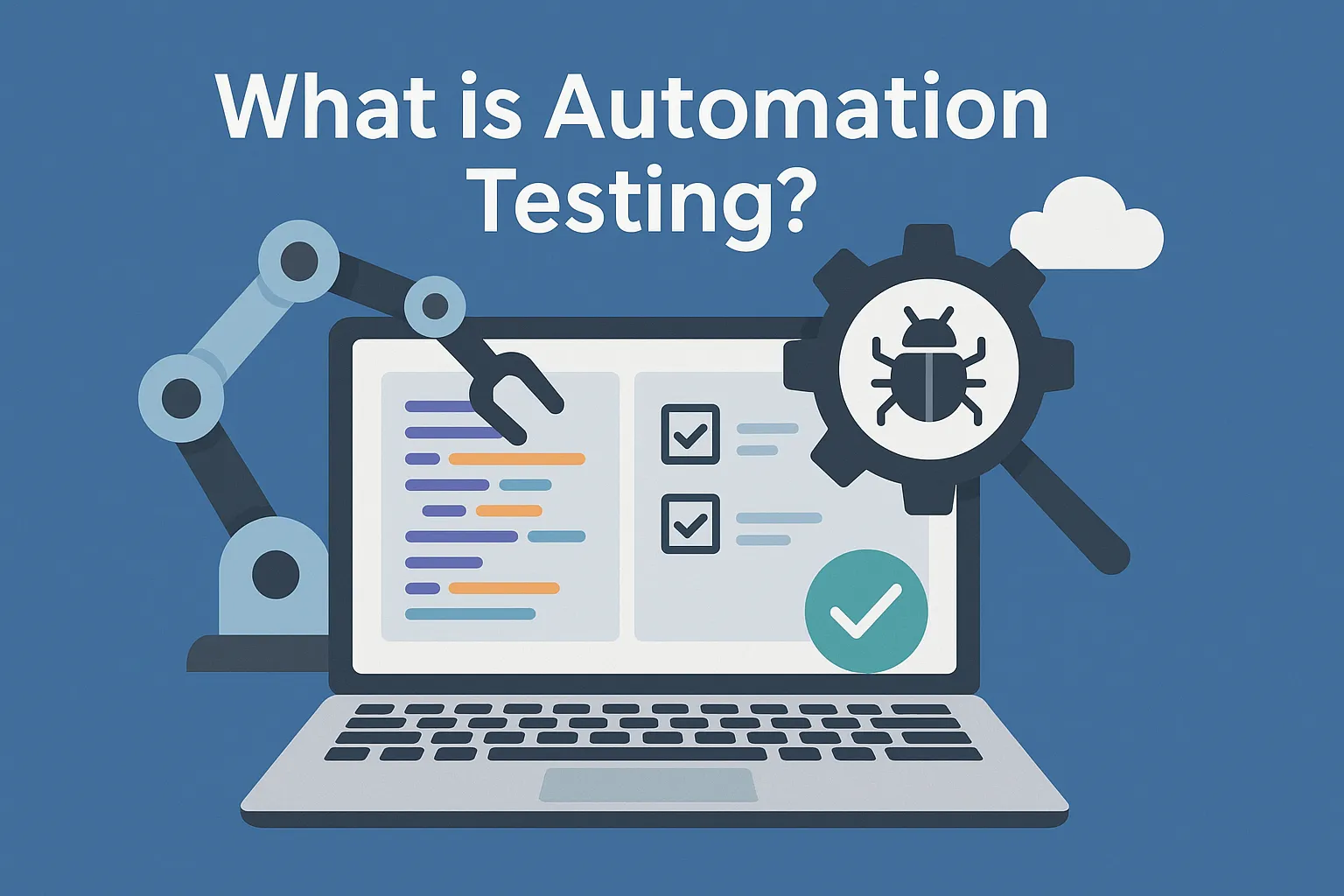
The benefits of automated testing are faster running, predictable outcomes, and suitability for large-scale regression and performance testing. Nevertheless, it does require initial setup, technical skill to develop and maintain scripts, and is not so strong at subjective judgments such as user experience.
When to Use Manual Testing?
Manual testing should be utilized when:
-
The product is in its nascent phases of development with perpetually shifting requirements
-
Usability or exploratory testing is required to obtain qualitative feedback
-
Tests are executed rarely or only periodically
-
Human judgment needs to identify minute UI/UX problems

In the case of whether manual or automation software testing should be utilized, manual testing triumphs when a bit of creativity and adaptability is needed.
When to Use Automation Testing?
Automation testing best applies in cases where:
-
Test cases are not changing and require repeated execution frequently
-
Regression testing on large projects is necessary
-
Cross-browser or environment compatibility must be tested
-
Performance or load testing is important
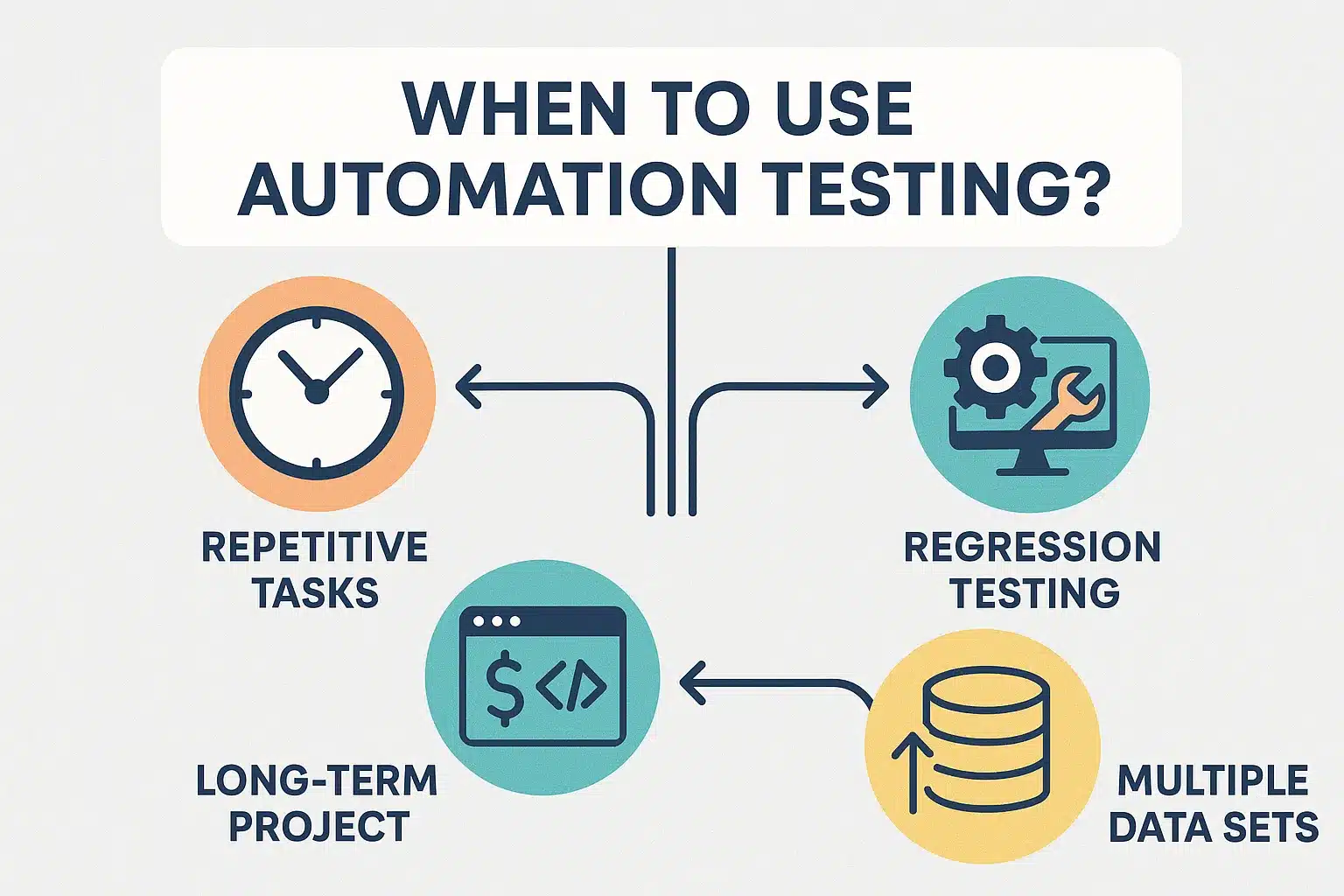
To sum up, automation testing wins the debate for automation vs manual testing when it comes to saving time and achieving consistent coverage on large codebases.
Manual Testing Pros
-
Adaptable and flexible to changes
-
No programming knowledge is required
-
Great for user interface feedback and exploratory testing
Manual Testing Cons
-
Time-consuming and repetitive
-
Risk of uneven test coverage
-
Not scalable for large projects
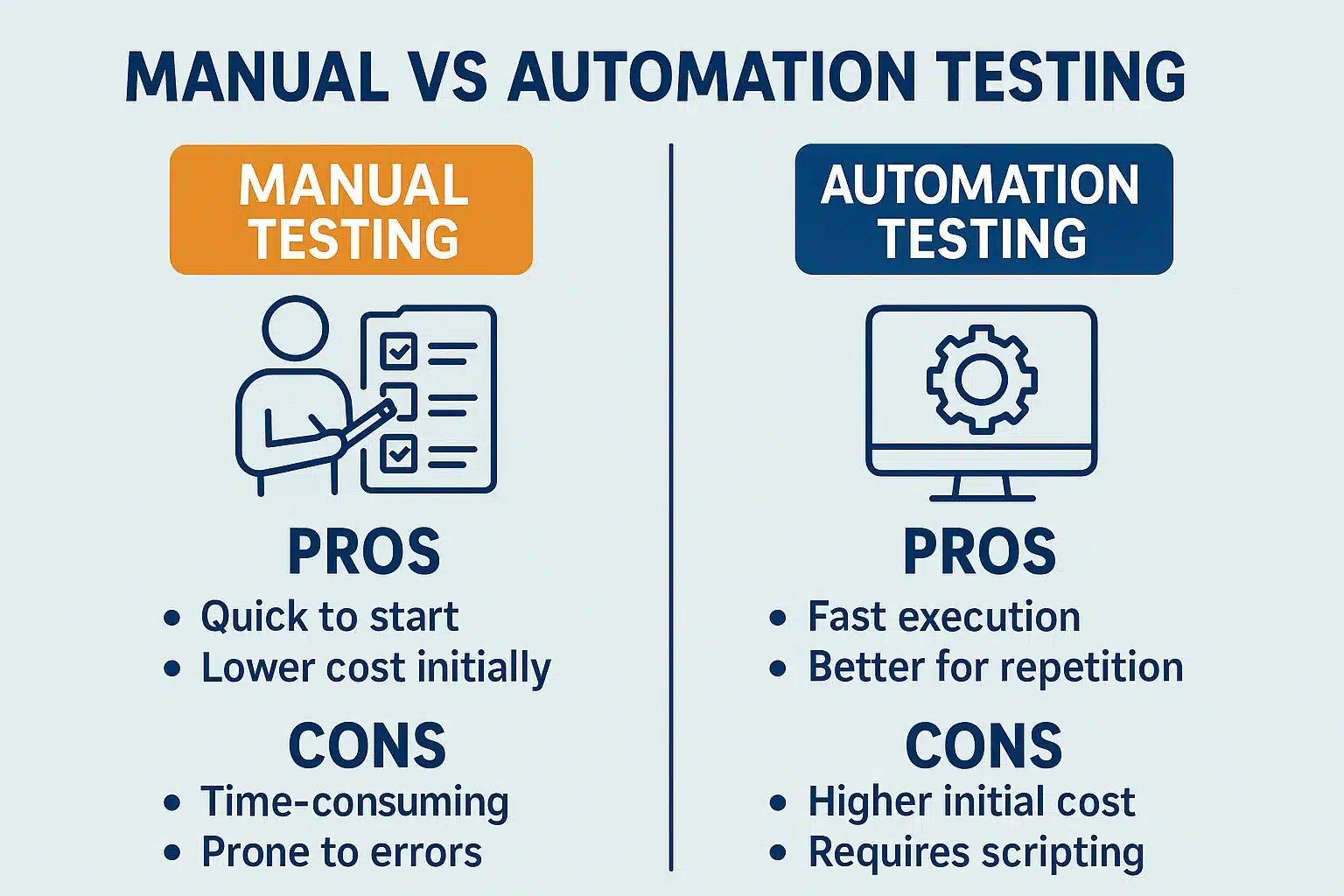
Automation Testing Benefits
-
Fast execution and reversibility
-
Maintains parallel and large-scale testing
-
Economical on long-term projects
Automation Testing Limitations
-
Higher upfront setup cost and time
-
Requires coding and maintenance skills
-
Limited in executing subjective or visual elements
Cost, Time, and Accuracy in Manual vs Automation Testing
Manual testing appears to be less expensive in the initial stages but turns out to be costly in the long term due to effort and potentially omitted defects. Automation testing costs the effort upfront in infrastructure and writing scripts but delivers faster and more precise results for multiple test cycles. While automation is more accurate, it can never replace human judgment where subjective interpretation is needed — hence making automation vs manual software testing a combination approach a necessity.
How to Decide: Manual vs Automation Testing?
While deciding when and where to use manual vs automation testing, it depends on several factors:
-
Project complexity and size (larger and more complicated projects would be better handled by automation)
-
Test running frequency (compulsive regression would be for automation)
-
Budget and team capacity available (smaller budgets might favor manual initially)
-
Application type (very complex UIs might need manual monitoring)
Organizations should utilize, test, and try both approaches to best achieve coverage as well as efficiency.
Test Automation Tools
A productive test automation tool can potentially increase productivity significantly.
Selenium, Katalon Studio, Keploy, and Postman are a few of the tools that make scripting and running automated tests very simple, allowing for faster feedback cycles and more reliable releases. Proper selection of a test automation tool is the path to successful automation implementation and ROI optimization. Here you can find some useful insights on: Top 7 Test Automation Tools
Keploy's Role in Connecting Manual and Automation Testing

Keploy streamlines the auto-to-manual switch. It records live API calls during manual testing and translates them into automated test cases, limiting the amount of human effort that is put into script creation and maintenance. With enhanced mocking support, Keploy accelerates isolated testing of the API, shortening test cycles and enhancing reliability.
Conclusion
The decision between manual and automation testing isn't one or the other, but rather one of identifying their strengths and applying them judiciously. Automation testing speeds up redundant tasks and ensures consistency, and manual testing provides the finely-tuned discrimination necessary for exploratory and usability testing. By prudent merging of both methods and utilization of proper tools like Keploy, businesses can improve software quality, speed up releases, and provide for flexibility. Ultimately, a balance between automation testing and manual testing is credited with the delivery of successful software products.
FAQs
-
Is manual testing outdated?
Ans: No. Although automation is picking up steam, there is still a place for manual testing in terms of usability, exploratory testing, and where human intuition is key. It is an accompaniment to automation and not its substitute.
-
Is it worth it for small projects to implement automation testing?
Ans: Yes, especially if they are repetitive or expansion-burdened. But manual testing can turn out to be less expensive in the first place for tiny, extremely changing projects.
-
Is automation testing faster than manual testing?
Ans: Automation testing is way faster for repetitive and bulk tests. Manual testing provides more qualitative feedback but takes more time.
-
What are the automation testing skills needed?
Ans: Automation of tests involves knowledge of programming, automation framework working knowledge, test script writing, and test script maintenance.
-
Am I stuck using just one testing technique?
Ans: No. The union of manual and automation testing delivers end-to-end coverage by utilizing the strength of each for greater quality and efficiency.
