Meeting EU Standards: How to Keep Your Epoxy Resin Supply Chain Compliant Under Strict Chemical Safety Rules
Epoxy resin holds together some of the most demanding industries on earth — electronics packaging, wind turbine blades, marine anti-corrosion coatings, thick-section deep pour epoxy resin castings for furniture and countertops. Strip out the adhesive strength, the mechanical toughness, the chemical resistance, and half of modern manufacturing stops functioning. But the EU has raised its regulatory bar so high that compliance isn't a paperwork exercise anymore. It's a supply chain survival skill.
So how does a purchasing manager or R&D engineer actually build a compliance strategy that holds up? And more to the point — how do you pick an epoxy resin manufacturer whose every batch clears EU customs without a second look?
Here's the practical breakdown.
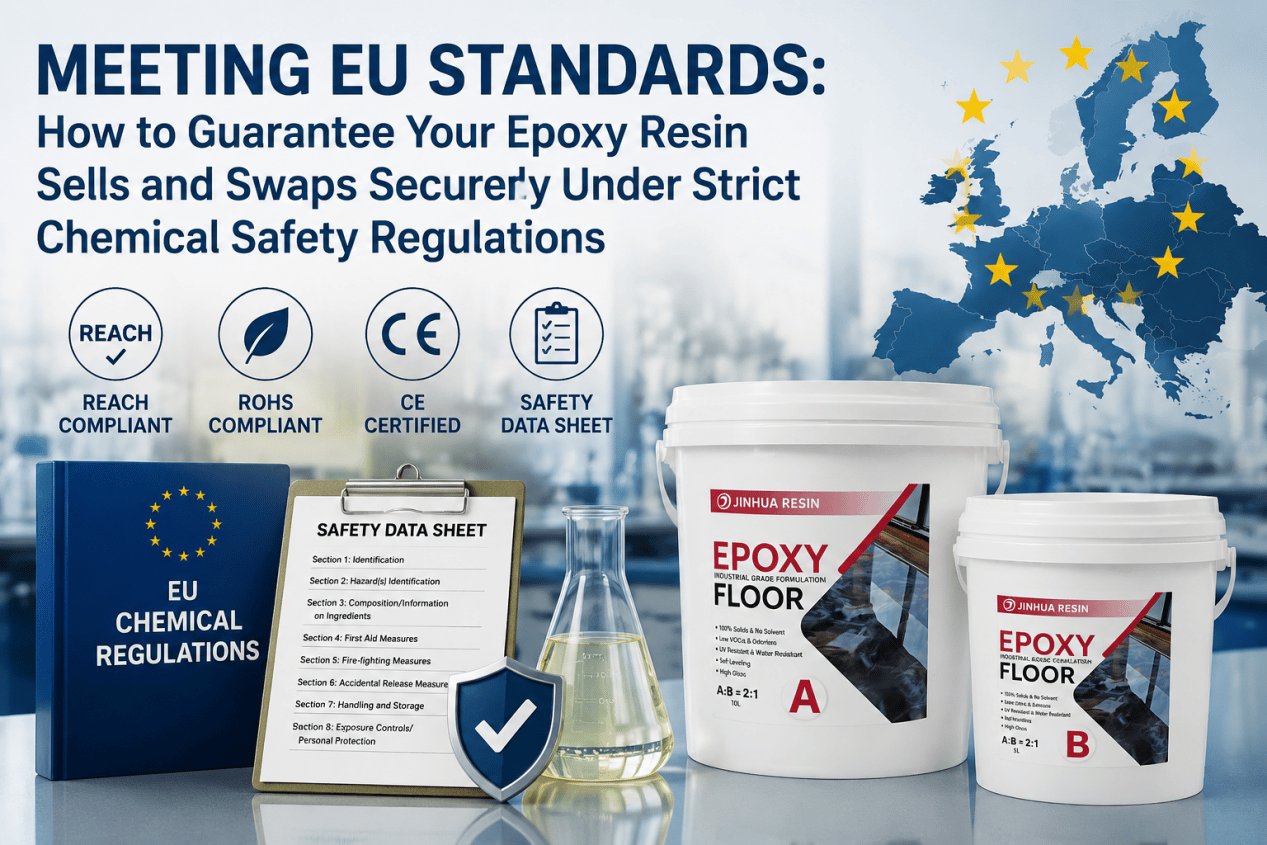
1. REACH and RoHS: The Two Frameworks You Can't Skip
Before anything else touches your pre-screening checklist, your supplier needs to clear these two bars.
REACH — full life-cycle chemical oversight
REACH (Registration, Evaluation, Authorisation, and Restriction of Chemicals) is still the toughest chemical law in the world to work around.
Registration: Export more than one metric ton of a substance per year into the EU, and it needs to be registered with the European Chemicals Agency (ECHA). For epoxy resins specifically, watch the registration status of precursors like Bisphenol A (BPA) and Epichlorohydrin — that status determines whether your shipments move or sit in customs.
SVHC screening: ECHA refreshes its Substances of Very High Concern list twice a year. Cross 0.1% by weight of any SVHC in your formulation, and you're legally required to disclose it down the entire supply chain.
RoHS — the electronics gatekeeper
Any resin headed for potting, encapsulation, chip bonding, or PCBs answers to RoHS (Restriction of Hazardous Substances) — no exceptions.
RoHS caps ten hazardous substances at under 0.1% (0.01% for cadmium) in homogeneous materials — lead, cadmium, mercury, and phthalates like DEHP, BBP, DBP, and DIBP among them. ECHA keeps revisiting exemptions under the EU Green Deal, so what passed last year might not pass this year. Staying current isn't optional.
2. Vetting a Manufacturer: What Actually Holds Up
A supplier telling you their product is "eco-friendly" means nothing in a customs dispute. You need documents, not adjectives. That's just as true for buyers sourcing deep pour epoxy resin for large-format castings as it is for anyone else — thicker pours mean more cured resin sitting closer to end users, so the documentation trail matters even more. Here's how to separate compliant epoxy resin manufacturer from the ones cutting corners.
Step 1 — Read the SDS like a lawyer, not a customer
The Safety Data Sheet is the chemical's passport. A real one aligns with the EU's CLP (Classification, Labelling, and Packaging) Regulation:
Section 1 should carry a Unique Formula Identifier (UFI) — a 16-character code confirming the formulation is registered with EU poison centers.
The hazards section shouldn't read like marketing copy. Uncured epoxy resins are skin sensitizers and carry real aquatic toxicity risks. A trustworthy SDS states this plainly, with handling, PPE, and disposal instructions attached.
Step 2 — Ask for third-party test reports, not self-certifications
Self-declared conformity certificates aren't proof of anything. Ask instead for testing reports from accredited labs — SGS, TÜV, Intertek. For REACH specifically, request the most recent SVHC screening, one that actually reflects ECHA's latest candidate list additions.
Step 3 — Check who holds the REACH registration
Buying from a manufacturer outside the EU? Find out whether they've appointed an Only Representative (OR) inside the EU to handle their registration. If they haven't, the registration burden — and the cost — lands on you. A supplier with solid OR infrastructure, one that can issue a formal REACH Statement of Compliance, takes that liability off your plate entirely.
3. Where the Rules Get Stricter: High-Risk Applications
Standard compliance covers most cases. It doesn't cover these — and this is exactly where epoxy resin manufacturers with weaker documentation tend to get caught out.
Food Contact Materials (FCM)
Epoxy resin in food can linings, industrial food processing equipment, or potable water pipes falls under a much tighter regime. Regulation (EC) No 1895/2005 bans certain epoxy derivatives outright and sets strict migration limits on others — BADGE (Bisphenol A Diglycidyl Ether) among them. You'll need a formal Declaration of Compliance (DoC) before this material goes anywhere near food.
Toys and Consumer Goods
Anything with sustained skin contact triggers tight limits on polycyclic aromatic hydrocarbons (PAHs) and specific bisphenols — limits that push toward near-zero detection. Make sure the formulation is certified skin-safe and solvent-free before it reaches this market.
4. Where the Market Is Heading: Low-VOC and Bio-Based Resins
Europe isn't just tightening restrictions — it's pushing the entire category toward zero-pollution formulations. Low-VOC, solvent-free, and bio-based epoxy resins are becoming the baseline expectation, not a premium add-on — and that shift is showing up in deep pour epoxy resin formulations just as fast as it is in coatings and adhesives.
The epoxy resin manufacturers who see this coming aren't waiting for the next regulation to force their hand. Some are already reformulating around renewable feedstocks — plant oils, cardanol from cashew nutshell liquid — which sidesteps a lot of the environmental review headaches petrochemical-based resins run into.
The upside isn't just compliance. It's carbon footprint, and it's leverage in premium European accounts that are actively screening for exactly this.
Bottom Line
Sourcing EU-compliant epoxy resin isn't a box to check once and forget. It protects your brand, keeps shipments out of customs holds, and secures the market access you're paying for. Vet the REACH and RoHS credentials properly, demand real documentation instead of promises, and favor epoxy resin manufacturers already moving toward green chemistry — that combination is what keeps a supply chain resilient instead of one bad audit away from collapse.

