Mini PC Price: The Ultimate Comparison Tool for Mini Computer Shoppers
Shopping for a mini PC has always been a hassle. You open a dozen retailer tabs, copy specs into a spreadsheet, and still struggle to figure out which listing actually offers the best value. Is that $299 box with 8 GB RAM a better deal than the $349 one with 16 GB? The listing titles rarely make the difference obvious. Enter Mini PC Price — a free, community-powered comparison table that puts every mini PC listing side by side, with all the specs that actually matter.
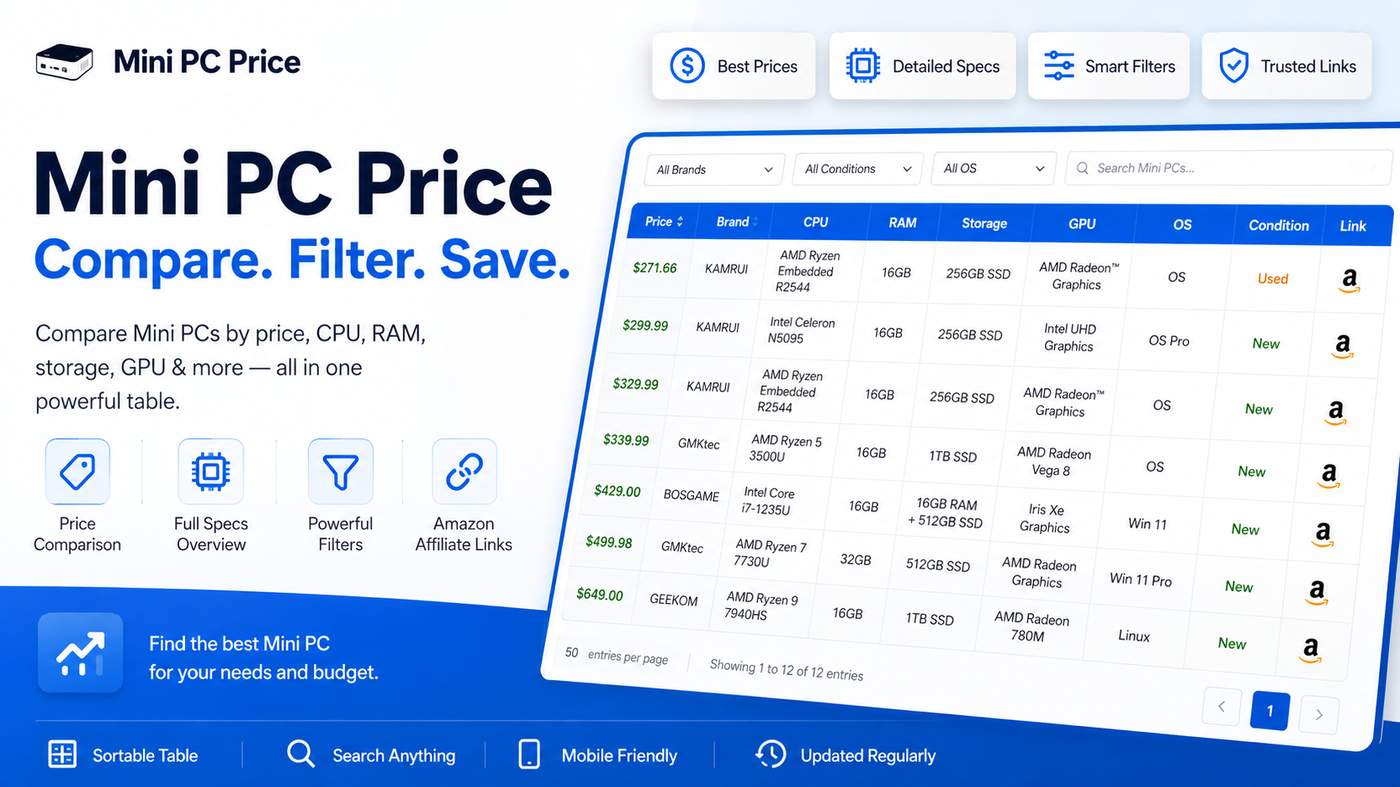
One Table, Everything You Need
Mini PC Price is not another curated top-ten list or a simple deal feed. It is a full-parameter database where each row represents a real marketplace listing. Prices refresh daily, and specs are collected from official product pages, with critical attributes — RAM type, GPU class, OS bundle, and upgrade paths — manually verified where mismatches are common. The default sort is price ascending, so the cheapest options appear first, but users can sort by any column: RAM, storage, CPU speed, or even power draw.
What truly sets this tool apart is its flexibility. Users can stack structured filters — price under $150, RAM at least 16 GB, OS equals Windows 11, brand equals Minisforum — to narrow hundreds of listings down to a handful worth a closer look. Columns are fully customizable: office buyers can focus on RAM, storage, and OS, while gamers can add GPU RAM, CPU boost clocks, and power consumption. Search as you type works instantly across brands, chip names like 7840HS or N100, port counts, or product titles.
Built for the Community, By the Community
Mini PC Price is designed as both a public catalog and a personal workspace. Users can save filtered results or hand-picked shortlists to named groups and share them with a single click — perfect for forum discussions or team buying decisions. But perhaps the most innovative feature is community editing. Spot a wrong CPU label, a missing RAM max, or a stale price? Edit the field directly. Your change appears in your view immediately, and after review, approved edits go live for everyone. This keeps the database current without waiting on a central team to catch every listing error.
The tool covers the full spectrum of mini PCs, from stick-class boxes under $100 to mid-range office machines, gaming rigs with discrete or high-end integrated graphics, and expensive workstations at the top. Every parameter is tracked: pricing and condition, brand and model details, processor specs, memory (with critical distinctions like soldered vs upgradeable), storage type and interface, GPU details, operating system, ports and connectivity, display support, physical dimensions and power consumption, and even warranty and security features.
Why It Matters
Mini PC Price exists because comparison-shopping for these devices has always been unnecessarily painful. Most trackers show a title and a price tag — this tool shows the full spec sheet, normalized into consistent columns you can sort, filter, and customize. It saves hours of manual research and helps buyers make informed decisions without guesswork. Whether you are hunting for a budget mini PC under $150, a Windows 11-ready office desktop, or a gaming machine with 16 GB RAM and capable graphics, Mini PC Price gives you the clarity to choose with confidence.


The community editing part is what made this click for me. Letting people fix specs instead of waiting for you to catch every mistake is a nice touch for a database like this.
This also feels like one of those products that could be getting a lot more organic traffic than it probably is right now. At this stage that would give you a lot more real buying behavior to learn from.
Have you had that thought yourself yet?
Thanks, really appreciate that! The community editing feature was actually the one I was most nervous about — I wasn't sure if people would actually take the time to contribute. But it's been amazing to see users jump in and fix things within hours of a listing going up. It completely changed how I think about data maintenance.
And yes — you're absolutely right about the organic traffic potential. I've definitely had that thought. At this stage, I'm still trying to figure out the right balance between building features and getting the tool in front of more people. More traffic would mean more real buying behavior to learn from, which would help me prioritize what to build next.
Yes, I think there’s definitely an opportunity there. I can point out where you have traffic gaps and where you may be leaking traffic right now.
If you’d like to know, email me at mumar@growwithmumar.online and I can guide you through where the gaps and leaks are and what I’d focus on first.