Most AI Agents Still Don’t Do the Work
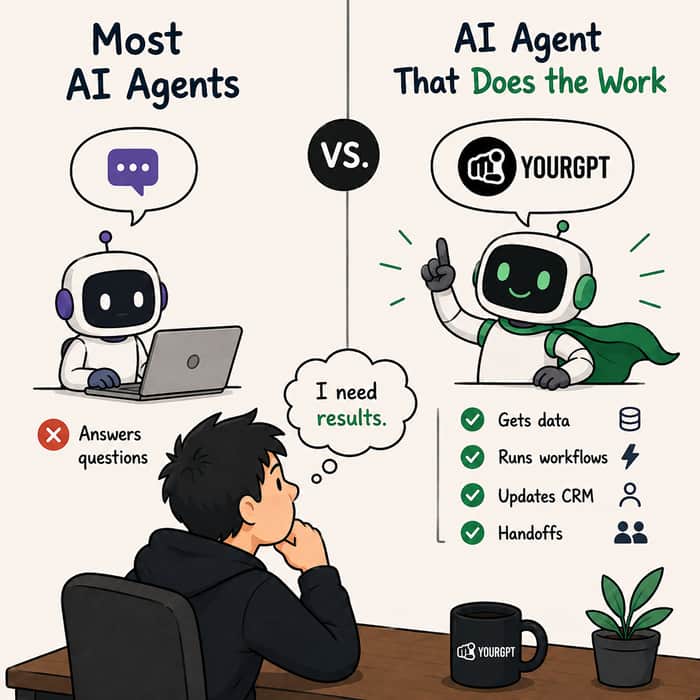
Most AI agent platforms promise the same thing:
“Automate your support, sales, and operations.”
But after testing several tools, I noticed the same pattern:
They can respond.
They struggle to execute.
So I tested YourGPT across three practical setups:
- SaaS support
- Ecommerce sales/support
- Internal ops workflow
The biggest surprise?
The real value was not just the AI agent.
It was the workflow layer behind it.
I built an agent that could:
Answer from documentation
Understand screenshots
Capture leads
Push data to Zapier
Trigger API workflows
Hand off to a human with full context
That last point matters.
Most “AI agents” are still basic responders with better branding.
The real unlock is when AI moves from:
“Here’s an answer.”
to
“I handled it.”
But there’s a catch:
AI will not fix broken operations.
Messy docs create bad outputs.
Unclear workflows create confused agents.
No ownership creates automation chaos.
Clean docs plus clear workflows create actual leverage.
That was my biggest lesson from testing YourGPT:
Good AI agents do not replace your systems.
They expose them.
For small teams, that is either a huge advantage or a very uncomfortable mirror.
My rating: 9/10 for teams that want AI agents across support, sales, and operations.
Not because it is magic.
Because it gets closer to what AI agents should actually be:
Less: “Here’s an answer.”
More: “I handled it.”
Curious — are your AI agents actually doing work, or just generating replies?

The gap is usually the last mile — the AI reasons fine but can't handle the context switch when a real customer says something unexpected. Built Vokio for local businesses and the hardest part wasn't the AI, it was teaching it when NOT to answer.
A lot of indie founders are building great products…
with terrible distribution.
You don’t just need a product.
You need attention.
I help founders grow with content, engagement, and social media marketing on Fiverr.
This hits the nail on the head. There’s a massive gap between a flashy Twitter demo showing an agent 'solving a problem' and actually letting that agent loose on your live production systems.
Answering questions is easy; executing a reliable chain of actions where an error rate compounds at every single step is where the real bottleneck is. Until we get solid rollback mechanisms and better state management, most agents are just going to remain fancy notification bots that point humans to where the actual work needs to be done.
Really liked the point about AI exposing broken systems instead of fixing them.
I think a lot of teams underestimate how important the workflow layer actually is. An AI agent is only as useful as the clarity of the environment around it.
I’m currently working on an education-focused AI product around classroom engagement and silent student participation, and I’m already noticing the same thing during validation conversations with teachers — the challenge is rarely just “getting answers,” it’s creating workflows that actually help humans notice and act on important signals earlier.
The “responding vs handling” distinction in your post explains that really well.
I’d draw the line at whether the agent changes state.
Answering a question is cheap. Updating a lead, creating a ticket, kicking off a refund path, or promising a delivery date needs a workflow contract around it: source docs used, action proposed, owner, missing context, and the approval or rollback path.
If those pieces are visible, the human handoff stops being a failure mode and becomes the control layer. Without them, “handled it” is just a nicer wrapper around “hope the chatbot guessed right.”
This is the right distinction. A lot of “AI agent” products still feel like upgraded chat widgets because they stop at answering instead of completing the workflow.
The useful angle here is execution with context: docs, screenshots, lead capture, Zapier/API actions, and human handoff. That is much closer to an operational layer than a support bot.
The naming/category frame matters a lot in this space because “AI agent” is already becoming noisy. If the product is positioned as another agent responder, it gets compared with every chatbot. If it is positioned around agents that actually execute workflows, the category feels more serious.
For that direction, a name like Viryxa .com would fit better as a sharper AI automation brand. It gives the product room to move beyond support replies into sales, ops, workflow execution, and agent coordination without sounding like just another chat tool.
The product insight is strong. I’d make the brand and positioning carry that same “handled it, not just answered it” promise.