Most AI outreach tools optimize emails. Not lead quality.
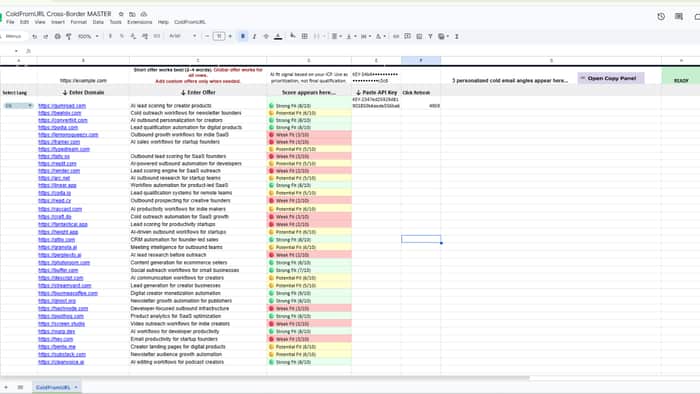
I realized most AI outreach tools have the same flaw:
they assume every lead is worth contacting.
That’s dangerous.
A bad-fit company doesn’t just waste time:
it burns domains,
reply rates,
and outbound volume.
So I rebuilt my scoring engine around commercial context.
Now the system checks:
• what the company actually does
• how they position themselves
• whether the offer realistically fits
before generating any outreach.
Only after the lead passes contextual qualification
does the system generate outreach angles.
Because the real bottleneck usually isn’t writing emails.
It’s qualification.

A lot of tools optimize the visible layer because it's easier to demo.
Lead quality is messier and less obvious, but probably where most of the leverage actually is.
That’s exactly what I started noticing. Generating emails is easy to showcase.
Contextual qualification is much harder - but probably where most outbound performance actually comes from.
The qualification point lands for warm lists too. Most founders batch-blast their entire list with the same conversion email. But someone who opened every email last month and visited the pricing page is not the same person as someone who downloaded a lead magnet six months ago and has been silent since. Sending the same message to both wastes one and alienates the other. The email is not the problem. Knowing who is ready for it is.
Agree. Timing and intent signals are massively underrated in outbound.
This is the right distinction.
Most outreach tools make the email sound better, but they do not make the target more likely to buy. That is why founders end up burning domains, volume, and reputation on companies that were never a fit.
The stronger product angle here is not AI outreach. It is commercial signal intelligence before outreach happens: understanding the company, the positioning, the offer fit, and only then deciding whether the lead deserves a message.
I’d be careful with the name before this becomes a bigger system. If the brand sounds like another AI email tool, people will mentally place it in the same crowded bucket you are trying to separate from.
A name like Exirra.com would fit this direction better because it feels closer to signal, qualification, and intelligence, not just outbound automation. That matters here because your real value is upstream of the email.
Appreciate the feedback, but I actually like the directness of ColdFromURL.
The product started from analyzing websites and generating outreach from real context, so the name ended up reflecting the workflow pretty naturally.
I’ve also noticed you mentioned Exirra on another one of my posts 😄
Fair point. ColdFromURL has real clarity for the current wedge, and I would not ignore that.
The question I’d pressure-test is not “should you rename now?” It is whether the product is being understood as an email-generation workflow or as the upstream intelligence layer that decides who is worth contacting.
That distinction matters because it changes the landing page, pricing, buyer expectation, and maybe the name later.
If useful, I can do a focused naming/positioning audit around this: current name strength, category ceiling, buyer perception, domain/name risk, and whether the stronger frame is “AI cold email from URL” or “commercial signal intelligence before outreach.”
Not a long consulting thing. Just a sharp written breakdown you can use before the product gets too locked into the email-tool bucket.
I’m doing a few of these at $99 while refining the format. If useful, connect here and I can put together a clear outside read for ColdFromURL:
https://www.linkedin.com/in/aryan-y-0163b0278/
Fair call, and yes, I mentioned Exirra because the pattern I’m reacting to is similar: products where the real value is intelligence/signal before the visible workflow.
For ColdFromURL specifically, I agree the name is very clear for the current wedge. It says exactly what the product does: take a URL, understand the company, and generate context-aware outreach. That directness is useful early.
The only thing I’d separate is workflow clarity from category ceiling.
If the product stays as “generate cold emails from a URL,” ColdFromURL is a strong descriptive name.
But if the bigger direction becomes lead qualification, commercial signal analysis, offer-fit scoring, and deciding who deserves outreach before the email is written, then the name may start framing the product too narrowly as an email-generation tool.
That is where I think the naming question becomes worth revisiting.
Not pushing you to rename now. I’d just watch whether users describe the value as “better cold emails” or “knowing who is actually worth contacting.” If it is the second one, the brand may need to move upstream with the product.
That’s a very fair distinction. Right now I’m intentionally leaning into workflow clarity because the product is still early and I want people to instantly understand what it does.
But I do think the bigger opportunity sits upstream:
qualification, commercial context, and deciding whether outreach even makes sense before generation starts.
So I’m watching that closely as the product evolves.
That is the exact thing I would pressure-test now.
If you intentionally lean into workflow clarity, ColdFromURL is doing its job. People understand it quickly.
But if users start valuing the upstream layer more — qualification, commercial context, offer-fit, and deciding whether outreach is worth sending at all — then the product starts moving into a different category before the brand catches up.
That is the kind of decision where a focused naming/positioning audit would be useful.
I would look at:
current name strength
where ColdFromURL helps conversion
where it creates a category ceiling
whether the buyer is paying for email generation or commercial signal
how the landing page should frame the upstream value
whether the brand should stay descriptive or prepare for a broader intelligence layer
I’m doing a few of these at $99 while refining the format.
If useful, connect here and I can put together a clear outside read for ColdFromURL before more users, copy, and product memory lock it into the email-tool bucket:
https://www.linkedin.com/in/aryan-y-0163b0278/