Most SaaS Content Fails for One Simple Reason
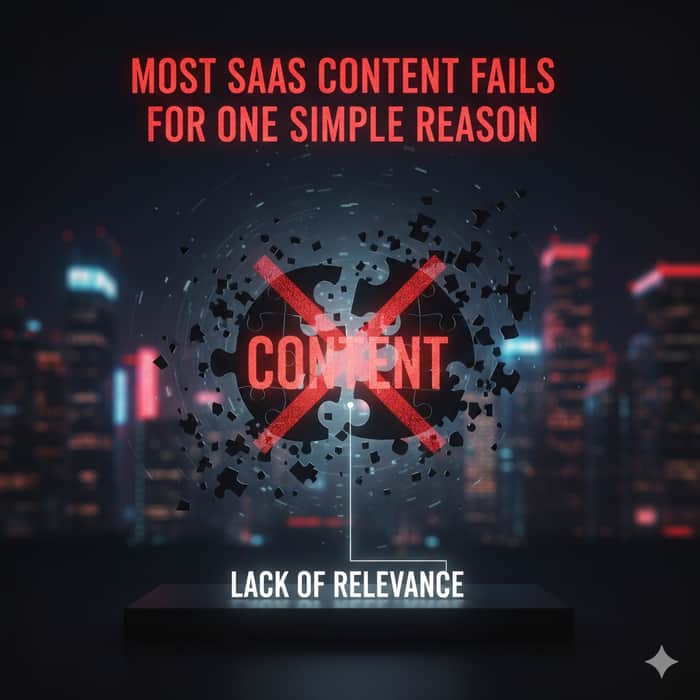
Most SaaS Content Fails for One Simple Reason
(And It’s Not SEO)
SaaS founders are told the same advice over and over:
“Publish more content.”
“Target high-volume keywords.”
“Be consistent for 6–12 months.”
So they do exactly that.
Blogs get published.
Keywords get sprinkled.
Content calendars get filled.
And yet…
Traffic grows slowly. Leads are inconsistent. Sales don’t clearly connect back to content.
At some point, content starts to feel like a checkbox instead of a growth engine.
That’s usually when founders assume content “just takes time.”
Sometimes that’s true.
Often, it’s not.
The Real Issue Isn’t Volume — It’s Intent
Most SaaS content isn’t bad.
It’s just misaligned.
Articles explain concepts well but don’t guide decisions.
They attract readers who want information, not buyers who want clarity.
So content performs technically —
It ranks
It gets impressions
It looks productive
But it doesn’t move revenue.
The gap isn’t SEO knowledge.
It’s buyer intent mapping.
Why “Educational” Content Alone Doesn’t Convert
Education is safe.
It feels helpful.
It’s easy to justify.
But buyers don’t convert because they learned something new.
They convert when something clicks.
When they feel:
“This problem is exactly what I’m dealing with.”
“They understand my situation better than I do.”
“This solution fits where I am right now.”
Most SaaS blogs skip that moment entirely.
They teach what without addressing why now.
What High-Performing SaaS Content Does Differently
The SaaS content that actually drives demos and sign-ups does a few things quietly:
It speaks to a specific stage of awareness
It anticipates objections instead of avoiding them
It connects the problem to a cost founders already feel
It makes the next step feel logical, not forced
This kind of content doesn’t shout.
It doesn’t oversell.
It guides.
And because it guides, it converts.
SEO Is a Tool — Not the Strategy
SEO matters. A lot.
But SEO without positioning turns content into a library instead of a sales asset.
Founders often realize this after publishing dozens of posts that:
Rank but don’t convert
Get traffic but not demos
Build visibility without leverage
At that point, the question changes from:
“How do we get more content out?”
To:
“How do we make content work harder?”
That’s a strategic shift — not a tactical one.
The Quiet Advantage Most SaaS Teams Miss
Here’s something interesting:
Founders trust content long before they trust sales pages.
Blog posts, guides, and breakdowns shape perception before a buyer ever books a call.
Which means:
Content isn’t just top-of-funnel
It’s pre-selling your product
It’s setting expectations for value
When content is aligned, sales calls feel easier.
When it’s not, sales has to work twice as hard.
When Content Becomes a Growth Asset
The moment content is treated as a buyer journey, not a publishing task, things change:
Leads feel warmer
Sales cycles shorten
Founders stop guessing what to write next
Content decisions become strategic instead of reactive
That’s usually when teams stop chasing trends — and start building systems.
Not louder content.
Smarter content.
Final Thought
If your SaaS content:
Educates but doesn’t persuade
Ranks but doesn’t convert
Exists but doesn’t clearly support revenue
The problem isn’t effort.
It’s alignment.
When content finally speaks to the right person, at the right moment, with the right framing — growth stops feeling random.
It starts feeling intentional.
Thoughtfully structured SaaS content can do more than drive traffic — it can quietly move decisions.

This matches what I’ve seen. Content usually fails when it doesn’t map to a decision the reader is already trying to make.
Curious — what’s the earliest signal you watch to know a piece actually landed?
For example:
Those signals tend to show up long before traffic or SEO metrics move.
Follow ups
Exactly — follow-ups mean the content didn’t just resonate, it moved someone closer to a decision.
That's what we do at Quratulain Creatives,we help already published SaaS projects to point out where their messaging is failing and rewrite it for clarity
That makes sense.
When content consistently generates follow-ups, it’s doing more than informing — it’s narrowing the decision space.
That’s usually the difference between “good content” and content that actually moves the business.