Most SaaS Founders Compete on Features. They Should Compete on Outcomes.
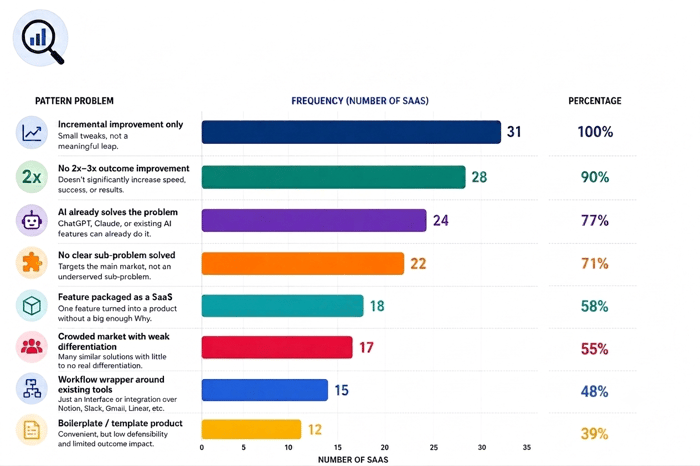
Every day, you see tons of new SaaS ideas launching on platforms like Product Hunt, Peerlist, Indie Hackers, and many others. But if you look carefully, you'll notice that most of them follow the same path and focus on the same way of solving problems. As a result, many fail or never achieve the success that the initial hype promised.
Through my research as a product strategist and consultant for new SaaS products, I have noticed one repeated pattern among founders. Most optimize existing solutions in ways that do not multiply customer outcomes.
They focus on improving how the work is done rather than improving the results it delivers to customers. The real question is not whether a task can be completed faster or with AI, but whether it creates a significantly better outcome for the user.
Today, all-in-one platforms, summarisation tools, automation, and faster workflows have become the standard capabilities of AI assistants. Those features alone are no longer enough to create a meaningful competitive advantage. Instead of competing on features or workflows, founders should compete on outcomes.
Why are new SaaS founders unaware of this and building the same kinds of products?
This pattern is not limited to SaaS founders. It applies to many new entrepreneurs across different industries. From my experience exploring different online businesses, I believe the main reasons are a lack of deep knowledge about the market, limited research, and the desire to build something quickly while following the latest hype.
Thorough research and a clear understanding of what you are building can save months—or even years—of failure. Having enough data and market knowledge is what allows someone to master a niche.
People naturally prefer simple and quick ideas. Because of this, many founders choose to build products that are easy to create instead of investing time in understanding deeper customer problems. The result is that many products end up looking almost identical and compete in crowded markets with very little differentiation.
Some entrepreneurs have the technical skills to build software, but they do not have a scalable or unique idea. There is a significant difference between knowing how to build a product and knowing what product is worth building.
For xample
I analysed these five recently launched SaaS projects on Peerlist:
- TabAI – AI Chrome productivity extension
- AI Commit Message Generator – Developer tool for writing commit messages
- AI Bio Generator – Personal branding tool
- AI Screenshot-to-Post Generator – Social media content tool
- AI Resume Headline Generator – Resume builder
Why these products struggle
• ChatGPT and browser AI assistants already provide similar functionality.
• AI coding assistants built into modern IDEs already generate commit messages.
• ChatGPT and Claude can generate high-quality bios within seconds.
• Existing LLMs and AI writing tools already convert screenshots into social media posts.
• General-purpose AI models already write effective resume headlines instantly.
These products mainly solve minor or infrequent problems rather than highly demanded, high-impact sub-problems. They provide incremental convenience instead of delivering a measurable 2×–3× improvement in customer outcomes.
In addition, their core capabilities can already be achieved using ChatGPT, Claude, Gemini, or AI features built into existing software. This makes it difficult for them to establish a strong competitive advantage.
The lesson is simple:
Compete on outcomes, not on how the job is done.
Don't ask, "Can the work be completed?" Ask, "How much better is the customer's result because of this product?"
That is where sustainable SaaS opportunities are created.
I'd love to hear your perspective.
Have you noticed the same pattern among recent SaaS launches?

Couldn't agree more. The feature checklist becomes a trap because it's easier to measure than outcomes. What I've seen work: pick one outcome metric, obsess over it, and let that drive your roadmap. Everything else is noise. Curious what outcome metric you'd choose if you were starting from scratch today?