Most small custom-product businesses look like a black box. I turned mine into an Open Factory
Most small custom-product businesses look like a black box.
A customer uploads photos, places an order, and then has no idea what is happening behind the scenes.
I wanted RepliToy, the custom figurine workshop I started about a year ago, to feel different. So I turned it into an Open Factory page. Now customers do not just place an order and wait. They can follow the life of a real tiny workshop, see their order move through the process, and feel like they are part of something more human than a standard online checkout.
There are two things that matter most to me here, and I think they can apply to many small businesses too.
The first is transparency and trust.
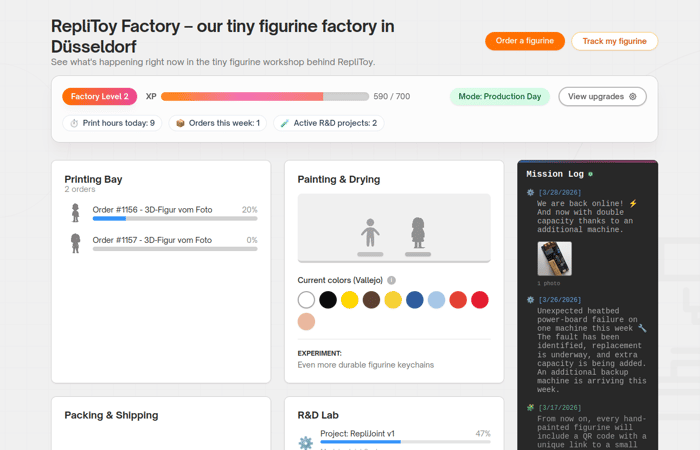
When I open this data, people can see that there is a real process behind the product. I am not trying to create a polished brand image while hiding everything important. On the page, they can recognize their own figurines, their silhouettes, and the actual work that is happening around them. They can see whether I am in production mode, doing maintenance, testing something new, working on research, or building a new feature.
That creates a very different feeling from a normal online shop. You do not just see a product page. You see that there is a real person, real work, real progress, and a real workshop behind it.
I also keep a mission log with regular updates. I try to post when there is something worth sharing, ideally every week. There, I show what is going on in the workshop: experiments, improvements, new ideas, unexpected problems, and lessons learned. Not only the wins, but also the losses.
I think this gives the business something that is hard to fake, especially now, in the AI era.
Generating polished images, polished text, polished branding is easy today and even the impression that a whole expert team stands behind a business. You can make almost anything look convincing. But showing the real process is different, showing proof of work is different. Showing who you are, what you are building, what went right, and what went wrong creates a kind of authenticity that is much harder to imitate.
The second part is gamification.
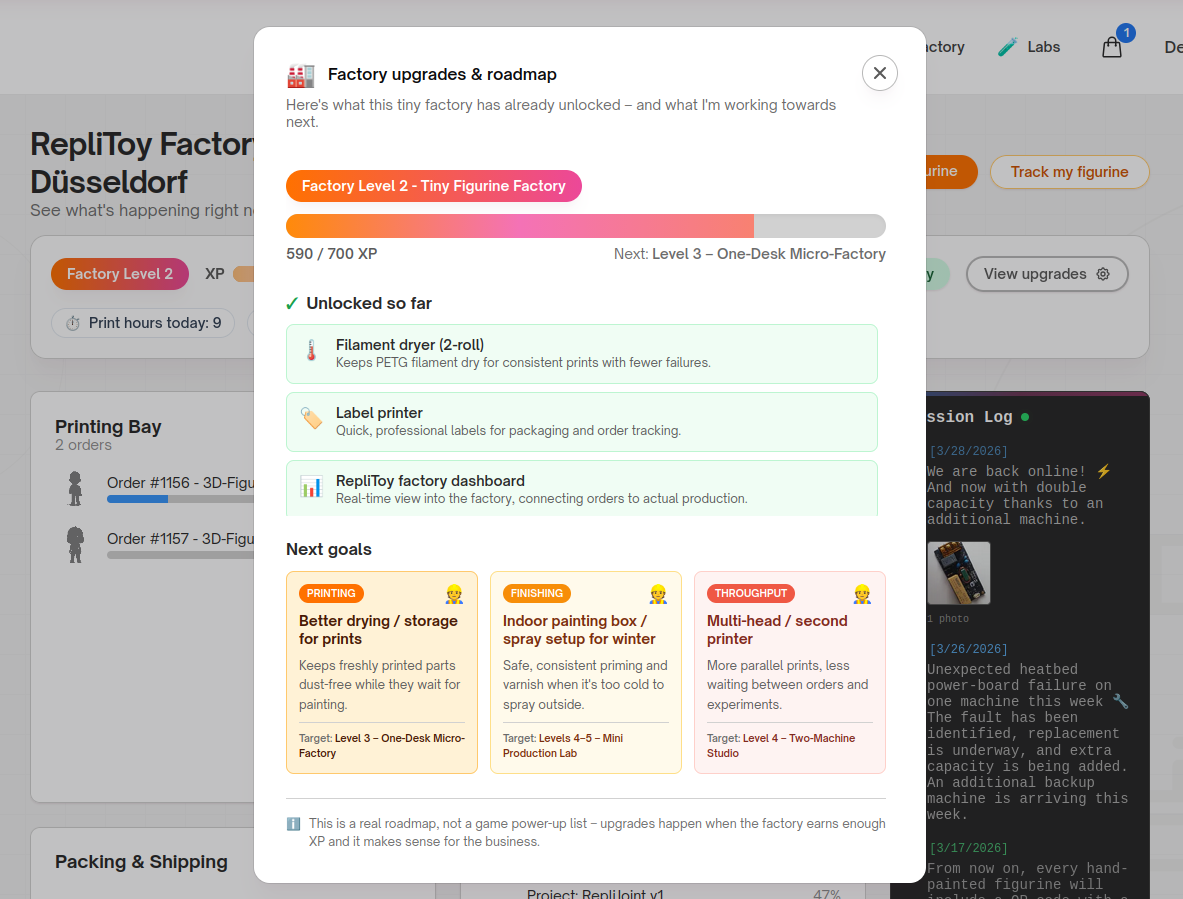
Every figurine and every order adds experience to the factory, a bit like in a tycoon game. People can see that the workshop is growing step by step. I introduced levels, so the factory does not feel static. It feels like something alive, something that develops over time.
Research also gives experience, because experimentation is part of building a real small factory too, not just order fulfillment. I liked that part conceptually. It means that not only finished orders count. Learning counts too. Maintenance counts. Improvements count. The factory grows not only when I ship something, but also when I make the process better.
For the customer, this makes the page more fun and more memorable. They are not just buying an object. They are watching a tiny workshop evolve. But honestly, it also helps me. When you build something on your own, long stretches of work can feel heavy. A bit of gamification changes the energy. In a strange way, it reminds me that I am not only doing repetitive tasks. I am building something real, and at the same time I am playing a game that reflects that progress back to me.
The Open Factory page is not just a slogan. It is a way to make the workshop visible and understandable.
People can see the factory level, experience, current mode, and unlocked upgrades. I also publish a few simple operational signals like print hours, orders per week, and active research and development projects.
The page includes the main parts of the workshop process: printing, paint and drying, packing and shipping, research and development, and the mission log with photos and videos. The point is not to describe every detail of the interface, but to make the business legible. Even if someone visits for the first time, they can immediately understand that there is a real process behind the product. I also link from products to the factory page, so customers get additional trust and could imagine their order in the pipeline.
Sure, the page is also not there only to create trust. Visitors can directly order a figurine and contribute to the growth of the factory themselves, or track their own current order. So it is both a window into the workshop and a way to become part of it.
Additional layer of transparency: AI-readable status updates.
In addition to the visual factory page, I created a status JSON file that publishes the same kind of workshop data in a machine-readable form, with some extra detail. The idea is simple: if humans can understand the factory through the page, maybe AI systems and search engines should also be able to understand it more clearly through structured data.
I see this as an experiment in AI-readable trust.
We've entered the time when discovery happens not only through classic search engine optimization, but also through AI systems, summaries, assistants, and language models. etc. So, today it is not enough to only look real. It becomes increasingly valuable to be understandable, both for people and for machines.
At this point, most of my traffic already comes from LLM-driven discovery rather than classic search. The website still does not have many backlinks, but I am already getting visitors from ChatGPT, and also from systems connected to Bing and Google. So I wanted to test whether a tiny handmade business could publish signals that are useful not only for customers, but also for AI-enabled search engines and LLMs.
That does not mean the status update is some magical ranking trick. But it does seem to create an additional signal that this business is real, active, structured, and doing actual work. At least in my case, ChatGPT already picked it up and mentioned the factory in a response.
For me, that is interesting because it connects two things that usually feel very far apart - handmade production and machine-readable visibility.
A tiny figurine workshop is probably not the kind of business people imagine when they think about structured operational data, but that is exactly why I find this experiment exciting.
Why this matters more in the AI era
We all know, it has become very easy to make a product look real online.
You can generate product images, brand text, and even the whole story around a business in a very convincing way. But for the customer, that creates a problem, it becomes harder to see what is actually real behind the shop.
In categories like figurines, gifts, and handmade products, that matters a lot. People are not only buying the result. They are also buying the process, the care, and the person behind it.
That is why I think showing the real process matters more now than before.
For a handmade business, authenticity is no longer just a nice brand value. It becomes part of the product itself. Showing the actual workshop, the actual process, the real production modes, the experiments, the maintenance, the small wins, and even the occasional failure creates a kind of trust that is much harder to imitate than a polished landing page.
In other words, if anyone can generate a convincing image, then the real advantage is not just presentation. The real advantage is traceability. It is being able to show that something is actually happening, that a real person is doing real work, and that the business behind the product is visible.
That is one reason I built the Open Factory page. Not to make RepliToy look bigger, but to make it easier to verify, easier to understand, and more human.
In the end, this is what I am trying to build with RepliToy.
Not just a place where you order a figurine and wait, but a small real workshop that people can actually see and follow.
I would be curious if anyone else here has tried something similar, either by making operations more visible or by adding a bit of gamification to them. And I must admit, it also makes running this small business much more fun.
