Most solo SaaS founders don’t fail on product or GTM. They fail on “decision debt.”
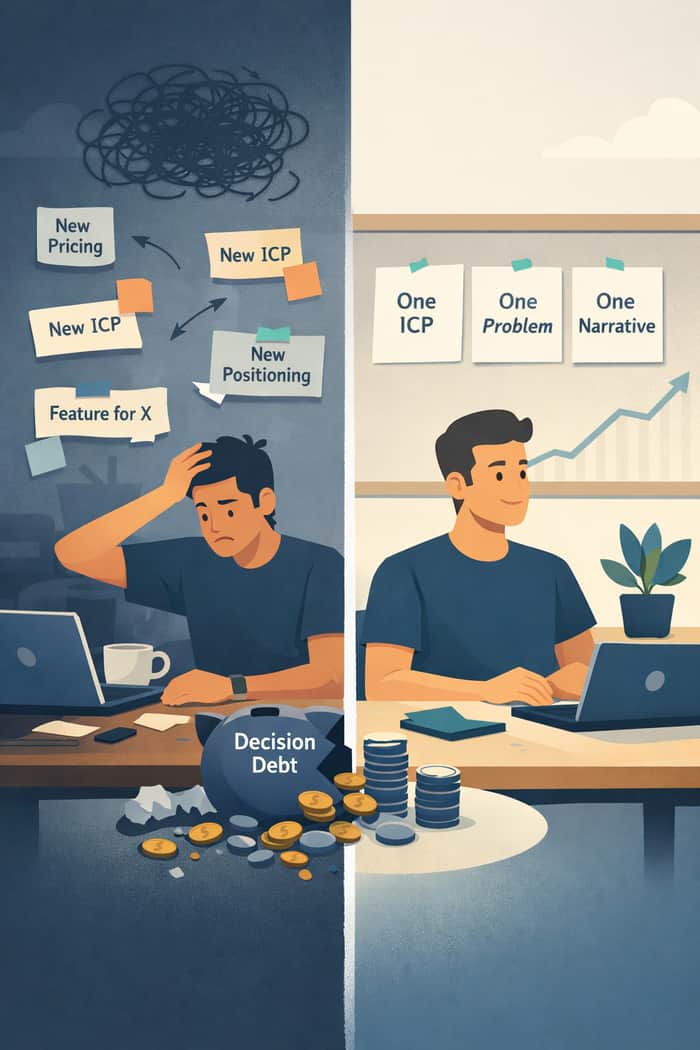
Something I’ve been noticing (and felt myself earlier):
As a solo founder, you’re not short on ideas.
You’re not even short on execution.
You’re short on committed decisions.
So what happens:
positioning changes every few weeks
pricing keeps getting tweaked
ICP keeps expanding “just in case”
features get added for different use cases
Individually, each decision feels small.
Collectively, they create drag.
Because now:
messaging never compounds
users don’t see a clear fit
nothing gets sharp enough to pull demand
It looks like “iteration.”
But it’s actually:
👉 avoiding committing to one path long enough
The shift (for me at least):
treat early decisions as constraints, not experiments
pick:
one ICP
one problem
one narrative
…and let everything else be wrong for a while.
Feels uncomfortable, but it’s the only way things start clicking.
Curious if others have felt this
or if I’m over-indexing on this pattern

This resonates because it reframes the real bottleneck — not execution speed, but decision continuity.
What I keep seeing is that founders don’t struggle to decide once… they struggle to hold decisions long enough for them to compound into clarity.
The moment you keep reopening the same decisions (pricing, ICP, positioning), everything downstream becomes noisy again.
Feels like the real leverage is not better decisions — but fewer reopened decisions.
Decision debt is the perfect frame for this. It accumulates invisibly - each undocumented decision is a small liability, harmless in isolation, but compounding into paralysis when you're trying to pivot or onboard someone 6 months later.
The root cause is that solo SaaS founders have no system for logging decisions with context. The decision gets made, sometimes the outcome gets tracked, but the reasoning disappears. Six weeks later you're relitigating the same question with no memory of why you decided the first time.
Building a Solopreneur Notion OS with a dedicated decisions database for exactly this - every key decision gets a card: context, options considered, what was chosen, expected outcome. Linked to projects and clients. The decisions log becomes institutional memory for a one-person company. What's your current system for tracking the reasoning behind product decisions?
this resonates. Ive noticed decision debt often comes from weak signals when youre not seeing a clear pattern in who actually resonates, every ICP feels plausible so you keep expanding. once you start noticing the same roles or segments repeatedly engaging, it becomes much easier to commit and let messaging compound instead of constantly resetting.
This is very real. Ive seen the same thing, but what made a difference for me was realizing that the problem isnt just lack of commitment, its also lack of signal. When youre deciding in a vacuum, everything feels reversible so you keep tweaking. Once decisions are grounded in real patterns like whos actually engaging or showing intent its much easier to commit and let things compound. Otherwise it just turns into endless iteration that looks like progress but isnt.
That’s a great point
Feels like decision debt and lack of signal feed into each other
When there’s no strong signal everything feels reversible so you keep tweaking, but that prevents you from ever generating the signal in the first place
Grounding decisions in real user behavior is probably what makes commitment feel less risky and more obvious
yeah exactly once you start grounding decisions in real signals, commitment becomes much easier because you’re not guessing anymore. Ive noticed that looking at whos actually engaging with similar products often creates that clarity fast you start seeing the same roles, use cases, or segments show up, and that naturally narrows ICP instead of expanding it. at that point decisions feel less like bets and more like following a pattern.