Most "startup platforms" are just boring directories. I tried to build a living portfolio for builders.
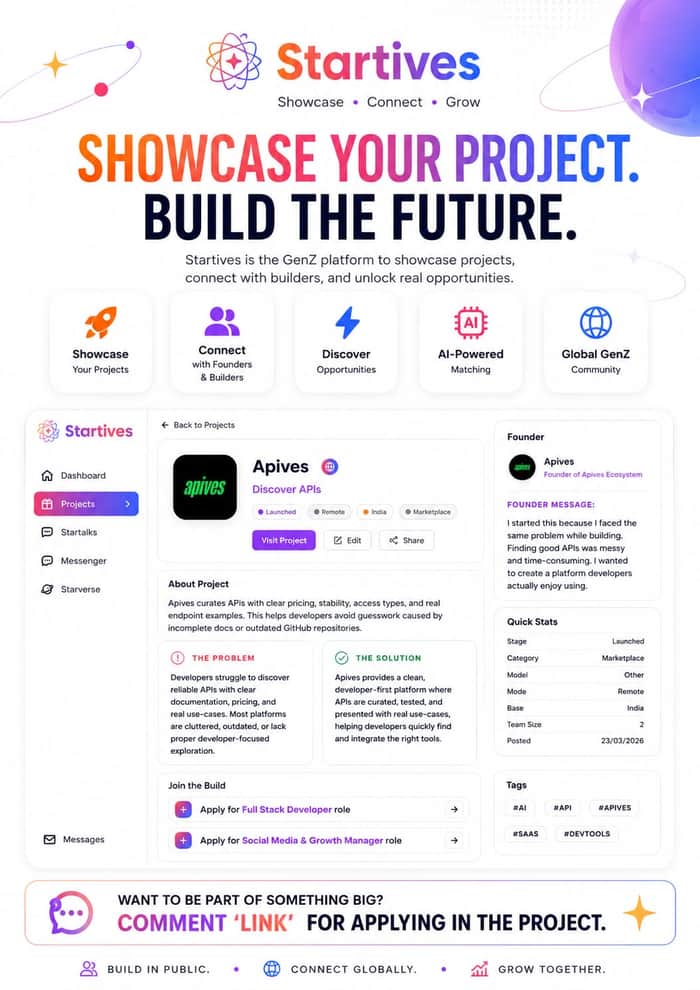
Hey IH,
Let's be honest: most platforms for founders are just glorified spreadsheets. A list of names, a list of projects. They feel static and soulless. You post your project, and it just sits there.
When I started building Startives, my main goal was to create something that felt alive. A place where your project isn't just a line item, but a living, breathing entity.
I wanted to move beyond the "directory" model. Here's a look at the philosophy behind some of our core features (and a peek at the UI):
-
It's Your Story, Not Just Your Stats
Look at the project page for "Apives" in the screenshot. We don't just ask for your MRR. We have dedicated sections for "The Problem" and "The Solution." Why? Because your journey matters. People connect with stories, not just stats. This helps you attract partners who believe in your why, not just your what. -
It's About Building a Team, Not Just "Hiring"
See that "Join the Build" section? We intentionally avoided the word "Jobs." You're not hiring employees; you're inviting people to join a mission. This framing attracts people with a builder mindset who want to contribute, not just clock in. -
Discoverability Powered by AI, Not Just Tags
Anyone can add tags. We're using AI-Powered Matching to connect you with opportunities you might have missed. It looks beyond simple keywords to understand the context of your project and skills, connecting you with the right founders, investors, or even your first users. -
A Live Community, Not a Ghost Town
The "Startalks" and "Starverse" features are the heart of this. They provide a live feed of what's happening across the ecosystem. It's designed to create serendipity—that magical moment where you discover your future co-founder because you saw them post a great idea.
My big bet is that the future isn't about static portfolios. It's about dynamic, story-driven platforms where builders can showcase their work, connect with real people, and find opportunities organically.
It's a huge mission, and we're just getting started.
You can explore it here: startives.com
What's the one feature you wish existed on platforms like LinkedIn or IH to help you showcase your projects better?

Agreed - the cold start problem is the real test. Dynamic profiles only work if there's enough activity to make them feel alive from day one. How are you seeding the first wave of active users?
The 'living portfolio' framing is the right instinct - static directories die because they capture a moment in time and then decay. The interesting builders are always in motion, so any platform that freezes them into a profile immediately starts misrepresenting them.
The operational problem that usually kills this: keeping the data fresh requires either the founder to actively update (which they won't) or a pull mechanism that syncs from where the builder is already active. The platforms that solve this pull from Twitter/X, GitHub commits, or product revenue APIs rather than asking founders to log in and update manually.
I've been thinking about this while building a Solopreneur OS in Notion - the Revenue Dashboard and Projects databases have the same core challenge. If updating the system is extra work, it won't get updated. The design constraint is: can I make the update feel like a natural part of the work, not a separate admin task?
What's your current approach to keeping builder profiles current - active maintenance, automated pulls, or something else?
Esto es fantanstico, nosotros en ab4cus implementamos algo parecido con un directorio de miembros para la startup y fintech que mermite hacer evaluaciones en las 3 lineas mas necesaria de una empresa emergente (legal, finanzas y tecnologia) podriamos hacer match para colaborarnos
The 'living vs static' framing is exactly right, and it's the same problem solopreneurs face with their own internal systems.
Most founders track their projects in dead spreadsheets or disconnected Notion pages - a list of tasks here, some client notes there, a revenue sheet somewhere else. Nothing talks to each other. Everything sits there.
I'm building a Notion OS for solopreneurs at $0-5K MRR specifically to solve this - six linked databases: clients, projects, tasks, revenue, decisions, weekly review. The point is that a client links to active projects which link to open tasks which link to the revenue that came from them. When you open a project it feels like something alive, not a row in a spreadsheet.
Your insight about 'static and soulless' is the right diagnosis. Did you find the biggest blocker to making it feel alive was the data model (how things connect) or the UI (how things are presented)?
The directory problem is a data model problem. Static directories store facts about companies at a point in time and have no mechanism to reflect how a builder or project has evolved. The 'living' version of this requires treating the portfolio as a set of queryable relationships -- what changed, when, what was the outcome -- rather than a snapshot. The founders I've seen build this well for themselves are using operational databases where their builds, experiments, and decisions are structured data they can actually query ('what did I try that worked in B2B vs consumer?') rather than a portfolio people browse. The public-facing portfolio is just a read view on that operational database. If you're building this as a platform for other builders, the hardest part is probably getting them to input data at a granularity where the 'living' layer is meaningful -- not just project names but actual decision logs and outcome data. What's the minimum data input you're requiring to make the portfolio actually dynamic?
The directory problem is a discoverability problem dressed up as a presentation problem. Most directories are boring not because of the UI but because being listed in a directory is a passive act -- you fill out a form, you exist in a table, nothing changes. The living portfolio idea is interesting because it shifts the model from 'exist in a directory' to 'generate signal from activity.' The products that get traction from directories are almost always the ones that treat the listing as the start of a distribution sequence, not the destination. Listing + community post + IH milestone update + launch-day comment thread = a distribution loop, not a single entry. The directory is just the canonical reference. The momentum comes from the activity that references it.
The idea is really great. Love the concept.
The strongest idea here is moving founder profiles away from static proof and toward live momentum. A normal directory shows what someone has built. What you’re describing is closer to a builder graph: story, intent, current needs, open collaboration, and live signals around who is actively creating.
That is a better category than “startup platform,” because startup platform sounds broad and crowded. The sharper frame might be something like a living builder network or founder opportunity layer.
One thing I’d watch is the name Startives. It hints at startups, but it feels a bit forced and may not carry the bigger mission if this becomes more than project listings. For a more serious builder-network or opportunity platform, Beryxa .com would feel cleaner, broader, and less directory-like.