Most startup "post-mortems" are written too late. Here is how to spot the fire early.
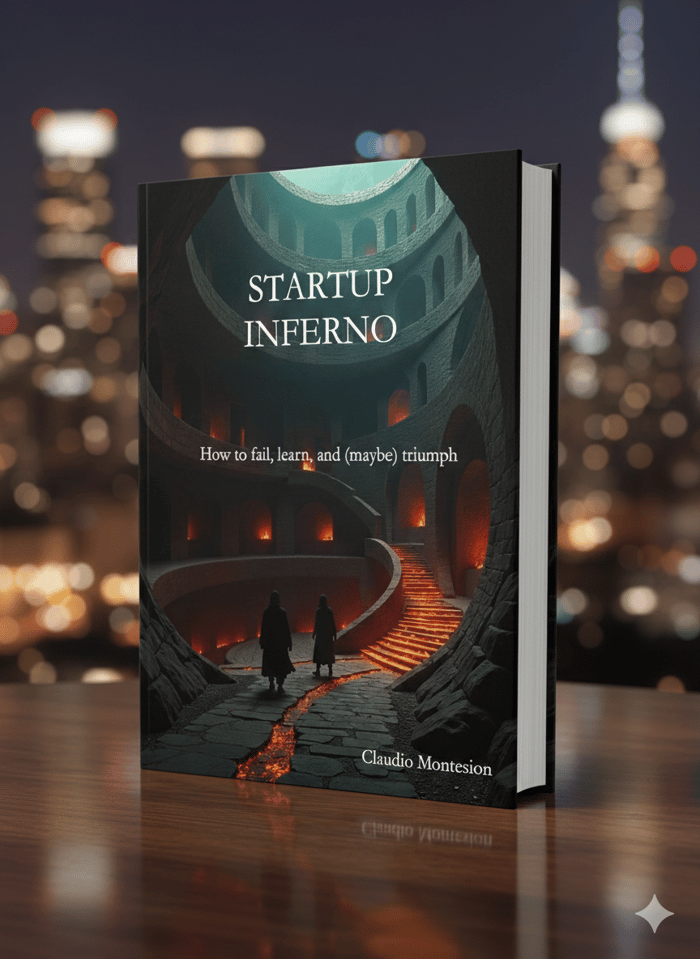
We’ve all read the post-mortems on why startups fail. "No market need," "Ran out of cash," "Team disharmony." But these are just symptoms.
After writing "Startup Inferno", I’ve realized that the real causes are often psychological traps we fall into long before the bank account hits zero. We don't just fail; we descend through specific circles of dysfunction.
If you are running a startup right now, ask yourself which circle you are currently navigating:
-
Circle 5 (Wrath): Are your co-founder meetings becoming "shouting matches" or, worse, "cold silences"? This is the fastest way to burn your legacy from the inside.
-
Circle 8 (Fraud): Are you "faking it" so hard to investors and users that you’ve started believing your own inflated numbers? The Inferno always demands the truth eventually.
-
Circle 2 (Lust): Are you chasing "shiny object" features instead of fixing the core boring problem that actually pays the bills?
The goal isn't just to build a startup; it's to survive the journey without losing your sanity or your integrity.
I’m curious to hear from the founders here: What is the "hottest" problem you’re facing in your startup right now? Is it a people problem, a money problem, or an ego problem?
I’ve mapped out the way through these traps here: dub.sh/MfnhapC
#Startups #Founders #Entrepreneurship #BuildInPublic #StartupInferno

Cold outreach scales linearly - same effort per reply every week. It's necessary for early traction but the founders who get to $10k+ MRR almost always layer in a compounding channel underneath it. SEO, community, partnerships, or product-led growth.
What's the channel you're betting on to build independently of your outreach?
Couldn't agree more. Cold outreach keeps the lights on and validates the offer, but it's basically a hamster wheel, if you stop running, revenue stops coming. It’s pure linear effort.
To move past that ceiling, you have to transition from renting attention (cold DMs, paid ads) to compounding attention (systems that work for you while you sleep).
Right now, the channel I'm betting on for the long haul is building in public combined with organic content (SEO/social storytelling). By sharing the raw process, teardowns, and frameworks publicly (like this exact discussion), it attracts the exact target audience over time. It takes months to show momentum, but unlike cold outreach, a good piece of content or a solid framework can keep pulling in qualified signups years after you published it.
What about you? What compounding channel have you found to be the most reliable once you outgrew pure hustle mode?
This is one of the more honest frameworks I've seen for pre-mortem thinking. Most founders wait until the company is dead to do the autopsy.
One pattern I'd add after studying 100+ startup failures: the warning signs you describe (co-founder tension, feature-chasing over the core problem) typically appear 6-12 months before the company actually fails. By the time you're writing the post-mortem, you're explaining decisions made a year ago.
The practical version of your framework is a monthly startup health check — 3 questions: Are we building what customers actually asked for? Are co-founder relationships still honest? Do we have a realistic read on runway?
If you want to see these patterns in the wild, I've been cataloguing 127+ startup failure case studies organized by failure archetype at bishtpradeep.gumroad.com/l/dead-startup-database — many of your circles show up as recurring themes. Happy to share examples.
Spot on. That lag is precisely what makes startup failure so dangerous, it's a slow burn disguised as "just a rough quarter," and by the time the math catches up, the momentum is long gone.
I love your 3 question health check framework, too. That kind of brutal, regular friction audit is the only real defense against slowly drifting off course.
Also, thanks for dropping the link, cataloguing 127+ failures is an incredible dataset. I'll definitely check out the database; seeing those archetypes mapped out across real cases is super valuable.
Out of all those 127+ case studies, was there one specific failure pattern or "circle" that surprised you the most by how often it blindsided otherwise smart founders?
The "boring problem" trap is the one that got me early on. I was building accounting tools and kept wanting to add analysis features when the core workflow - just getting transactions coded correctly - was still flaky.
The early warning sign I've learned to watch for: when you're excited to work on Feature X but keep "scheduling" time to fix Core Problem Y. That excitement gap is usually the signal. The stuff you avoid is usually the stuff that matters most.
For solo founders without daily co-founder check-ins, writing a weekly "what am I avoiding?" note helps. It's embarrassing how often the answer is obvious once you write it down.
Spot on, Jack! The 'Excitement Gap' you mentioned is the silent killer of many promising ventures. We often treat our startups like a 'cosplay', focusing on the shiny features (the fun part) while the foundation is still burning.
In my book Startup Inferno, I call this the 'Bypass Syndrome': founders trying to scale the summit before they’ve even secured the base camp. Your weekly 'What am I avoiding?' note is a brilliant, low-tech diagnostic tool. It forces you to look into the 'Hell' of your own project rather than looking away.
As a solo founder, that level of honesty is your only real protection against a post-mortem. Have you found that once you identify the 'avoided problem,' the solution is usually simpler than the complex feature you were trying to build instead?
This comment was deleted 4 hours ago
This really resonated with me. It’s so true that many “failures” are just the late signals of a problem that started much earlier, and often internally. The way you framed psychological traps like chasing shiny features or ego issues helps put why things go off track into perspective instead of just listing symptoms like “no market need.”
I’d love to hear more about practical ways you’ve helped founders spot the early signals before they spiral, especially for solo founders who don’t have co-founder check-ins every day.
Precisely, Maryam! 'No market need' is just the autopsy report; the actual disease is often the founder's ego or a lack of internal discipline months before the crash.
For solo founders, the isolation is the biggest trap. Without a co-founder to call out your 'startup cosplay,' you need to build your own early-warning system. In Start Up Inferno, I suggest a method I call the 'Brutal Mirror':
The Ghost Metric: stop looking at 'vanity metrics' (likes, signups). Look at the one metric you are most afraid of, usually churn or actual task completion on the core problem.
External Audits: every two weeks, explain your progress to someone outside your bubble. If you find yourself over-explaining or 'selling' them the idea instead of showing results, you are already spiraling into a trap.
The 'Inversion' Test: ask yourself: 'If I wanted to destroy my startup in 30 days, what would I keep doing?' If the answer matches your current routine, it’s time to pivot.
The goal isn't just to list symptoms, but to provide a framework to survive the 'hell' of self-deception. Are you currently navigating a solo project? I'd love to hear which of those 'shiny features' is tempting you right now!"
Circle 2 (Lust) hits hard. The "shiny object" trap is real, it's easier to build exciting new features than to grind on the boring stuff that actually moves metrics. For me right now: it's the discipline problem. Knowing exactly what I should do (talk to users, fix conversion, write content) but finding reasons to optimize my dev setup instead. Not a people or money problem, just me getting in my own way. What circle did you find most founders underestimate when you were writing the book?
The 'Dev Setup' trap is the ultimate comfort zone, Carterr. It feels like work, but it’s actually the most sophisticated form of procrastination. You're not alone in that circle!
To answer your question: the circle that founders underestimate the most is Circle 4 (Greed), but not in terms of money. It’s the Greed of Time.
Founders often think they have an infinite runway of 'trying things out.' They spend months 'perfecting' before hitting the market, not realizing that time is their most expensive and non-renewable resource. They underestimate the burn rate of their own focus and energy.
In Startup Inferno, I argue that the only way out of Circle 2 is to treat 'talking to users' not as a chore, but as the only feature that matters.
If you had to delete every tool in your dev setup except for one to talk to customers, which one would survive? Start there.