Most teams think they have a detection problem. They don't.
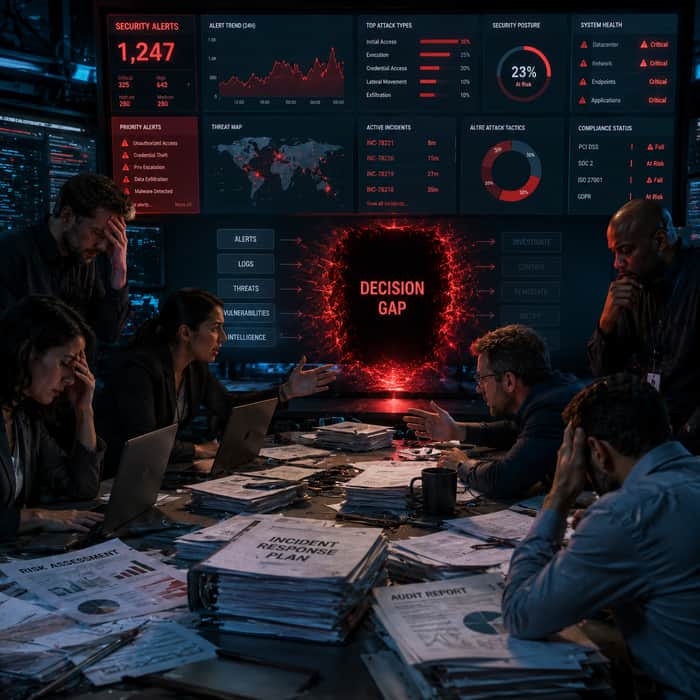
After watching how security and compliance teams actually work — not how they describe their work in demos, but what happens on a Tuesday when something real needs a decision — the pattern is always the same.
The data is there. The alerts fired. The report got generated. And the room gets quiet in a very specific way — everybody has seen the same data and nobody wants to be the one who calls it.
Because finding the problem was never the hard part. The hard part is — what do we actually do about it without creating three new problems in the process.
In security you can surface every vulnerability in the environment and still not know what's safe to prioritize right now given what else is live. In fintech and compliance you can track every regulatory rule and still freeze at the moment of action because nobody can predict with confidence what holds up in an audit six months from now.
So the work develops this specific texture. More alerts. More reports. More data. And somehow the moment a real decision lands, everything slows down anyway. Context is incomplete. Tradeoffs aren't clear. Consequences aren't predictable enough for anyone to want to own the outcome. So it goes to a manual check. Gets escalated. Becomes a "let's wait" call that sits in someone's queue.
That's not a tooling gap. The tooling is often genuinely good.
That's a decision liability gap. And they're completely different problems.
Adding more AI doesn't fix it either because the question was never "what's happening." The actual question is "what should we do here, right now, without creating something worse downstream." Most products built in this space are still only answering the first one and wondering why adoption stalls after the demo.
The builders who figure out the next layer won't win by finding more. They'll win by making decisions safer to take — by building systems that can carry some of the accountability for what happens after the action, not just surface what triggered it.
That's where the real gap is. And most of the market is still looking in the wrong place.

Appreciate the kind words. The "decision-ready" framing is what consistently separates teams that actually use their data from teams that just have dashboards. Most orgs can detect anomalies — what they can't do is get the right context to the right person in time to act on it. That last mile is where most BI implementations fail quietly.
The pattern you're describing in security/compliance is nearly universal: alerts get generated, nobody has clear ownership of the response workflow, and by the time something escalates it's already too late for the cheapest fix. What I've seen work is building the analytics layer with decision workflows in mind from day one — not reporting first and adding workflow later.
If you're working on something in this space, my SQL diagnostic scripts pack includes some query patterns for surfacing decision bottlenecks in operational data → https://growthwithshehroz.gumroad.com/l/psmqnx — free, might be useful as a starting point.
This is such an underrated point.
Most systems today are great at surfacing problems. The bottleneck is what happens after that. Teams hesitate because every action has second-order consequences nobody wants to own.
The companies that solve “decision confidence” instead of just “detection” are going to stand out fast.
Ha, yeah. Spent months building better alerts before realizing the real issue was we had zero clarity on who actually owned each service. Detection was never the bottleneck.
This "decision liability gap" shows up constantly in BI and analytics work too. Companies build Power BI dashboards and SSRS reports — they have full visibility — but when a KPI drops, nobody wants to call it because they're not sure the data is clean, the query is right, or they're reading the right slice. The real fix is building decision-ready reports: clear thresholds, designated owners, and recommended actions embedded in the report itself — not just surfacing numbers. Unreliable or slow queries make this worse because people lose trust in the data before they even get to the decision. If query performance is part of what's creating hesitation in your data stack, this free handbook breaks down the patterns: https://growthwithshehroz.gumroad.com/l/gwiow
You explained the analytics side of this really well especially the part about “decision-ready” systems. Most dashboards stop at visibility, but the real bottleneck is confidence in acting on the data. That’s the layer a lot of AI products still completely miss.
This is the right distinction.
Detection creates visibility.
Decision liability creates hesitation.
That second layer is where most security and compliance tools still feel unfinished.
The product that wins here is not another dashboard showing what happened.
It is the system that makes the next decision safer to take.
That is also why naming matters in this category.
If the name sounds like detection, teams expect alerts.
If it sounds like decision infrastructure, teams expect judgment, prioritization, and confidence.
For this kind of layer, Davoq.com fits much better than a narrow detection-style name.
It feels closer to serious decision infrastructure than another alerting tool.
Exactly. Most tools stop at surfacing risk. The harder problem is reducing hesitation around the decision itself. That’s the layer that actually changes operations.
Coming back to this because the detection vs decision-liability distinction is still the part I think most security/compliance products under-position.
A lot of tools can show risk. Very few make the next decision feel safer to take.
That difference changes the whole category: dashboard, alerting layer, compliance workflow, or decision infrastructure.
I’m now doing a few focused naming/positioning audits around exactly this kind of problem: current category frame, buyer perception, name/domain risk, whether the product sounds like detection or decision infrastructure, and what positioning would make the value feel more serious before more assets build around the current frame.
For this type of product, the audit would be especially useful because small wording differences decide whether buyers see it as “another risk tool” or as infrastructure for safer action.
I’m keeping the first few at $99 while refining the format.
If useful, connect here and I can give you a sharp outside read:
https://www.linkedin.com/in/aryan-y-0163b0278/
Exactly.
Once the product moves from “showing risk” to “helping teams take the next decision safely,” the category changes.
That’s where most tools under-position themselves.
They keep sounding like monitoring or detection, even when the real value is decision confidence.
If that’s the layer you’re building around, the name has to carry more weight too.
Otherwise buyers keep reading it as another risk dashboard instead of infrastructure for safer action.