Most users don’t churn — they just never finish
I might be wrong here, but…
I’ve been thinking about this a lot recently, and I’m not fully sure I’ve got it right yet…
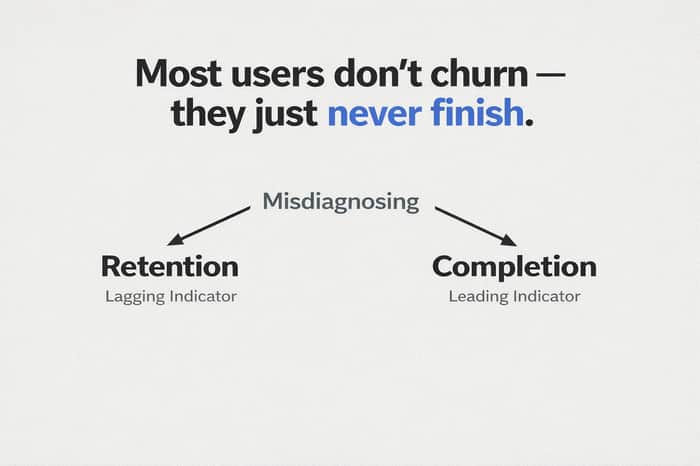
But I think a lot of what we call “retention problems” are actually something else.
Completion problems.
Most products today are really good at:
getting users in
giving them access
showing them what to do
But not necessarily getting them to finish.
And when users don’t finish, everything downstream looks like:
churn
low retention
weak engagement
But those are just outputs.
The real question is:
Did the user actually complete the thing that creates the result?
I started noticing this more with workbooks and course material.
People download PDFs.
They open them once.
Maybe they start…
But very few actually complete them.
And as a creator, you don’t really see that happening.
You just assume:
maybe they weren’t motivated
maybe the content wasn’t strong enough
But I’m starting to think the issue is more structural than that.
The experience itself creates friction.
The biggest drop-off seems to happen between:
download → done
That gap is where everything breaks.
I’ve been building something around this idea called Formely.
Formely turns static PDFs into hosted, fillable workbooks and tracks completion so you can see where users drop off.
Not just:
“did they open it?”
But:
how far did they get
where did they stop
what actually got completed
What’s been interesting is how much this changes how you think about content.
Instead of asking:
“Was this good?”
You start asking:
“Did they finish it?”
I’m starting to think we’re missing a layer in most products.
Something closer to:
completion tracking
behavioural visibility
outcome-based feedback loops
Almost like an infrastructure layer, not just a feature.
Curious if anyone else has been thinking about this?
Or if you’ve seen similar drop-off patterns in your own products.
Feels like there’s something here, but still figuring out how far it goes.

This framing is really useful. For a tool like mine where the job
to be done is completed in 10 seconds - open, go fullscreen, done -
I used to worry about bounce rate. But then I realized a user who
lands, uses the tool for 30 seconds and leaves satisfied is
actually a perfect session. The mistake was applying SaaS
engagement metrics to a utility tool. Once I stopped optimizing
for time-on-site and started optimizing for return visits and
direct traffic, the picture looked completely different.
This framing is really useful. For a tool like mine where the "job to be done" is completed in 10 seconds (open, go fullscreen, done), I used to worry about bounce rate. But then I realized — a user who lands, uses the tool for 30 seconds and leaves satisfied is actually a perfect session. The mistake was applying SaaS "engagement" metrics to a utility tool. Once I stopped optimizing for time-on-site and started optimizing for return visits and direct traffic, the picture looked completely different. Would love to hear how others have adjusted their success metrics based on the nature of their specific tool.
This hit hard. I see this in my own product. People sign up, start the onboarding flow, get halfway through and just... vanish. Not because the product is bad but because there is always something else competing for attention. Reducing friction in that first experience is everything.
This framing really clicked for me. We're building an AI-powered ad creative tool right now, and I've been obsessing over why some users generate their first ad set and come back daily while others sign up, poke around, and vanish. Your distinction between churn and completion made me rethink it — the ones who leave aren't rejecting the product. They just never got to the moment where they saw a finished ad they could actually use. The gap between "signed up" and "got the result" is where all the value either materializes or evaporates. We started tracking time-to-first-output as our north star metric instead of DAU, and it completely changed how we prioritized features. Reducing friction in that first workflow mattered way more than adding new capabilities. Curious what your early data from Formely shows — is the drop-off pattern consistent across different types of content, or do certain formats (shorter workbooks, more interactive elements) have meaningfully better completion rates?
This really clicks — “completion vs churn” is such a powerful way to look at it.
Feels like most products focus on getting users in, but not helping them reach the actual outcome. That gap is probably where most value is lost.
Curious — have you seen simple nudges improve completion rates?
This framing of completion vs. churn really clicks. We see this exact pattern building an ad creative tool — users sign up, start generating ads, but a surprising number never actually download or post them. They got the result but didn't complete the last mile. For a while we thought it was a product quality issue, but when we dug in, it was more about the gap between "I have an ad" and "I feel confident posting it." Adding small nudges like platform-specific previews and one-click copy for captions closed that gap more than any feature improvement did. Your point about needing a completion infrastructure layer is spot on. Most analytics tools tell you what users did, not where they stalled. The difference between "opened the tool" and "got the outcome they came for" is huge, and almost nobody tracks it well. Curious how you're handling the feedback loop — when you detect someone dropped off mid-workbook, do you trigger anything to pull them back in, or is it more about giving creators the data to redesign?
This really resonates. We're — users would sign up excited to make ads, open the editor, then just... stop. They didn't churn because the product was bad. They churned because there were too many steps between "I need an ad" and "here's your ad." The reframe from "did they like it" to "did they finish it" changed everything for us. We ripped out most of the manual steps and made it so you just paste a URL and get finished creatives. Completion rate jumped almost immediately. I think the underlying insight applies way beyond content and PDFs — any product where the user has to do work to get the result is vulnerable to this. The gap between access and outcome is where most value quietly leaks out.
The distinction matters because "never finished" is a product design problem, while "churned" gets misdiagnosed as an acquisition or targeting problem. If someone left without finishing, you delivered a doorstep experience, not an outcome — they got the promise but not the delivery.
The fix is usually less about adding features and more about making the path to the first meaningful win shorter and more obvious. Most products are designed around capability (here's everything you can do) when they should be designed around completion (here's the fastest way to get the thing you came for). The gap between those two is where engagement quietly dies.
I don't really understand how a SaaS / tool can be complete ? It's a tool, you use it or not.. there is no completion. Maybe I get something wrong?
We see this exact pattern with our Godot plugin. Users install it, try one thing, get a result that's 80% right, and then bounce because they don't know how to get it to 100%. The "completion" framing is way more useful than "churn" because it points you at a different fix. We stopped trying to send re-engagement emails and instead just made the first task completable in under 2 minutes. Retention went up without us touching anything else.
This is painfully accurate for marketplaces too. I run a lead-gen platform where contractors sign up, get approved, and then... nothing. They never buy their first lead. Out of 42 registered contractors, maybe 5 have actually completed a purchase. The other 37 didn't churn — they never started. My biggest mistake was treating registration as the finish line. It's not. Registration is just access. The real activation moment is when they see a lead in their area, for their service, and think "I need that job." So now I'm building a nudge sequence: Day 3 after approval, remind them they have a free lead credit. Day 7, show them a specific lead they missed. The gap between "signed up" and "got value" is where I'm losing almost everyone. Your framing of completion vs retention really clicks — I've been measuring the wrong thing.
Most users don’t churn.
They fade out before the product becomes true for them.
Access → exposure
Completion → belief
Belief → return
If the first outcome never gets completed, “retention” is often just the metric-name we give to a broken crossing.
This hits close to home, I'm building a travel app
and the hardest thing isn't getting people to sign up,
it's getting them to try the core feature (camera scan)
even once.
What I've found is that users who try the main feature in the
first session almost always come back. Users who don't
try it in the first session almost never do.
The whole onboarding question for me became, how do I
get someone to point their camera at something Japanese
within the first 2 minutes? Everything else is secondary.
Still figuring it out but your framing of "never finish"
vs "churn" is exactly the right way to think about it.
The more I dig into this, the more it feels like we’ve optimised everything around access…
but not around follow-through.
And that gap compounds over time.