My AI bill was bleeding me dry, so I built a "Smart Meter" for LLMs
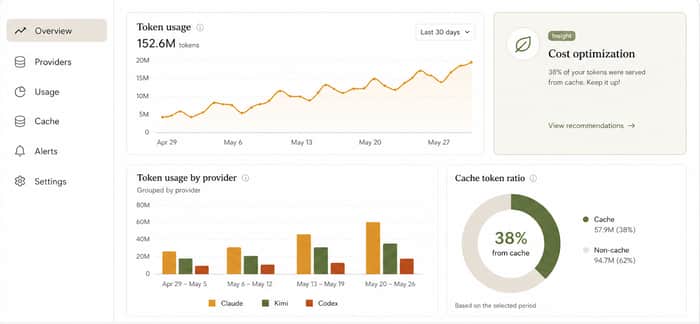
TL;DR: In 2026, AI is the new electricity bill. I got tired of "black box" invoices and secret model downgrades, so I built AiKey to bring FinOps to the AI stack.
Hey fellow Indie Hackers,
If 2024 was the year of "How do I make AI work?", 2026 is officially the year of "How do I pay for this without going broke?"
As a dev lead managing a stack of GPT-5, Claude 4, and several local clusters, I hit a breaking point last year. AI has become the "electricity" of our company, but we were essentially paying the bill without having a meter.
Here are the three "WTF" moments that forced me to build my own solution.
- The $4,000 Mystery Bill
Last quarter, our AI spending spiked by 40%. We weren't even in a heavy testing phase.
When I checked the provider dashboards, I hit a wall. Most platforms give you a "Total Sum" but zero attribution. Who burned the tokens? Was it the new marketing agent? A rogue loop in a background script?
In 2026, we’re still living with "dumb meters." We pay and pray, with no granular visibility into ROI at the project level.
- The "Model Nerfing" Scandal
This is the ultimate hidden tax. To save compute, some third-party providers secretly route your GPT-5 requests to cheaper, distilled versions during peak hours.
I spent an entire night debugging a prompt that suddenly turned "stupid," only to realize via raw packet inspection that the provider was declaring one model but delivering another. If you aren't auditing response quality in real-time, you’re paying for a first-class ticket and sitting in economy.
- .env File Hell
Managing raw API keys for a growing team of 15+ is a security nightmare.
Rotation: One key change means syncing 20 different environments.
Offboarding: Revoking access for a contractor shouldn't mean rotating the master key and breaking production.
The Solution: Bringing FinOps to the Infrastructure
I realized we needed a "Runtime Credential Layer" between our apps and the providers. So, we built AiKey. It’s not just a proxy; it’s an AI Credential Vault + Smart Meter.
Here’s how we’re running it now:
Virtual Key Orchestration: We no longer share master keys. We issue "Virtual Keys" with hard limits and metadata tags. By running aikey run --python agent.py, every cent is automatically attributed to a project or team.
The Quality Radar (Anti-Nerfing): We integrated fingerprint verification at the protocol level. If a provider tries to "nerf" the model, AiKey detects the mismatch in the response stream and triggers an alert or failover instantly.
Zero-Config Security: All master keys stay in an encrypted Vault. Credentials are injected at runtime, meaning zero code changes and zero .env leaks.
The Takeaway for 2026
In 2026, the gap between successful AI startups and the rest won't just be about the prompts—it'll be about AI Governance. You can't scale what you can't measure.
I’ve open-sourced the CLI layer because I think every dev needs a better "meter" for their AI stack.
I’d love to hear from you: How are you guys tracking your token spend per project? And have you caught any providers "nerfing" your flagship models lately?
Check out the project here: https://github.com/aikeylabs/launch

Hey, this post is exactly the problem I'm looking into. I'm a CS student building a small tool that tags AI API spend by feature/workflow so you can see which one is actually expensive, plus an alert before you blow a budget. The part where you mentioned not knowing which feature was eating the budget is exactly what I'm trying to solve.
Before I build more of it, I want to make sure I'm solving the right problem. Quick questions if you don't mind:
No pitch, just trying to validate before I sink time into building the wrong thing. Appreciate any honesty.
Appreciate you validating before building — that already puts you ahead of most.
To your three:
Tracking today: We can attribute spend to individuals, not features. I can tell you Alice spent $280 on Claude, but not which workflow that $280 powered. That gap is real and nobody has closed it cleanly.
Bill surprises: Constantly. The worst aren't spikes — they're quiet leaks. A forgotten key, a model that silently changed pricing, a workflow that drifted from occasional to daily with no alert. By the time the monthly report lands, the money's gone. So the alert piece you're adding is a smart instinct — alerts catch what monthly reports miss.
Would I pay $15-20/month: Honest answer — depends entirely on how the tagging works. If I or my team has to manually label every call by feature, probably not. That's friction with no personal payoff for the person doing it. Someone in another reply on this post made that point and they were spot-on. But if you can infer the feature from context — API route patterns, which repo triggered the call, deploy timestamps — without anyone doing extra work, then yes. That's not a nice-to-have.
One thought on the alert piece specifically: the alert that matters most isn't "you're about to hit your budget." It's "this specific feature just spiked 5x in the last hour, and it's not correlated with any deploy or config change — might be a bug or a runaway loop." That's the alert that saves real money. Generic budget thresholds are useful but easy to replicate. Anomaly alerts tied to specific features are where you differentiate.
Love how you’re turning a pretty messy headache into something teams can actually keep track of. I’ve been burned by surprise model downgrades too, and having a real-time canary check sounds like a lifesaver. Curious if you’re thinking about adding soft alerts before someone blows through a budget, kind of like a spending radar. That would save a ton of awkward end-of-month scrambling.
Thanks for sharing your experience — model downgrades are such a silent killer. The canary check is exactly for that: catching when a provider silently shifts you to a weaker model mid‑stream.
Soft alerts are definitely on the roadmap. Right now we have threshold‑based warnings (e.g., "you’ve hit 80% of your monthly budget"), but a radar‑style "spending is accelerating faster than usual" is a great idea. Would love to hear more about what kind of alerting would work best for your team.
If you’re up for trying the current version, the personal edition is free. The canary check alone might save you a few surprises.
the model-nerfing piece is the one i keep getting burned by. we run five agents on openrouter and venice and twice now i've watched response quality drop overnight without any published model change. how are you doing the fingerprint check at the protocol level. comparing token distributions across calls, or something cheaper like response length plus perplexity drift?
also: the per-project attribution problem is real even at our scale. brandon and i could not tell you which of our agents was eating the most until we tagged everything. fwiw we ended up doing it with openrouter's metadata field and a tiny supabase view, which is duct-tape compared to what you're showing.
Great points — and yes, model-nerfing / silent routing drift is exactly where we got burned too.
We do fingerprinting in 2 stages to keep it cheap:
Fast checks on every call: requested vs returned model/provider metadata, stop reason, latency bands, output-length ratio.
Drift checks on sampled traffic: rolling baselines by workflow (length distribution, refusal rate, structured-output validity, and embedding similarity against canary outputs).
If either layer trips, we run a small canary replay set across providers and flag mismatch risk.
Also +1 on your OpenRouter metadata + Supabase setup — that’s actually a very pragmatic pattern. We started similarly before adding stricter policy/alerting around it.
Cost visibility is one layer. There's another layer most AI founders haven't instrumented yet: what LLMs say about your product.
Once you're shipping an LLM-powered product, your costs are visible in dashboards. But the LLMs your users' customers interact with every day — ChatGPT, Claude, Perplexity — have already formed opinions about your category, your competitors, and whether your product exists. They formed those opinions from training data, not live crawling, so even a perfectly launched product can be invisible to the AI discovery layer entirely.
I've started treating "what does ChatGPT say when someone asks about [my category]?" as part of launch prep. Not because it's easy to change — it isn't — but because knowing the baseline before you go live is the difference between being surprised 6 months in and being able to act on it.
This is such an important point. Fully agree: cost visibility is only one layer — AI discovery visibility is another one most teams ignore.
We’ve started treating this as pre-launch ops too:
run a fixed prompt set across ChatGPT/Claude/Perplexity for category queries, competitor comparisons, and “best tools” prompts
snapshot baseline answers before launch
re-check on a cadence to track mention/share/position/factual consistency over time
It’s not a vanity metric for us — it informs positioning, docs/content priorities, and distribution strategy.
Really glad you raised this. Most teams only discover this gap months too late.
The 'no meter on the electricity bill' framing is exactly right. The thing that makes AI costs surprisingly hard to control for small operators (solo founders, 1-2 person teams) is that AI costs scale with workflow breadth rather than with revenue. A developer who starts using Claude for code review, then for documentation, then for customer support automation ends up with a monthly bill that reflects 'how much I'm trying to accomplish' rather than 'how many paying users I have.' That decoupling is genuinely new -- SaaS costs (infrastructure, tooling) used to scale with usage and therefore with revenue, so the unit economics self-regulated.
The FinOps approach you're describing (tagging, budgets per use case) is the right response, but it requires treating AI as a cost center with clear ownership per workflow. Most solo founders haven't done that -- they have one API key, one bill, and zero visibility into which workflow is eating the budget.
The operational discipline piece I've seen work: assign an AI 'budget line' to each workflow the same way you'd budget any SaaS tool. 'This feature can use up to /month in AI calls. If it exceeds that, it gets paused or optimized.' Forces the ROI conversation per workflow rather than in aggregate.
What patterns are you seeing in how people's costs spike -- is it usually a few high-volume workflows or a long tail of small ones adding up?
Great point — I completely agree with the “workflow breadth vs. revenue” decoupling.
That’s exactly the trap we see with small teams: one API key, one invoice, zero workflow ownership.
Your “budget line per workflow” framing is spot on. We’ve started doing the same with soft caps first, then optimization/pausing rules if a workflow keeps overshooting.
On your question: in our data, spikes are usually hybrid — one or two high-volume workflows cause the big jumps, while a long tail of “small but always-on” automations quietly compounds the baseline.
The tail is often harder to notice until request-level attribution is in place.
Really appreciate this take — it’s one of the most practical FinOps habits for early-stage teams.
We saw a similar problem. Tokens were consumed, but we couldn't really see how they were used. So we created a dashboard in our coding agent that summarizes tokens per provider/model/agents.
Every session/thread creates a summarized token consumption which is aggregated. Now we use that to close the loop: Analyze agent effectiveness, and improving the system prompts, agents markdown and skills.
Measuring is just the first step. Improving and upskilling your workflow is the real game changer.
Love this — fully agree with your last line: measurement is the starting point, not the finish line.
Your loop is exactly what we’re trying to push as well:
usage visibility → effectiveness analysis → prompt/agent/skill iteration.
Also +1 on session/thread-level aggregation. In our experience, that’s where teams finally see which workflows are “token-heavy but outcome-light.”
Curious: are you tracking any quality proxy alongside token metrics (e.g., task success rate, re-run rate, human override rate)?
That combo has been very useful for us when deciding what to optimize first.
The "$4,000 mystery bill" line hit. The same pattern shows up across the whole cloud stack in 2026, not just LLMs. Idle clusters running over weekends because nobody scaled them down. Storage tiers that never got moved to Archive. Forgotten dev environments billing all month.
The model-nerfing bit is the one I hadn't seen framed clearly before quality drift disguised as a billing problem. That's a smart angle.
Have you thought about cost-per-successful-output as the headline metric instead of tokens? Tokens lie. Outcomes don't.
Love this framing — “tokens lie, outcomes don’t” is exactly the direction we’re exploring.
We started with token-level metering because it’s the fastest way to get operational visibility, but I agree the north-star metric should be cost per successful outcome (task completion / accepted output / downstream conversion depending on workflow).
Right now we’re testing both layers:
If you have a clean definition of “successful output” that worked well in your stack, I’d genuinely love to compare notes.
Metering is the right first move — you can't cut what you can't see. Two things that tend to move the bill more than people expect, once you've got visibility:
Prompt caching. If you're sending a large stable system prompt / context on every call, caching it (most major APIs support this now) can knock 50-90% off the input cost for that portion. Biggest single lever in most agent loops.
Right-sizing the model per step. A lot of pipelines run everything through the top model. Classification, routing, extraction, "is this done yet" checks — those are usually fine on the cheap/fast model, and you only escalate to the big one for the actual reasoning step.
Does your tool break the spend down by call type or just by total? The per-step view is where the obvious wins usually hide.
Great points — both are huge levers in practice.
Prompt caching and per-step model right-sizing are exactly where a lot of “hidden easy wins” live once attribution is in place.
Today we break spend down beyond totals (project/service/model), and we’re expanding call-type granularity so teams can see routing/classification/reasoning/tool-call costs separately. That per-step view is where optimization becomes obvious.
If you’ve implemented a routing policy you like (e.g., cheap model first, escalate on confidence threshold), I’d love to hear your rule design.
Calling it "FinOps for AI" is exactly right. The pattern is identical to what happened with AWS in 2012, when "mystery bill" was a board-level conversation at every fast-growing SaaS. The companies that built CloudHealth and Cloudability won by pricing on percentage of savings, not per seat.
Worth thinking about: per-seat pricing for an observability tool is a tough sell because the buyer's instinct is "I'm already overspending, why am I paying more to find out where." Tie pricing to identified savings or to tokens monitored, and the ROI math sells itself. Ran an MSP for nearly 20 years and saw this in every cost-control cycle. The ones who tied price to value outcompeted the ones priced on usage of the tool itself.
This is super valuable context — thank you.
I agree seat-based pricing is often a bad fit for cost-governance products. Buyers want ROI to be self-evident, not another fixed software line item.
We’re actively thinking about value-linked models (e.g., monitored spend / identified savings bands) so pricing tracks outcomes, not just tool usage.
Your CloudHealth/Cloudability parallel is spot on — appreciated.
The "who burned the tokens" problem is exactly the attribution challenge we see in data warehouse environments - you have aggregate billing but no project-level cost center breakdown until you build the metadata layer yourself.
The approach that works in analytics: treat token consumption like database query cost - tag every request with project_id, user_id, model_version, and a correlation_id at emission time. That metadata makes the downstream BI work straightforward: cost per feature, cost per user cohort, anomaly detection on per-project burn rate. The hard part is not the SQL, it is getting the tagging discipline in place before costs scale.
The model nerfing detection angle is particularly interesting from a data quality standpoint - you are essentially doing data contract validation at the API level. The same principle applies to any external data dependency: if your source can silently degrade quality without a schema change, you need fingerprint-level checks, not just row count thresholds. If you are thinking about how to model and report on cost and quality data once it is flowing, my BI handbook covers the patterns: https://gum.co/vgiex
This is an excellent analogy — treating token spend like query-cost attribution in analytics is exactly how we think about it.
Completely agree: the hardest part isn’t downstream SQL, it’s enforcing tagging discipline at emission time before scale.
Also +1 on the data-contract lens for model integrity checks. “Schema unchanged, quality degraded” is the failure mode most teams underestimate.
Thanks for sharing this perspective — very aligned with what we’re seeing.
Yeah, the "schema unchanged, quality degraded" failure mode is what kills trust in DWH environments too — everything still loads green in SSIS but downstream KPIs quietly diverge for weeks before anyone catches it. The fix in BI was emission-time validation (data contracts at the source, not just at the mart). Sounds like LLM observability is converging on the same answer. Excited to see where Smart Meter goes.
Interesting take — the “AI bill as the new electricity bill” analogy actually hits hard. The lack of granular attribution is something I’ve seen become a real issue as teams start using multiple models across different workflows.
The “model nerfing” point was especially interesting. I haven’t personally caught providers downgrading responses, but I have noticed inconsistent output quality at times and usually assumed it was prompt drift or context issues. Curious — how are you validating fingerprint mismatches without creating false positives?
Also like the idea of virtual keys with spending limits. Feels much more scalable than sharing raw API keys across environments.
Great question — false positives are the main trap here.
We avoid hard conclusions from a single signal. Current approach is layered:
We alert on sustained divergence, not one-off variance. So it’s more “downgrade-risk signal” than binary accusation from a single response.
If useful, I can share the minimal rule set we use for alert thresholds.
The model nerfing point is the one that hits hardest. Most teams don't even realize it's happening because they don't have a baseline for what "good output" looks like from each model. They're paying for GPT-5 quality and accepting GPT-4-mini quality without noticing.
This is why I think AI cost management is actually an AI skills problem in disguise. If nobody on the team can tell the difference between a nerfed response and a real one, no amount of metering will save you. The meter tells you what you spent, but you still need someone who can evaluate whether you got what you paid for.
I'm building something adjacent at aisa.to (AI skills assessment) and one of the things that keeps coming up is that most people massively overestimate their ability to evaluate AI output quality. Your tool solves the infrastructure side, but there's a whole human calibration layer that most teams haven't even started thinking about.
Cool project, bookmarking the repo.
100% agree — this is not just an infra problem.
Metering tells you what happened; human calibration determines whether the output quality was acceptable for the task. Without that layer, teams can still overspend on low-value outputs.
Our view is: infra governance + evaluation discipline should be paired, not treated separately.
Your “human calibration gap” point is strong — would be interesting to compare how teams operationalize evaluator quality in production workflows.
Model nerfing is a wild hidden tax! Smart MVP for FinOps. Does it track specific MCP tool costs?
Great question. Short answer: yes, that’s on our active scope.
For MCP-style workflows, we treat tool calls as first-class cost events and attribute them by tool_name / workflow / caller, then roll them into the same request-level ledger.
The tricky part is normalizing different cost shapes (token-based, per-call, time-based), but that’s exactly the direction we’re building toward.
AiKey is a useful name for the API key layer, but the product you described feels broader than key management.
The real category here sounds like runtime AI governance: spend attribution, credential control, quality verification, and failover when providers quietly degrade output.
That is a much more infrastructure-heavy position than “AI key” or “smart meter.”
If this becomes the control layer between teams and AI providers, a harder .com like Davoq.com would probably fit the direction better. It sounds more like production infrastructure than a utility around API keys.
Really thoughtful take — thank you.
You’re right that the product has moved beyond “key management” into a broader runtime governance layer (attribution + credential control + quality checks + failover).
“AiKey” started from the credential surface, but the control-plane direction is real. We’re actively refining positioning to reflect that broader scope without losing clarity.
Appreciate the blunt branding feedback — super useful.
That makes sense. I’d probably keep “AiKey” close to the credential surface, but be careful letting it define the whole company if the real product is becoming the control plane.
The stronger positioning is probably something like: one layer to govern AI usage across cost, credentials, quality, routing, and provider reliability.
That gives you a bigger category without making it vague.
The naming question is really whether AiKey stays as the product/module name, or whether the broader control-plane company needs a harder infrastructure brand above it. Davoq.com was my instinct for that exact reason.
Happy to share a sharper take in DM if useful.