My GTM stack was $382 a month across four tools. I rebuilt it as one app for $49
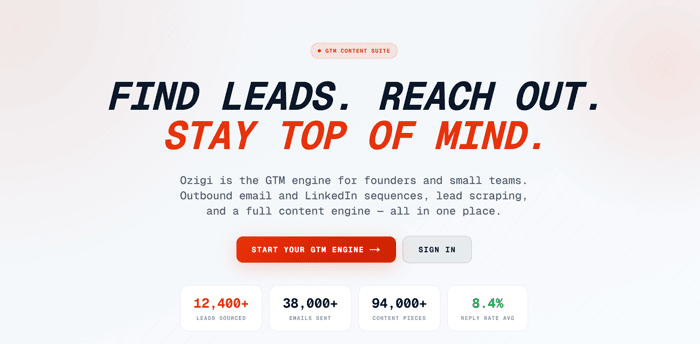
For most of last year, my go-to-market setup was four browser tabs and four invoices.
Clay to enrich leads. Apollo to find them and run sequences. lemlist for the email and LinkedIn outreach. And Copy.ai for the blog posts and social content that were supposed to warm people up before any of the outreach landed.
At the tiers I actually needed, that came to roughly:
- Clay (Launch): $185/mo
- Apollo (Basic): $49/mo
- lemlist (Multichannel): $99/mo
- Copy.ai: $49/mo
About $382 a month. Call it $4,500 a year, for a one-person motion.
The writing tool never saw the lead data, so the content was generic. The sending tool never saw my brand voice, so the cold email read like a different person than my blog. Leads got enriched in one place, scored in my head, written to in another, and tracked in a fourth. Every handoff was a spot where personalization quietly died. The end result was outreach that was technically personalized and emotionally hollow, and a cold email that any developer could smell was written by a machine.
So I built Ozigi to collapse the four jobs into one app.
The piece I am proudest of is small and a little petty. There is a hard list of banned words baked into the generator, "delve," "robust," "seamless," "leverage," and the rest of the AI tells, and the engine is not allowed to use any of them. The cold email and the blog post come out sounding like a human who actually looked at the person, not like a template.
The price is the part that made me want to post here.
The free tier runs the full motion with no credit card: lead sourcing, ICP scoring, email sequences, and content. The Pro plan, which does everything the $382 stack above did, with no limits, is $49 a month. One login, one voice, one bill.
Now the honest part, because I would want it if I were reading this.
Ozigi is built for people who sell to developers and technical buyers. Sourcing leans on GitHub and Dev.to, so if your ICP is a CFO who has never opened a terminal, Apollo's database will find them and Ozigi will not. If your entire job is industrial-volume cold email across hundreds of mailboxes, a dedicated sender like Instantly or Smartlead will out-send it. And if deep waterfall enrichment across dozens of providers is your core motion, Clay still goes deeper on pure data. Ozigi wins when you want all four jobs in one place, in one voice, without paying four times for the privilege.
I would love for you to break it. The free tier needs no card, so you can run a real campaign in about fifteen minutes: describe your ICP, let it source and score a list, generate the first cold email, then generate a blog post on the same topic and read both out loud. If they sound like the same person, it is working. If anything feels off, or sounds like AI, that is exactly the feedback I want.
https://ozigi.app

Love how honest this is especially about where Apollo or Clay still win for specific use cases. But collapsing that workflow so the content and data actually talk to each other is brilliant, and banning those AI buzzwords ("delve" is the absolute worst) is a massive touch.
Did you build Ozigi primarily to scratch your own itch while selling to devs, or was a unified GTM tool always the roadmap?
I built it to scratch an itch, then realized how much value it could add.
One of the sharpest launch posts I've seen recently — explicit limits, narrow ICP, free tier no card. Most launches don't pressure-test themselves this honestly.
"$382 → $49 no limits" is the part most likely to break. Tools you replaced charge what they charge because of real API costs. $49/mo no-limits across four functions suggests hidden limits or future price increases.
ICP ceiling is real. B2D is maybe 5-10K companies globally. Even 1% capture at $49 is $30-60K MRR. Fine for solo, but worth thinking about adjacent expansion paths before saturation.
GitHub/Dev.to sourcing has backlash risk. Dev community hates cold outreach based on GitHub activity. Tabnine, Codeium faced public backlash when developers realized contributions were being mined.
Banned word list is clever but small moat — catches surface tells, not structural ones. The deeper value prop is "one voice across content + outreach" — that's worth deepening.
Good launch. Will run the 15-minute test.
Thank you!
Thank you, again. What was your experience??
This is a sharp wedge because the pain is not just “four tools are expensive.” It is that the GTM context gets broken every time the workflow moves between sourcing, scoring, writing, sending, and content. That is exactly where personalization starts looking fake even when the data is technically there.
The strongest positioning here is “one GTM voice across the whole motion.” That feels more defensible than just being a cheaper Clay/Apollo/lemlist bundle.
One thing I would pressure-test early is the name. Ozigi is short and memorable, but the product is trying to become a serious GTM workflow layer for people selling to developers and technical buyers. If it grows beyond the current app into sourcing, scoring, sequencing, content, voice, and campaign intelligence, the name has to carry that platform feeling from day one.
Xevoa .com would fit that direction well because it feels more like a modern workflow/productivity platform than a lightweight GTM tool, while still leaving room for lead sourcing, outbound, content, automation, and technical-buyer campaigns under one cleaner brand.
Thanks.