My Home Is Under Renovation — and I Accidentally Became an AI Designer
Hi, I’m Qiban AI — an independent developer and entrepreneur, fully All in AI.
What I do is actually very simple:
I take ideas from my head and turn them into reality with AI — fast.
This account is my AI product lab, and also my entrepreneurship journal.
Here, I share my real thoughts and hands-on experiments around AI products and AI commercialization.
If you’re also exploring the boundaries of AI, you’re very welcome to join the conversation.
Let’s build and create together.
My Home Is Under Renovation — and I “Forced” Myself to Become an AI Designer
My home is currently under renovation.
And then… my product manager instincts kicked in — hard.
As a PM, I’ve always had a slightly restless urge to create.
Whenever a real problem appears, my first reaction is usually not:
“Is there an existing solution on the market?”
But rather:
“Can I build this myself?”
After Mianxin Companion AI,
after Qiban AI · Old Photo Restoration,
my third “AI baby” was born right in the middle of dust, arguments, and renovation chaos:
Qiban AI · One-Click AI Interior Design

Renovation Is Painful — In Every Possible Way
If you’ve ever renovated a home, you’ll understand these pain points instantly.
1️⃣ Communication Is an Invisible Gap
You say to your partner or designer:
“I want something a bit wabi-sabi, but not too cold — warm and livable.”
But what appears in the designer’s mind
often looks nothing like the home in your imagination.
You’re speaking the same language,
yet somehow living in completely different worlds.
2️⃣ The Result Is Always a Gamble
Before anything is actually built,
every design rendering comes with four unspoken words:
For reference only.
That sofa that looks amazing in the mockup.
That floor you debated for weeks.
- Will they work together?
- Will it look good in real life?
- Will it fail catastrophically?
No one can give you a definite answer.
3️⃣ The Budget Is a Bottomless Pit
The scariest part of renovation isn’t that it’s expensive.
It’s trial and error.
- Every “this doesn’t feel right.”
- Every “let’s tear it down and redo it.”
All of it burns real money.
As a product manager,
I’m almost instinctively allergic to systems with:
Information asymmetry + Uncertain experience + Uncontrollable cost
A Question That Changed Everything
AI can already create art.
AI can restore photos from decades ago.
So I asked myself:
Why can’t AI be my personal interior designer?
That question stayed with me —
right there among the dust, arguments, and sudden flashes of inspiration.
And slowly, my third product took shape.
Qiban AI · One-Click AI Interior Design
I had only one requirement for it:
Extremely simple — but visually impressive.
- You don’t need design knowledge.
- You don’t need to learn software.
- You don’t even need to know professional terminology.
Just three steps.
Three Steps — Hand Your Home to AI
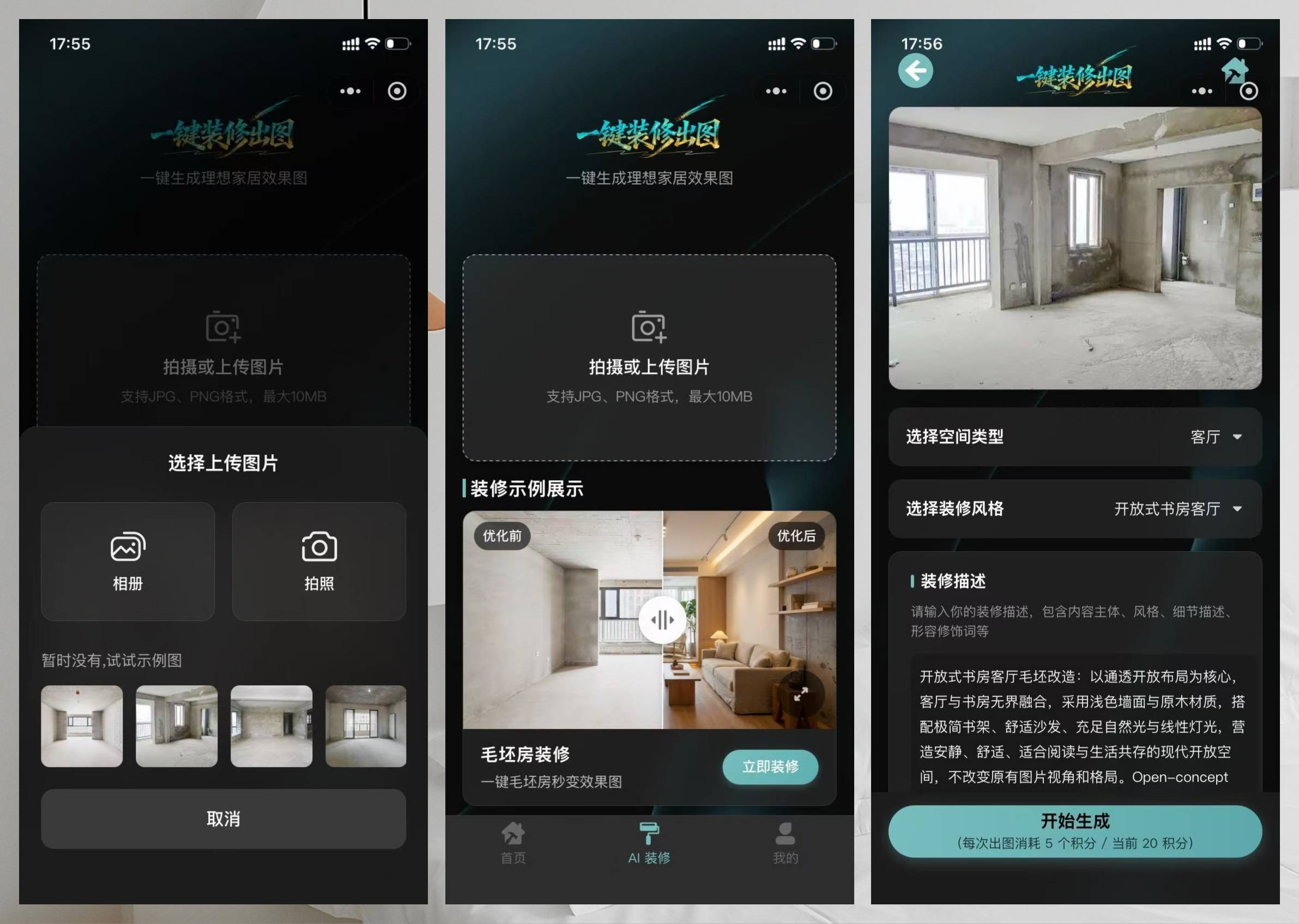
Step 1: Upload Your Space
Take a photo of your unfinished room,
or upload a basic floor plan.
Even if it’s rough,
AI can still understand the real spatial structure.
Step 2: Tell AI What This Space Is
- Living room?
- Bedroom?
- Dining room?
- Study?
- Kids’ room?
Just choose.
No explanations needed.
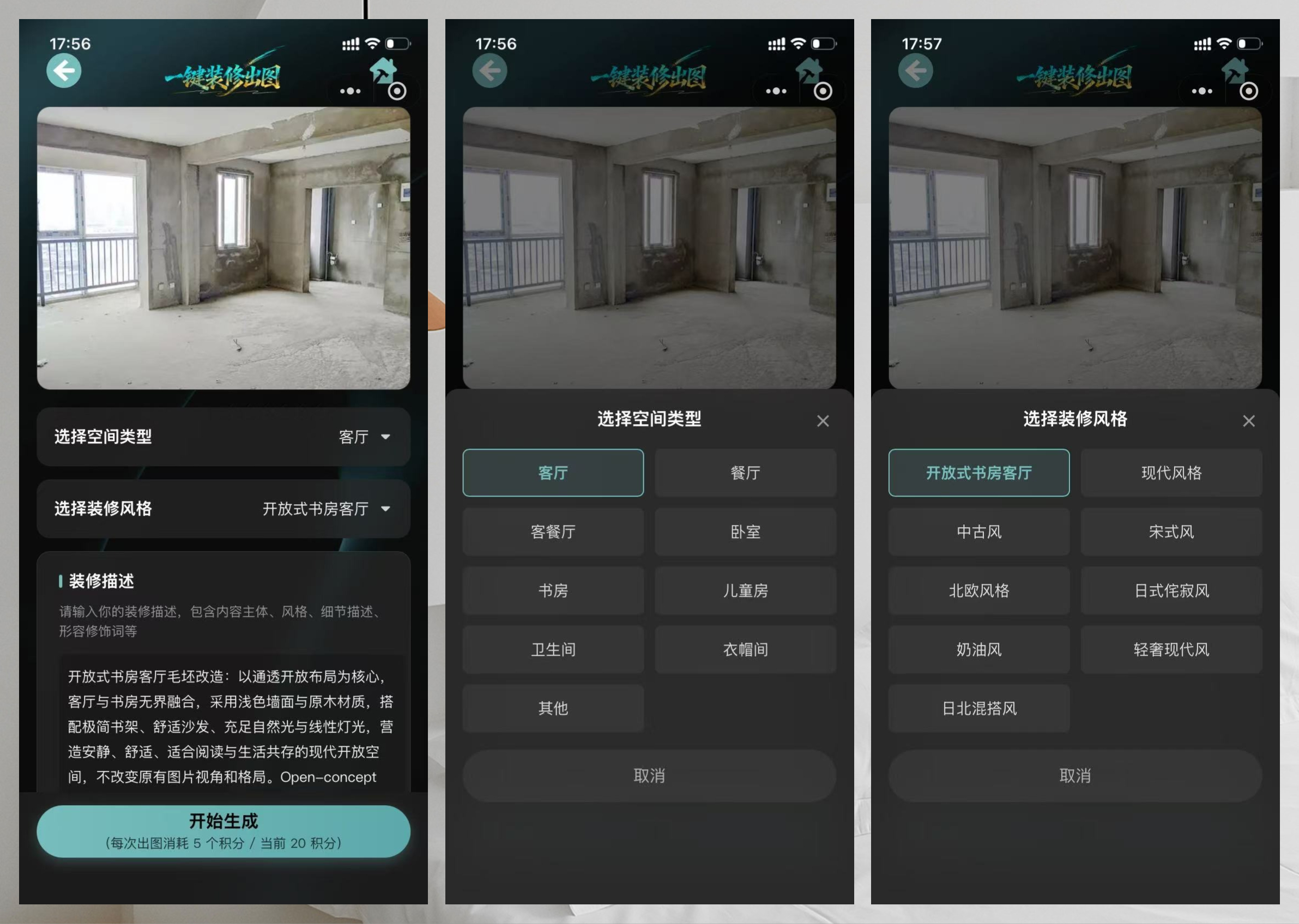
Step 3: Choose the “Feeling” You Like
- Modern?
- Japanese wood style?
- Creamy minimal?
- Industrial?
- New Chinese style?
No need to be “professional.”
Just follow your intuition.
Click Generate.
A few seconds later,
you get a high-resolution design image —
based on your actual space and your preferences.
It looks real.
Not overly luxurious.
Much closer to what a real renovated home would look like.
You can even add your own ideas through text input.
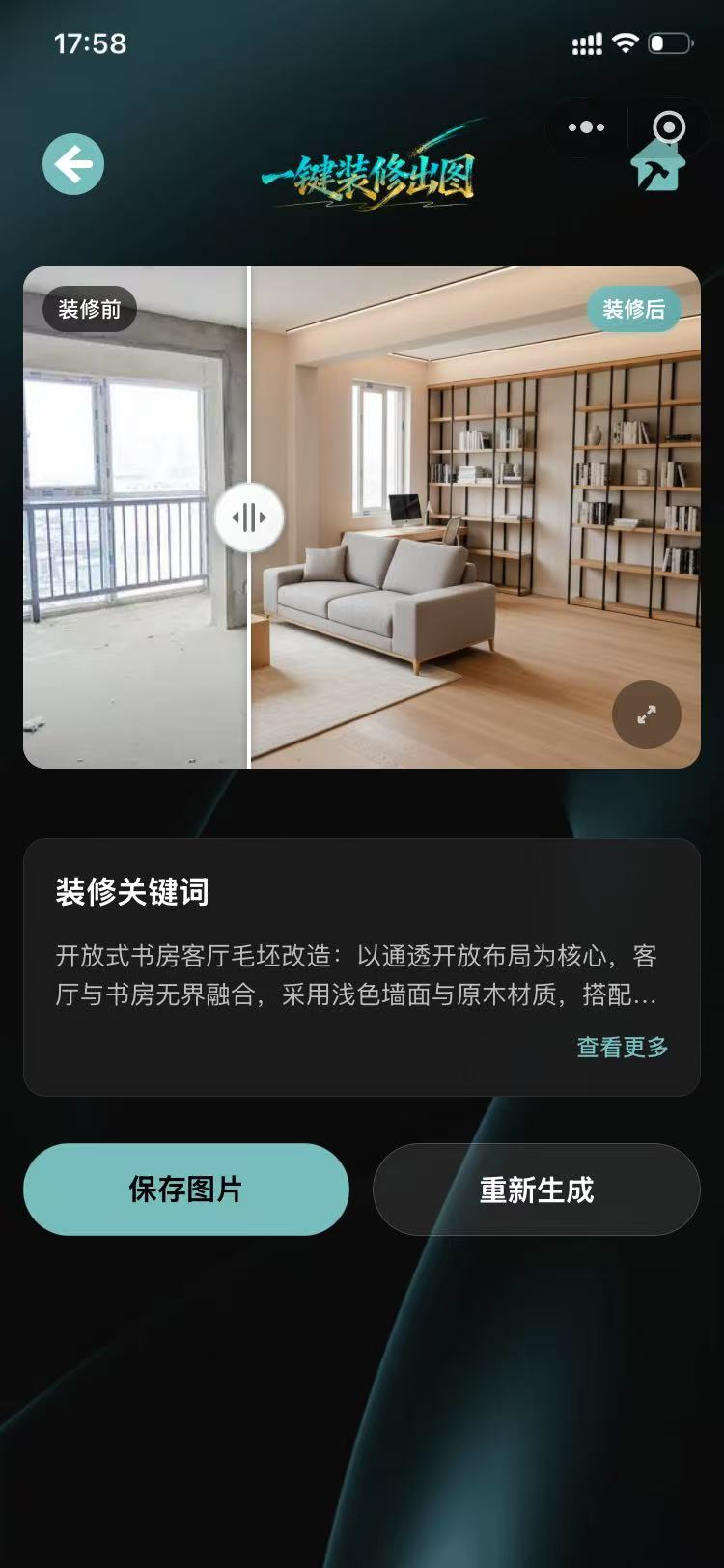
Honestly, even I was surprised the first time I saw the result.
It didn’t just match the “ideal home” in my head —
it gave me unexpected ideas I would’ve never thought of myself.
Who Is This Really For?
From the beginning,
I never wanted to replace professional interior designers.
This is more like a creative assistant on your renovation journey.
Especially useful for two types of people:
🧱 New Home Renovators
When facing an empty space,
you no longer have to rely purely on imagination.
You can try unlimited design possibilities in advance,
and when construction starts,
you already know what you want.
🛠 Home Renovation & Remodeling
You want to change things —
but you’re afraid of messing it up.
Take a photo of the current state.
Tell AI your ideas.
See the future first, then decide.
Every dollar spent feels more confident.
Final Thoughts: Creating for Yourself
If my previous products were about solving common problems for others as a PM,
This time, I went back to the most original motivation of creation:
Solve my own problem first.
This experience also made one thing increasingly clear to me:
Product managers are evolving in the AI era.
We’re no longer just translators of requirements.
We can jump in ourselves —
to build, test, and validate solutions directly.
From companion AI for elders,
to restoring memories,
to designing my own home.
My three AI products form a journey
from general needs to deeply personal pain points.
The Most Fascinating Part of This Era
When a problem troubles you,
you can always roll up your sleeves,
use AI,
and build a solution for yourself.
So —
what problem has been bothering you lately?
Maybe it’s worth asking:
Can AI help you with that too?
This account is my AI product lab and entrepreneurship journal,
where I document real thoughts and practices around AI products and commercialization.
If you’re exploring the edge of AI as well —
welcome to connect, share, and create together.
