My homepage ranks my users' products by how much they've paid me. Nobody has paid me anything.
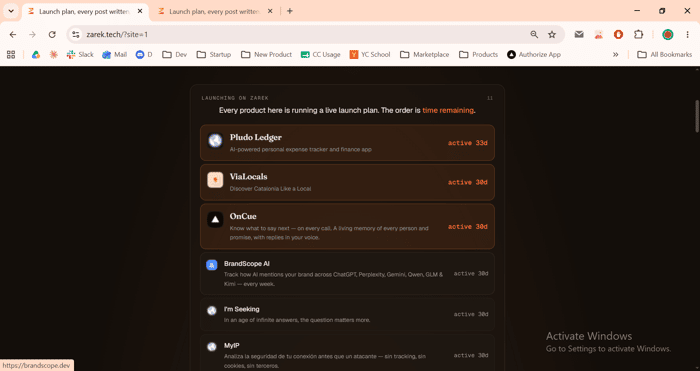
I build Zarek, a launch tool. Two weeks ago the landing page had two testimonials and no other proof on it.
So I put every product on it. All 11 accounts — name, tagline, favicon, live link — ranked by how much access time each one has left. Buy a longer block, sit higher for longer. Blocks stack and there's no cap.
One mechanism doing two jobs: social proof for me, and a reason to buy 12 months instead of 1.
Here's the part I have to say out loud. Zarek has collected $0. Nobody has ever paid. Before I shipped the list I granted all 11 products a free month, which means the leaderboard is currently ranking something I gave away. It looks like eleven paying customers. It's eleven people who got a gift.
I mark the trial rows "free trial" so it isn't a lie. It's still the most flattering possible arrangement of the truth, and I'm uneasy about it.
Two more numbers, since I'd rather post them than not. 85 people saw the landing page in 13 days. My own launch checker says my product is listed on 2 of the 19 places it looks. At six visitors a day I can't A/B test anything, so I have no way to know whether the leaderboard works at all.
The question I actually want answered: does a pay-to-rank leaderboard on your own homepage read as social proof, or as desperate? outbid.lol made $207k in 77 hours with this as the entire product. I'm bolting it onto a launch tool as a sidebar, and I can't tell if that's clever or if it cheapens the thing.
zarek.tech if you want to look. The list is under the hero.

I bet a ton of founders are trying to reverse-engineer OutBid right now to copy it. At its core, it’s basically gamified social clout. But the real question is the cold start—the founder must have leveraged an existing distribution channel or some serious personal leverage to kickstart that first growth loop.
Your question has a real answer, and it's neither of your two options, it's contingent on one thing you're circling: a pay-to-rank board reads as social proof when the ranking signals user quality, and as desperate when it signals the founder's revenue. Yours currently does the second. "Ranked by how much they've paid me" makes the homepage about your monetization, not your users' success. That's the tell a visitor feels even before they think it.
That's also why outbid.lol isn't your precedent. There, the bidding WAS the product, paying to rank was the entire game people came to play, so payment-as-ranking was the value. You bolted the same mechanic onto a launch tool, where the user's goal is "get discovered," not "win a bidding war." So the identical board that read as fun there reads as a placement fee here. Same mechanic, opposite meaning, decided entirely by whether ranking-by-payment is the product or a tax on it.
And your unease about "the most flattering arrangement of the truth" is a correct signal, but not for the reason you think. It's not dishonest, you labeled the trials. It's fragile, because it's manufactured proof, and manufactured proof is worse than none: a visitor who reads the "free trial" tags realizes the whole board was granted, and the thing that leaks isn't dishonesty, it's that you needed to build it. Real social proof is un-fakeable, people paid because they valued it. A board you gifted into existence proves only that you wanted a board.
Which points at the fix: rank on something un-fakeable that signals the products are worth seeing, clicks the listing actually drove, real usage, upvotes, with pay-to-boost as a visible secondary layer, not the primary sort. Then the board proves your users' value and your monetization rides on top, instead of the board being a display of your income.
But the honest meta-answer: you can't learn any of this at 6 visitors a day. You're polishing a conversion mechanic while your actual bottleneck is that you're on 2 of 19 launch spots and nobody's arriving. The leaderboard question only starts mattering once there's traffic to read it. What's your plan to get the next 850 visitors, not the next 85? That's the number that makes this question answerable.
Thank you.
I think the idea is clever, but I’d be more concerned about how the leaderboard is perceived than whether it actually works. If visitors understand that the ranking is paid placement, it feels more like advertising than social proof. The interesting part will be seeing whether it actually improves trust or just gets people curious enough to click.
I can't sure.
Hey Ahmad — respect for saying the $0 part out loud. A lot of people would leave the free-trial leaderboard up and hope nobody notices the gap.
On “proof vs desperate”: at six visitors a day the mechanism is mostly for you right now, not for buyers. Pay-to-rank only reads as social proof once a stranger can imagine someone else already paid. Until then it’s inventory of gifted trials — even labeled — so the uneasiness makes sense.
Two practical angles that helped me when traffic was that thin:
Curious: of the 11 on the board, has anyone come back after the free month ended and asked about paying — or is the silence total so far?
It is silence. Thank you for your kindness.