My image tool has zero server costs by design — now comes the hard part: distribution
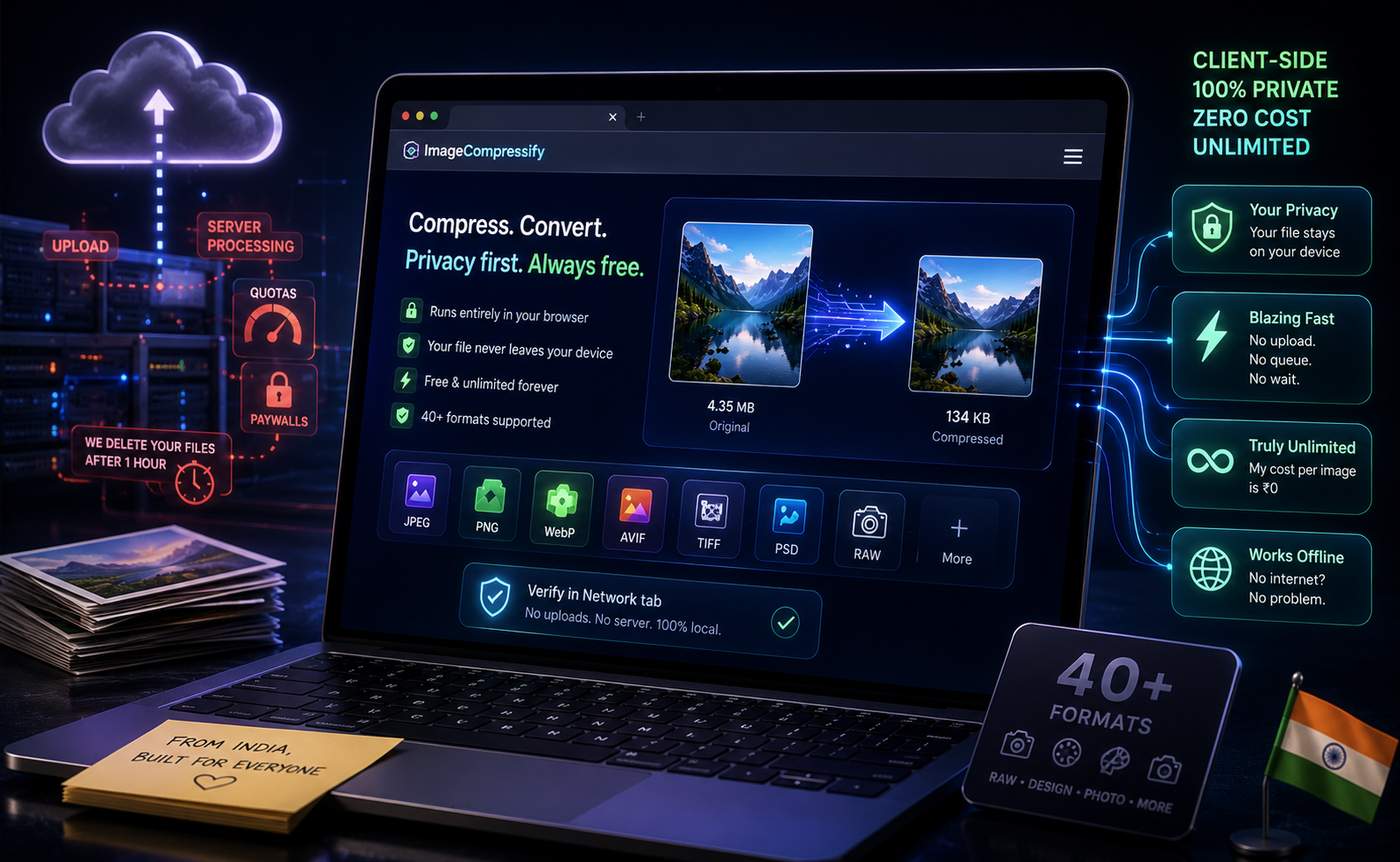
Most online image compressors share one architecture: you upload to their servers, their CPU does the work, and because that costs them money per file, you get quotas, paywalls, and "delete after 1 hour" privacy promises you have to take on faith.
I built ImageCompressify the other way: everything runs client-side in the browser. No upload, no server processing. The file never leaves your device — you can verify it in the Network tab. My marginal cost per image is zero, so "free and unlimited" is just how the architecture works, not a growth-stage subsidy waiting to expire.
The original itch: I'm from India, where millions of people compress photos for one reason — government forms and job portals with hard upload limits (2 MB, 100 KB, etc.). Watching people sit through ads or hit paywalls for something their own laptop can do in a second felt absurd.
Where it stands, honestly:
Product: live, 40+ formats including RAW camera files and design formats (the long tail of broken real-world files was 80% of the work — bit depths, color profiles, encoder quirks)
Traffic: tiny. I spent months on product and ~zero on distribution, which I now understand was the classic mistake
Revenue: ₹0 so far, by choice — see model below
The business model the architecture allows: the browser tool stays free and unlimited forever (it costs me nothing to honor that). Monetization comes from relevant affiliate placements, and later a server-side API for businesses that need automation and bulk processing — that runs on my servers, so metering it is honest. I'm deliberately not doing credits on the free tool; charging a meter on compute that happens on the user's device wouldn't survive five minutes of scrutiny from this crowd, and it shouldn't.
Question for IH community: for those who've grown free tools where the free tier is genuinely unlimited — what worked as the first repeatable acquisition channel? SEO compounds but is slow; I'm trying to figure out what fills the next 6 months while it does.
Happy to answer anything about client-side architecture or the wonderful hell of supporting 40 file formats.


The part that stood out to me isn't the compression itself, it's the alignment between the architecture and the pricing model.
A lot of "free" tools are free until usage grows enough that infrastructure costs force restrictions. If all the work happens in the browser, then unlimited usage is actually sustainable rather than a temporary acquisition strategy.
I'd be curious whether you've considered a browser extension as a distribution channel. For a tool that's entirely client-side, that seems like a pretty natural fit for users who repeatedly hit upload-size limits.
Love the local processing! And works too. One thing had me confused, I dropped an image and it looked like nothing happened. I was about to drop it again but only then noticed the processing queue had in fact filled. That could do with some visual confirmation, it doesn't stand out much.
This is really neat but also one of those tools I could use a lot, but never expect to pay. Simply because we're spoiled with great free tools in this space. Getting traffic and users? Yes, tough one. The local processing / privacy angle is your differentiator yet I don't see it prominently mentioned on the page itself. I'd consider going that route, pitch it in those industries where compliance, privacy and security matter more than in B2C.
Thanks for the valuable feedback — you flagged two real things and both are now shipped.
The silent-drop confusion: there's now a toast ("N images added to queue") plus the queue rows animate and highlight on drop, so it's obvious something happened. You caught a genuine gap — I'd stopped seeing it on my own product.
And you were right that the privacy angle was buried. It's now the headline of the page — "Compress & convert images — private, with nothing stored" — with trust badges (never uploaded, no limits, EXIF stripped) right under the tool, instead of being hidden in the body copy.
On your bigger point — pitching the privacy/compliance angle to industries where it matters more than B2C — that's exactly where I think the real opportunity is, and it's shaping how I'm thinking about a future API tier for businesses with sensitive assets. Appreciate you pushing on it.
This is the best kind of reply, you actually shipped it. Privacy as the headline plus the "never uploaded, EXIF stripped" badges is exactly right. I'd lean even harder into the regulated corners, legal, healthcare, HR, where "the file never leaves your device" isn't a nice-to-have but a compliance line. Great turnaround.
I'd be careful with one thing.
The challenge may not be distribution itself.
The harder decision could be whether the thing people find valuable about ImageCompressify is the same thing that eventually creates a business around it.
That sounds subtle, but it can quietly shape which growth signals deserve attention and which don't.