My Late-Night SaaS
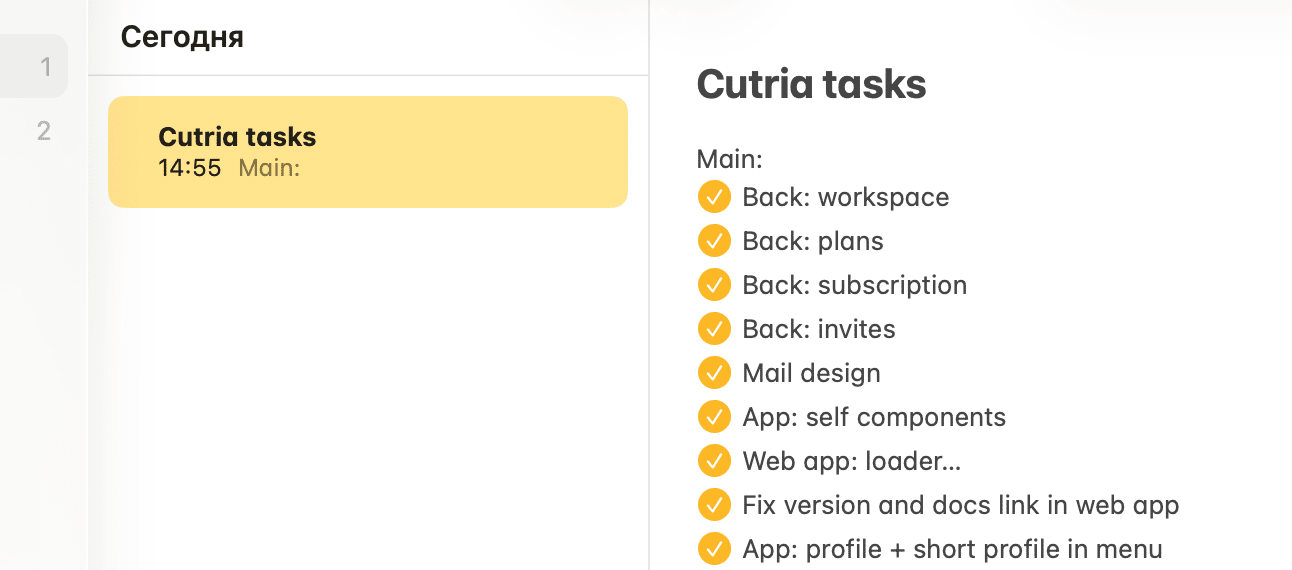
I started building my service on January 8, 2026. Right now, I have exactly 0 subscribers, a completely ruined work/life balance, and red eyes from coding on nights and weekends. But the paradox is that when you check another box on your humble to-do list, you get such a massive dopamine rush that the exhaustion just evaporates.
My goal is as down-to-earth as it gets: I want to get my first 300 paid users. This number will allow me to quit my day job, get my time back, and work full-time on what I love—my own project.
How was Cutria born in the first place?
It all started as a side product. A friend of mine asked me to help bring some order to the processes in his SMM agency. I built a system for him where he and his team handle all the planning, and as a result, the video editors get a fully written script with timelines instead of a messy pile of voice notes.
Implementing this thing saved every employee about 2 hours a day. When I got this feedback, something clicked in my head: "I could turn this into a Micro-SaaS." That's how Cutria came to be.
Who am I, and what's under the hood?
I'm a developer with 13+ years of experience. So I took the technical part seriously:
Backend: PHP (Laravel 12).
Front-end/Mobile: Flutter (the app is immediately available for all platforms).
Infrastructure: Everything runs on AWS (I rented an EC2 instance, S3 for media, CloudFront, and Route53 for the domain).
SaaS on "Hardcore Mode": Regional Specifics
I live in Kyrgyzstan. We have a lot of awesome and talented guys here, but building a global startup from here solo and without investments is like playing on hardcore mode.
Stripe is not available to us.
Local banks don't know how to handle proper international subscription-based acquiring.
Payouts from Google Play to developers from Kyrgyzstan are unavailable due to Google's own policies.
Because of this, I had to completely abandon In-App purchases inside the mobile apps.
The Release is a Pain (Why "an app in a month" is a myth)
If someone tells you they can code an app and publish it to the stores in a month—don't believe them. I've been in the launch process for 10 days now, and here is what it looks like:
Integrating Paddle (instead of Stripe) into the code — 2 days.
Waiting for Paddle account approval — 4 days.
Filling out all the forms, policies, and screenshots for the App Store and Google Play — 2 days.
Apple: Rejected the app twice, yelling: "You're a SaaS, add an in-app purchase button!" I had to fight them for a long time, proving that on iOS it's just a "Reader app" for viewing content. They let it through on the third try.
Google: Sent me to "closed testing," and now, according to the platform's rules, I am forced to wait 14 days before I can release.
Despite all this bureaucracy, the web version is already up and running, and the iOS app is already available in the App Store! Now I'm just waiting for the green light from the Play Market. This is my first step. Next up is marketing, which I currently know nothing about, but I will definitely figure it out.
I would love your feedback, marketing advice, and just general support! Project link: cutria.com


The part about having 0 subscribers but still getting excited every time you close a task hit home. Most people only see the success stories, not the months of building before the first paying customer shows up.
What I found especially interesting was that Cutria came from solving a real operational problem first. Saving a team 2 hours a day is a much stronger starting point than trying to invent a problem from scratch.
Also, the "hardcore mode" challenges are real. Founders in a lot of regions have to spend energy solving payment and platform issues that people in bigger startup hubs never even think about.
Since you're heading into the marketing phase, I'd focus less on ads and more on validating where your early users already spend time. This guide on GTM planning for startups has some practical ideas around that: https://foundersbar.com/gtm-for-startups
Wishing you luck on the journey to those first 300 customers. The first few are usually the hardest because you're still figuring out who gets the most value from the product.
Hey, saw you integrated Paddle — quick question: when a subscriber cancels, do you have any way to intercept it before it goes through? Pause offer, discount, anything?
Paddle sends me a webhook notifying the user that they've canceled their subscription, along with the date the subscription will become inactive. It then sends a second webhook notifying them that the subscription has ended. I email the client after the cancellation and after the subscription has expired.
Really relate to this — I'm at a similar stage with my own SaaS (started a couple months ago, also 0-to-1 mode). The payment gateway stuff sounds brutal, especially having to work around Stripe not being available.
On the marketing side since you mentioned knowing nothing about it: the thing that's helped me most so far is just picking 2 channels and going deep. For a tool like yours I'd look at where SMM agency owners hang out — maybe Twitter/X build-in-public and a couple relevant subreddits. Start by being helpful in those spaces before promoting. Also, Product Hunt is worth a launch once you've got your Google Play version live — having all three platforms ready makes a stronger pitch.
Good luck with the Play Store approval. The waiting is the worst part.
Thank you so much for your support. I wrote an article about marketing today. Now I know exactly where and how to find my first 100 clients.
laravel + flutter is a solid combo for a solo dev. really feel you on the stripe/payment gateway mess. being outside the 'supported' countries is basically playing on nightmare mode. i went through that paddle approval loop recently too - it's a grind but definitely beats dealing with local banks that don't understand saas subscriptions
The local bank wasn't a problem; I even spoke with the head of acquiring at one of the banks. She promised to provide me with any technical assistance. But an unexpected problem arose. American banks can block the transaction.