My SaaS Competes With $10M-Funded Tools. I Charge $25/mo and I'm Fine With That
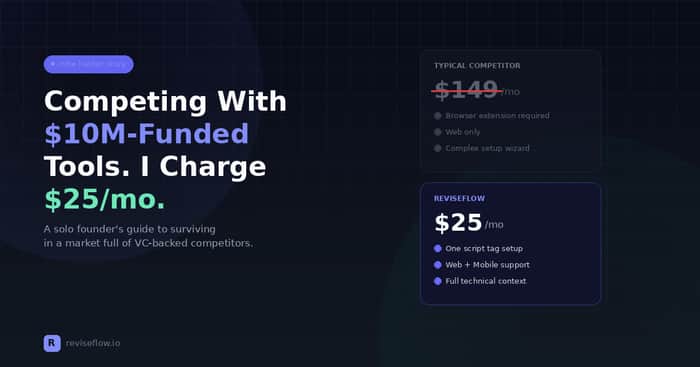
Hey everyone, Selim here. I posted here a while ago about building ReviseFlow, a visual feedback tool for websites and mobile apps. Today I want to talk about something a bit different. I want to talk about what it feels like to compete against companies that have raised more money than I'll probably make in my entire life.
Because that's my reality right now. I'm a solo founder charging $25/mo and my competitors have massive teams, VC funding, and marketing budgets that could buy a house in most countries. And honestly? I think I'm in a better position than them. Let me explain why.
The Market I Walked Into
When I started looking at the visual feedback space, I was kind of shocked at the prices. BugHerd charges $49 to $149 per month. Markerio is around $39 to $159. UserSnap goes even higher. These are established companies with big teams and enterprise sales processes.
My first reaction was "there's no way I can compete with this." They have more developers, more designers, more marketing people, more everything. But then I started actually using their products. And I noticed something interesting.
Most of them are bloated. They've been adding features for years to justify their enterprise pricing. Features that 80% of their users never touch. Complex dashboards, workflow builders, reporting suites, integrations with tools nobody uses anymore. And all of this complexity makes the setup process painful. Some of them literally require a browser extension just to work.
That's when I realized that being small is actually my advantage, not my weakness.
Why Being Solo Actually Helps
Here's something I think a lot of indie hackers don't appreciate enough. When you're one person building a product, you can be opinionated. You don't have a product manager telling you to add a feature because one enterprise client asked for it. You don't have investors pushing you toward "growth at all costs" which usually means making the product worse for everyone.
I decided early on that ReviseFlow would be stupidly simple to set up. For web, it's one script tag. Copy, paste, done. For React Native apps, you wrap your app with one component and give it a token. That's it. No browser extensions, no config files, no onboarding wizard with 12 steps.
Could I add more configuration options? Sure. Would some enterprise customers want that? Probably. But every option I add makes it harder for the other 95% of users who just want the thing to work. And I'd rather serve those 95% really well than chase the 5% who want something I'm not trying to be.
The Pricing Decision Everyone Questioned
When I told people I was going to charge $25/mo for Pro, almost everyone said I was making a mistake. "You're leaving money on the table." "You should charge at least $49." "Enterprise clients won't take you seriously at that price point."
And maybe they're right about some of that. But here's my thinking.
I'm not trying to sell to enterprises right now. I'm trying to sell to freelance developers, small agencies, indie makers. People like me. People who actually care about the price because it comes out of their own pocket or their small business budget. These people see $49/mo and they think twice. They see $25/mo and they think "okay that's worth trying."
My free tier also doesn't have a watermark. This was a very deliberate decision. When a freelancer puts a feedback widget on their client's site, they don't want "Powered by ReviseFlow" showing up. That looks unprofessional. Most competitors use the watermark as a forcing function to upgrade. I think that's a bad experience and it makes people resent your product instead of love it.
The Agency plan is $49.99/mo for 20 seats and 50 projects with white-labeling. That's basicaly what one seat costs on some competitor platforms. I know agencies are price-sensitive because I used to work at one. This pricing makes ReviseFlow an easy yes in a budget meeting.
The Technical Moat Nobody Notices
People often ask me "what stops BugHerd from just copying what you do?" And the honest answer is nothing. They absolutly could. But I think they won't, and here's why.
ReviseFlow supports both web and mobile apps. This sounds simple but it's actually a significant technical challenge. The web widget uses html2canvas-pro to capture screenshots and works in a sandboxed iframe. The React Native SDK uses completely different technology, react-native-view-shot for captures and react-native-svg with PanResponder for annotation drawings.
But here's the key part. Both platforms share the same backend, the same dashboard, the same feedback model. A project manager can see web bugs and mobile bugs in the same board. This required careful API design from the beginning. The widget endpoints accept a platform field and the entire presigned upload and feedback submission flow works identically regardless of platform.
For a funded competitor to add this, they'd need to refactor their entire architecture. Their codebase is probably deeply coupled to web-only assumptions after years of development. Starting with both platforms from day one is an advantage that's really hard to retrofit.
I also built the auto-context capture to be much more detailed than what I've seen elsewhere. When someone submits feedback through ReviseFlow, it automatically captures console errors, network failures with status codes and timing data, viewport dimensions, pixel ratio, zoom level, browser version, OS details, and the CSS selector path of where they clicked. All without the user doing anything. This means the developer receiving the feedback almost never needs to ask follow-up questions.
Things That Keep Me Up at Night
I'm not going to pretend everything is perfect. There are real disadvantages to being a solo founder competing in this space.
Marketing reach is the biggest one. I can't run $50k/month ad campaigns. I can't sponsor every developer podcast. I can't have a booth at every conference. My competitors can and do all of these things. So I rely heavily on content marketing and word of mouth, which are slower.
I also worry about the "nobody got fired for buying IBM" effect. When a team lead at a mid-size company needs a feedback tool, they're more likely to pick the established brand even if it costs more. Because if something goes wrong, they can point to the fact that they chose the market leader. Picking the small indie tool is a career risk, even if the product is better.
And there's the support question. Right now I handle all support myself. This is fine at my current scale but it won't scale forever. At some point I'll need to either hire someone or be very strategic about what kind of customers I pursue.
My Unfair Advantages
But I also have things that funded competitors simply can't replicate.
My cost structure is incredibly lean. No office, no team salaries, no investor expectations for 10x growth. This means I can be profitable at a level that would be considered a failure for a VC-backed company. I don't need 10,000 customers to survive. I need a few hundred who love the product enough to pay $25 or $50 a month.
I can ship fast because there's no approval process. When a user reports a bug or requests a feature, I can often fix or build it the same day. Try doing that at a company with 50 employees and a two-week sprint cycle.
I also genuinly care about every single user. This isn't just marketing speak. When you have 50 customers, each one matters enormously. I know their use cases, their pain points, their team structure. This level of attention creates loyalty that no amount of marketing spend can buy.
What I'd Tell Other Indie Hackers
If you're building something that competes with well-funded companies, here's what I've learned so far.
Don't try to match their feature list. You will lose that game every time. Instead, pick one or two things and do them significantly better. For me it's simplicity of setup and multi-platform support.
Price for your actual customer, not for who you wish your customer was. If you're targeting indie developers and small agencies, price accordingly. You can always increase prices later as you move upmarket.
Use your speed as a weapon. The fact that you can go from idea to shipped feature in one day is an insane advantage. Most funded companies take weeks for the same thing. Your customers will notice and appreciate this.
And finally, don't be intimidated by the funding numbers. Most of that money goes to things that don't make the product better. Office rent, management layers, investor reporting, HR departments. Your competitor might have $10M in the bank but only a fraction of that actually touches the product you're competing against.
Give It a Try
If this resonates with you, check out ReviseFlow at reviseflow.io. Free tier, no watermark, no credit card. One script tag and you're collecting visual feedback with full technical context.
I'd also love to hear from others in similar situations. Are you competing against funded players in your space? How's it going? What's working for you? Drop a comment, I read all of them.
See you around.
