My Strategies to Finding Underserved, Low-Competition Keywords on Google
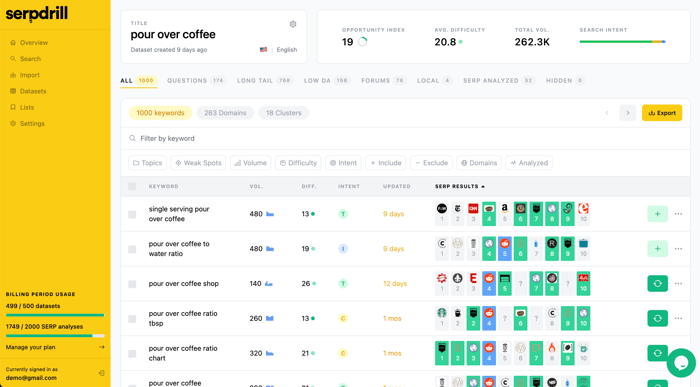
Hey Indie Hackers! I've been working in SEO for over a decade now and since I began my journey, a lot has changed—but also a lot hasn't. The formula still remains the same to rank fast on Google: Create great content for underserved keywords.
Before I start: Full disclosure, I built Serpdrill, the tool mentioned in this post. If you'd like to try it out using the strategies I've laid out below, I'm happy to walk through it with you. Just ping me kyle@serpdrill[dot]com.
So today I want to talk about a few ways I think about finding low-competition keywords that your website can get ranked on the first page of Google.
1. Study the SERPs
If you're not looking at search engine result pages (SERPs) before you write for keywords, you're starting off on the wrong foot. The best way to know what works in Google is to, well, visit Google of course.
Once you visit a SERP, you should initially be looking for a few things:
- Are the search results highly relevant to the query?
- Is the content in the results well-structured and well-written?
If the answer is no to either of these, you can probably create better content and have a chance at outranking.
Unfortunately, though, most keywords that you'll come across nail both of these. So how can we analyze the SERPs even further?
Here's a great checklist:
- Are there any search results with low domain authority (DA under 25)?
- Are there any search results that have a low word count (under 750 words)?
- Are there any search results that are actually PDF or other file extensions?
- Are there any search results that are from forums like Quora or Reddit? (This might be changing now that the Helpful Content update is out so keep an eye on this)
If the answer is yes to any of these, you've found what I call a "weak spot" in the SERP. If there are multiple, even better, you've got a higher chance of ranking well, quickly.
Of course you can do this manually, but you can also use Serpdrill to automate this across hundreds to thousands of keywords in a single search or keyword import. To try this out, just head to serpdrill.com, create an account for free (no credit card required) and search using a seed keyword. Soon you'll see a new list of up to 500 long tail keywords to further analyze using the checklist above.
2. Take a Weak Competitor and Outrank Them
Another easy way to find low-competition keywords is to find a competitor with a domain authority under 25, and extract all the keywords that they rank for. You can use multiple SEO tools for this, but since Serpdrill also analyzes the SERPs for you, it's a lot easier to use to see the full picture.
Once you've extracted all the keywords that this competitor ranks for, we can identify a list of keywords to target that likely won't take a ton of effort since your "weak" competitor is already ranking for them.
I've used this method to extract thousands of keywords over the years and outrank/compete on the same SERPs as competitors.
3. Go for Zero Volume Keywords
So you go into your favorite keyword tool and see a keyword you want to target has zero monthly search volume, no problem! Often times SEOs will write of zero volume keywords because why would you want to waste effort there?
Well, they're not truly zero volume keywords. They just don't have enough consistent traffic to garner a monthly volume in most keyword tools.
So still, why should you target them? Here's why:
- Zero volume keywords are usually long tail and high intent so users coming through these tend to have higher conversion rates.
- Ranking for zero volume keywords is a great way to collect keywords that will help boost your site's topical authority when you begin to target larger keywords.
- Big SEOs aren't targeting these keywords so there is little competition to outrank you.
In Serpdrill, you can search specifically for these keywords by choosing the "Advanced" button next to search and setting your max volume to 0.
Conclusion
Hopefully that gives you a good start to finding some keywords that you can rank for relatively quickly. Let me know if you have any questions and I'd be happy to help.
Also, you get 5 free credits to toy around with Serpdrill so you might as well take advantage of it. But, if you're not feeling up for it, I also have a free tool that will extract thousands of keywords from Google Search suggestions and organize them for you here. No signup required there.
