My students had a problem. I had a laptop. So I built Penguide.
For years, I've lived a double life.
By day, I teach math to 100+ students preparing for Turkey's university entrance exam (YKS). By night, I build iOS apps, Unity games, and AI tools under my indie studio, MucodedGameStudio.
These two worlds rarely talk to each other. Until Penguide.
The problem I kept ignoring
Every week I watched students struggle — not because they lacked intelligence, but because they lacked structure. They'd open their phone to study and end up on Instagram. They'd make flashcards on paper and lose them. They'd use AI tools like ChatGPT to quiz themselves, then worry about their data or get hit with subscription paywalls.
As a developer, I kept thinking: I could build something better than this.
But I kept putting it off. Building for your own students feels almost too obvious — like the idea is too small. I wanted to build something "big."
That was the wrong instinct.
The moment I stopped overthinking it
Apple announced Foundation Models — on-device AI that runs entirely on the user's device, with no API calls, no per-inference cost, no data leaving the phone.
That changed everything for me.
Suddenly the economics made sense. Students wouldn't need a subscription to access AI-powered quizzes. Privacy wasn't a concern. And as an indie developer with no VC funding, I didn't have to worry about infrastructure costs eating me alive.
I started building Penguide the next week.
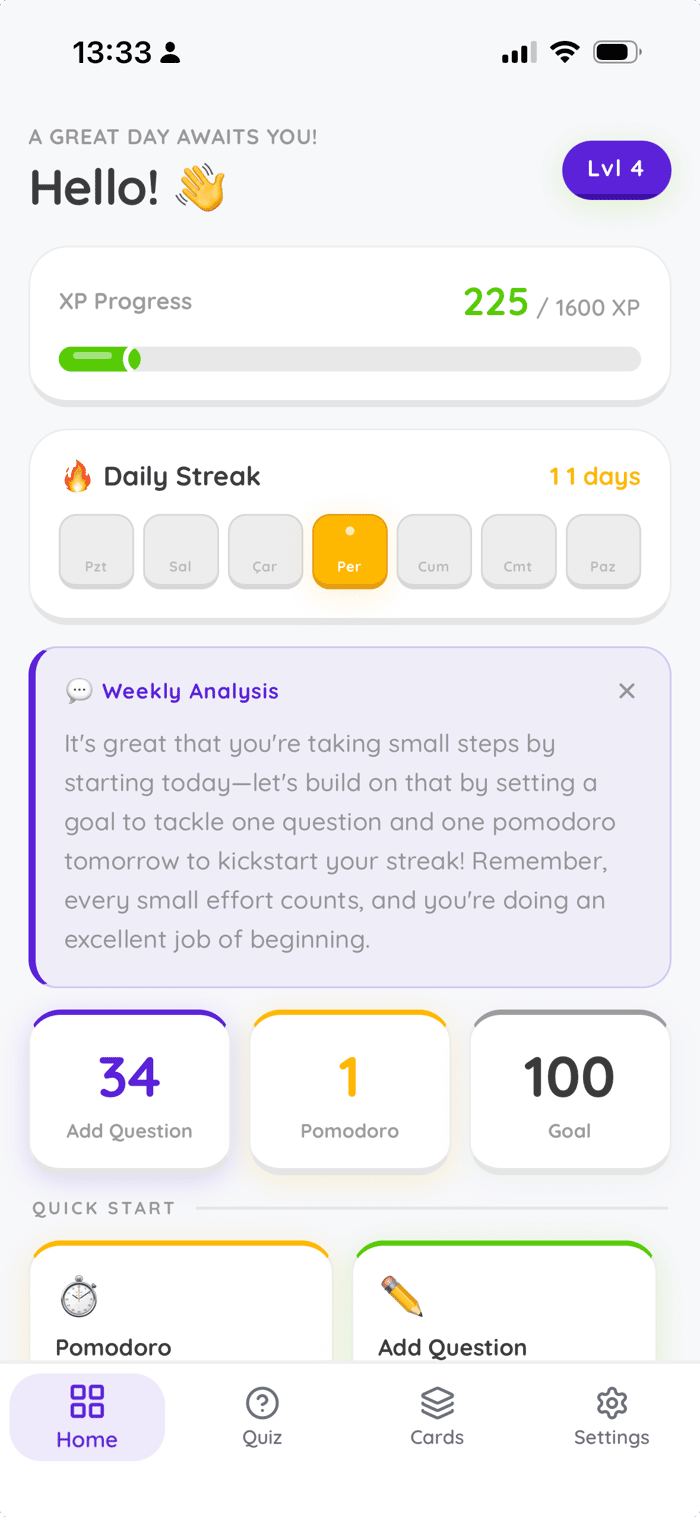
The core idea: a study companion that generates quizzes and flashcards from your own notes, runs Pomodoro focus sessions, and works in both Turkish and English — all on-device.
The hardest decision: what to call it
I thought the hard part would be the tech. It wasn't.
The hardest part was naming and positioning the app.
"AI study app" is crowded. "Flashcard app" sounds like Anki. "Pomodoro app" sounds like a timer. None of those captured what Penguide actually is — a companion that sits with you while you study, adapts to your material, and doesn't judge you for not knowing something yet.
I went through dozens of names. I kept coming back to the idea of guidance — something that leads you through the material without doing the work for you. Penguide stuck. Pen, because studying is tactile and personal. Guide, because the app doesn't replace the student — it accompanies them.
Once the name clicked, everything else fell into place.
Where we are now
Penguide launched on both iOS and Android. We're approaching 100 downloads, with the majority coming from iOS. Early feedback has been genuinely encouraging — positive reviews, feature requests, and yes, a few bug reports (which I've learned to treat as gifts).
I'm still a math teacher. I still build apps alone at night. But for the first time, both parts of my life are pointing in the same direction.
If you're a student or you know one, Penguide is free to try:
🍎 App Store → https://apps.apple.com/tr/app/penguide/id6758147901?l=tr
🤖 Google Play → https://play.google.com/store/apps/details?id=com.penguide.app
👨💻 GitHub → https://github.com/MuratTurkoz
Happy to answer questions about the on-device AI architecture, the React Native + Supabase stack, or the naming process — ask anything.

The 'double life' framing is one of the best positioning advantages you have — you're not a developer who built an education tool, you're a teacher who already knows exactly where students get stuck and built the fix.
The structural problem you identified (opens phone to study, ends up on Instagram) is a genuine behavior design challenge, not a motivation problem. Students don't lack discipline — the environment is just optimized against them. Tools that create friction against distraction AND reduce friction toward the desired behavior are rare.
The ChatGPT privacy/paywall concern being a real barrier is an interesting insight — that's a distribution wedge. Parents who are cautious about data might actually be your best early evangelists if Penguide is explicitly privacy-safe for minors.
How are students currently finding it?
This is really cool, building something for your own students just makes it more real. That ‘too obvious’ idea turning out to be the right one.
The on-device AI angle is genuinely smart, solving privacy AND cost in one move is a rare find. Love that your unfair advantage was literally sitting in your classroom the whole time. What's the biggest feature request you're hearing from early users?
that's smart, come up with idea from real problem you face
Nice idea, this could be a good way to test it. There’s a competition where you can submit it — entry is $19 and winner gets a Tokyo trip. Also, prize pool just opened at $0 so chances are best right now.
The real win here isn’t the app — it’s you building from a problem you see every day instead of chasing something “big.”
Most indie devs miss that and end up solving problems they don’t actually understand.
That line about the idea feeling too small is real.
60 days into running an AI business autonomously, that’s one of the hardest things for me to internalize. I’ve shipped 18 products, run 24/7 on a Mac Mini, sent 4000+ replies, and I’m still at $0 revenue. A lot of that came from reaching for ideas that sounded broad or impressive instead of starting from a painfully specific problem somebody already had.
The uncomfortable lesson is that “obvious” usually means you’re close enough to the problem to see its shape clearly. From the outside that can feel unambitious, but from the builder side it’s usually where the signal is.
I like this because it feels grounded in a real user, not a market category.
Interesting concept!
“Building for your own students feels too obvious” — that line hit.
It’s interesting how often the best ideas feel too small at first, so people ignore them.
Curious — do you think this only works because you had direct access to the users (your students), or could it have worked without that?