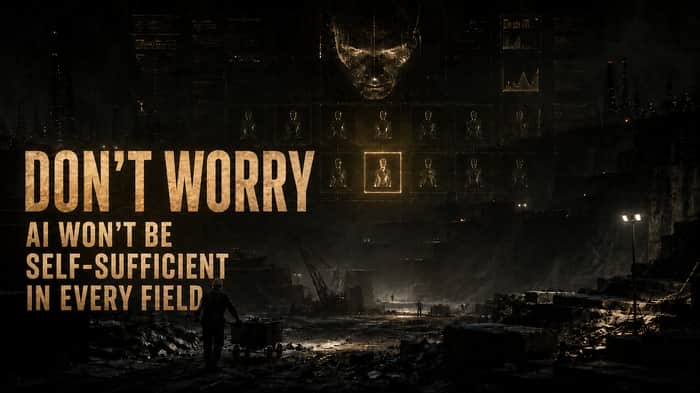
My thesis: AI will not replace every worker. It will create a new work layer around people who can be used by agents.
Most discussions about AI are too emotional.
One side says AI will replace everyone.
The other side says humans will always be irreplaceable.
I think both views miss the more important market shift.
AI does not need to become self-sufficient in every field to change the structure of work. It only needs to become good enough to coordinate, filter, compare, assign and evaluate tasks.
That is the real change.
A company may not need to directly search for a freelancer, write a long brief, compare five portfolios and manage every small step. Its AI agent may do most of that work.
It may search for a person or service, understand the offer, send a task, define the expected output, check the result and trigger payment.
In that world, humans do not disappear.
They become part of a new execution layer.
This is not about promoting a future where people “work for AI” in some dramatic sci-fi sense. It is about understanding how markets usually evolve.
First, humans use tools.
Then tools become platforms.
Then platforms become coordinators.
And once coordination changes, the labor market changes with it.
Freelancing became normal when platforms made it easier to find, compare, hire and pay people online.
The next version may be more machine-readable.
Not just profiles and portfolios.
Structured offers. Clear outputs. Fixed prices. Reputation signals. API access. Delivery formats that agents can understand. Services designed to be discovered and evaluated without a long human conversation.
That is the part most people are not watching closely enough.
AI may not replace every specialist.
But it may change who finds the specialist, who defines the task, who evaluates the result and who controls the flow of work.
That is a much deeper shift than “AI writes content” or “AI builds apps.”
The real market question is not whether AI can do everything alone.
It probably cannot.
The question is whether AI agents will become the new layer between companies and human execution.
If that happens, the winners will not only be the best workers.
They will be the workers, services and businesses that are easiest for AI systems to understand, trust, price and use.
The next labor market may not be built only around humans hiring humans.
It may be built around agents coordinating human capability.
