My wife got paywalled on 5 resume builders in a row, so I built one with a ₹25 one-time unlock
Last month, my wife was applying for a new job.
She needed a resume. Opened Google, typed "resume builder," started trying them one by one.
Same pattern every time. "Free to start!" → pick a template → fill in every section → and right at the
download button: "Sign up and pay ₹150 to unlock."
She tried another. Same trap. Then another.
Finally she came to me frustrated: "All of them waste your time and then ask for money at the end."
I'd been feeling the same rage for months — resume builders have perfected the bait-and-switch playbook.
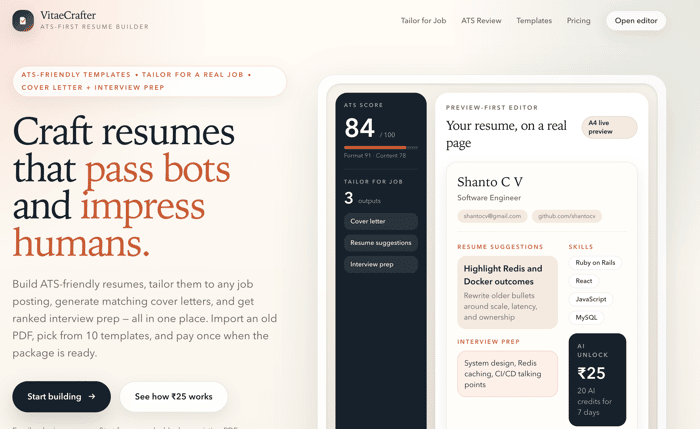
That conversation pushed me over the edge, so I built VitaeCrafter.
The model:
- Sign in with email OTP (no password)
- Build your resume for free — 10 ATS-friendly templates, live preview, AI resume tailoring to any job
posting, AI cover letter generation, AI interview prep - Pay ₹25 (~$0.30) once to unlock PDF downloads for 7 days
- During those 7 days: unlimited downloads, unlimited edits, unlimited template switches
- After 7 days:
- Editor never locks — you can edit your resume forever
- You can re-download the last version you exported during the paid window
- To download a newly edited version, pay ₹25 again for another 7 days
- After your first payment, you get a permanent public resume URL at
your-username.vitaecrafter.com— free forever
Why ₹25 and not free?
I genuinely wanted to make it free. But servers, AI API calls (OpenAI, Anthropic, Gemini), SES email, and
Razorpay fees all cost real money every day. ₹25 is the absolute minimum I could charge without losing money
per user. I'll keep it there as long as I possibly can.
Stack: Next.js 15 on Cloudflare Workers (fast globally for resume previews), Phoenix/Elixir backend on
Hetzner, PostgreSQL, AWS SES for OTP email, Razorpay for payments, three LLM providers for the AI features.
Questions I'd love IH feedback on:
- Is ₹25 too low? IH is global — should I price in USD at ~$1 instead? I'm worried about leaving money on
the table from users outside India. - Is the "edit forever, re-pay to download" friction too annoying? I intended it as "pay when you actually need a fresh export" — not as a recurring lockout trick.
- Would you pay ₹25 every time you update your resume for a new job application? Or would you prefer a
30-day / 90-day / lifetime tier instead? - The 3-LLM setup is expensive. Any founder here who's simplified to one provider after launch? Did quality
drop?
Day 1 of being public. Would love honest teardowns — especially on the pricing model and whether the 7-day window is friction or freedom.

I've built something adjacent — an AI tool that
tailors resumes to specific job descriptions — so
this pricing model question is one I've been
wrestling with too, just from the free side of
the spectrum.
On your actual questions:
Is ₹25 too low? I don't think it's about low vs
high in absolute terms — it's about what the price
signals. ₹25 for a one-time unlock reads as "trivial
friction removal," almost like a tip, which might
actually work against you psychologically. People
associate near-free pricing with lower perceived
value, even when the underlying tool is genuinely
good. I'd test $1-2 USD for international users
specifically, since that price point still feels
like "barely anything" to that audience while
signaling slightly more seriousness.
On the re-pay-to-download friction: I think your
instinct that it's "pay when you actually need a
fresh export" is right in theory, but the actual
user psychology at the moment of re-editing is
different — they already paid once, they feel
ownership over their resume, and hitting a second
paywall for an edit (even ₹25) can feel like the
exact bait-and-switch pattern you built this to
avoid. I'd test a 30-day window instead of 7 — it
removes that repeat-friction feeling while still
monetizing genuine reuse.
On the LLM provider question — I only use one
(Claude) for my tool, and honestly the simplicity
has been worth more than any marginal quality gain
from multi-provider routing, at least at this
stage. Unless you're seeing measurably different
output quality per provider for specific resume
sections, I'd guess the 3-LLM complexity is costing
you more in maintenance than it's earning in
quality.
Genuinely curious to see how the pricing test goes —
this exact question (free vs. tiny-paywall vs.
subscription) is one I haven't resolved for my own
tool either.
I know a few fellow indie hackers who might be willing to answer your questions about pricing strategies and LLM cost optimization for free. Happy to forward them your questions if you'd like.