Navaitools: Your Go-To AI Tool Directory for Productivity & Innovation
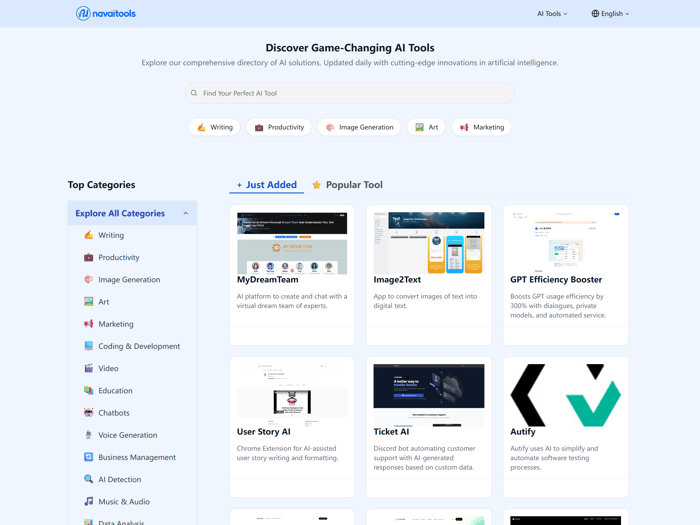
In the fast-paced AI era, finding the right AI tools amid countless options is overwhelming. That’s the spark behind Navaitools — a curated, real-time updated directory designed to connect users with top-tier AI solutions effortlessly.
Developed with a user-centric approach, the team conducted extensive research to identify pain points across professionals, creators, and businesses. It categorizes 1500+ AI tools into 20+ core areas (writing, image generation, coding, customer support, etc.) and updates daily to include cutting-edge innovations. Rigorous screening via user reviews and ratings ensures only high-value tools make the cut, paired with intuitive navigation for quick searches.
Navaitools’ core purpose is to bridge AI tools and users. It empowers individuals and teams to find tailored solutions — from AI writing assistants for freelancers to automated support bots for small businesses, and data analysis tools for marketers.
The platform drives tangible value: small businesses cut response times by 75% with AI customer service tools; freelancers boost productivity to take on more clients; teams halve content creation time with social media tools. It simplifies AI adoption, letting users focus on growth, creativity, and efficiency.
Navaitools is more than a directory — it’s your shortcut to AI-powered success. Discover the best AI tools to streamline workflows and stay competitive today.

This is really useful — with the pace AI tools are coming out, it is overwhelming to find the right ones for your workflow, especially when you're juggling productivity, marketing, coding, and ops needs all at once. A curated directory with categories and real updates can save so much time instead of scrolling through lists or search results.
A pattern I’ve noticed with tool directories that founders actually use is when they link tool suggestions to clear use cases (e.g., “generate social captions” vs “help refine UX copy”). That makes it less about browsing and more about problem → tool matched.
Curious — as you add more tools, are you thinking about a problem-first filter (e.g., “for founders,” “for customer support,” “for dev workflows”), or sticking primarily with category lists? That choice often shapes how adoptable a directory feels early on.