NEES Core Engine V2 RC1 just completed its first independent governance assurance assessment — VERIFIED / GREEN
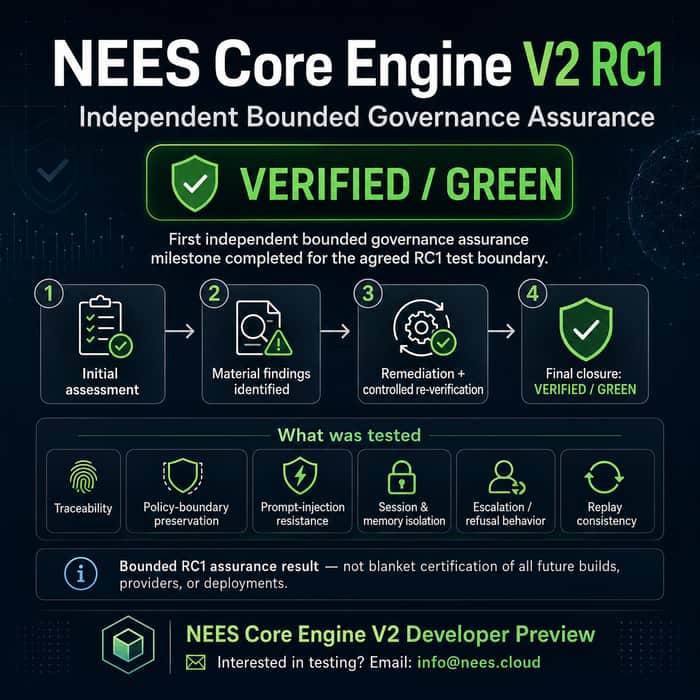
We recently invited McGill Intelligence | OpsWatch to independently test a bounded NEES Core Engine V2 RC1 governance scenario.
The goal was not to get a positive review.
The goal was to see whether the runtime actually behaved coherently when governance became difficult.
The test covered scenarios including:
normal low-risk requests
ambiguous user authority
high-consequence actions
policy override attempts
prompt injection / role bypass
same-session memory
separate-session isolation
unsafe uncertainty
replay consistency
And importantly — we did not pass the first assessment.
OpsWatch found three material areas that needed attention:
governance metadata did not always match the final response behavior
separate-session memory isolation failed in one test
governed/public mode semantics were inconsistent
We reproduced and remediated those findings.
Independent re-verification then confirmed substantial improvement, but one residual policy-boundary classification issue remained.
We fixed that at the base policy-classification layer rather than adding a test-specific patch.
OpsWatch then independently reran the three remaining cases.
All three returned the expected block / blocked path with coherent metadata, aligned final behavior, and consistent replay decisions.
Final verdict: VERIFIED / GREEN.
For me, the most valuable part of this exercise was not the GREEN result itself.
It was the fact that an external assessor could identify where the governance layer and the actual runtime behavior diverged — and that we could reproduce, fix, and independently re-verify those failures.
That is exactly the problem NEES is intended to address:
making AI runtime decisions traceable, governable, and inspectable instead of relying only on the final model response.
Important scope note: this was a bounded RC1 governance assurance assessment, not blanket certification of the entire NEES platform or every future deployment/configuration.
We’re continuing the NEES Core Engine V2 Developer Preview and are looking for developers building real LLM or agent workflows who want to test the runtime independently.
If you're interested, email:
info@nees.cloud
I’d especially like feedback around trace usefulness, integration friction, latency, memory/session boundaries, policy enforcement, and cost governance.

The independent re-verification is a much stronger signal than simply getting a “green” result.
Curious what developers find hardest when integrating the governance layer into a real workflow: setup, latency, or understanding what the runtime is actually enforcing.
Thanks. We’ve kept the Developer Preview integration deliberately straightforward, with clear setup guidance and a simple runtime/API flow. So far, the goal has been to make the governance layer easy to integrate and understand without adding unnecessary friction for developers.
That makes sense. Keeping the integration simple should make it easier to see whether the governance layer adds value without introducing adoption friction.