Newest innovations of the week
Aptera

Aptera Motors has announced plans to start production of its Launch Edition EV, which is equipped with around 700 watts of proprietary solar technology. The EV can power up to 40 miles per day with solar energy and features solar cells on the roof and all upward-facing surfaces, such as the interior dash. The company aims to start production in 2023, and plans to have seven assembly plants operational by 2028. Currently, Aptera has over 40,000 reservations for the Launch Edition.
Clearspace

This company aims to remove trash from space. Cleaning up space debris refers to the process of removing man-made objects in Earth's orbit that no longer serve a useful purpose. These objects often referred to as "space junk," can include defunct satellites, rocket stages, and other debris that can pose a big risk of collision with active satellites and spacecraft. There are various methods being proposed and tested for cleaning up space debris, such as using nets or harpoons to capture debris, using lasers to push debris out of orbit, and using spacecraft equipped with propulsion systems to deorbit debris.
Scythe Robotics

This Colorado-based company develops autonomous lawnmowers for the professional landscape industry. They already received 7000 reservations for their all-electric, fully autonomous mower. Their latest generation model can mow all day on a single charge and features sensors that enable it to operate safely in dynamic environments, capturing property and mower performance data to help landscapers improve workflow and manage labor costs.
https://www.scytherobotics.com/
Lund University
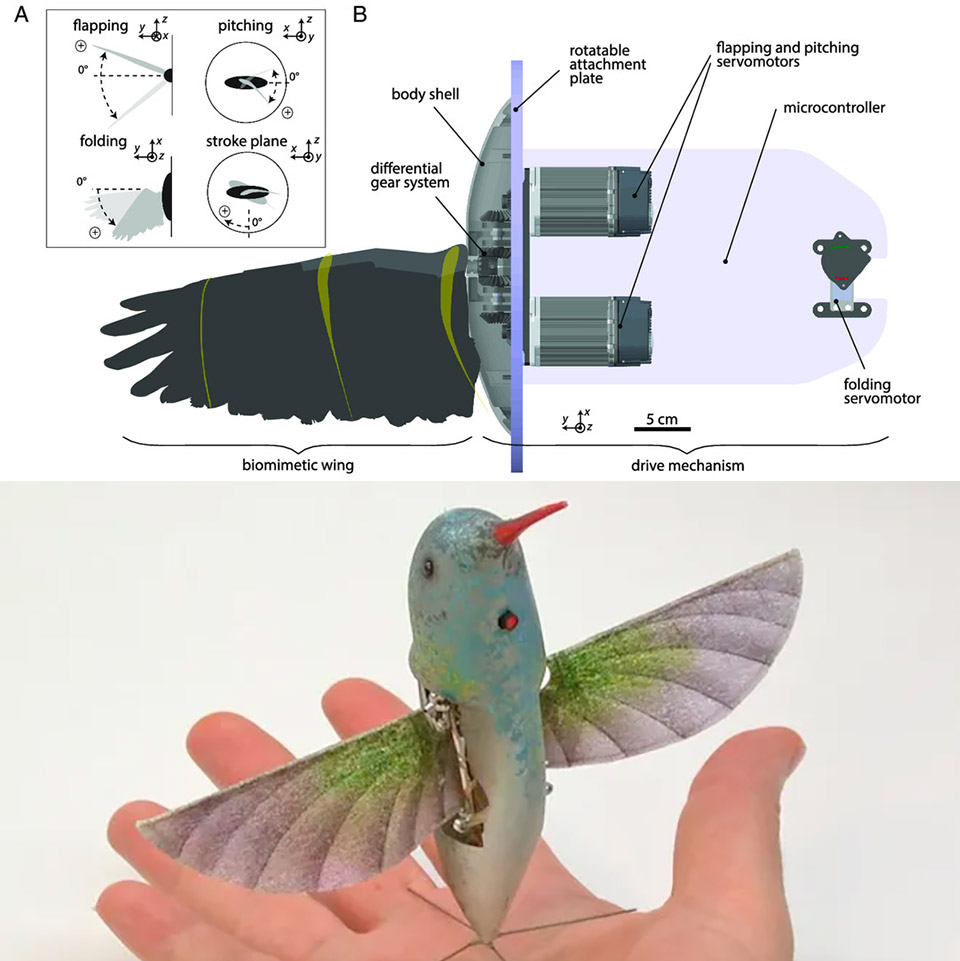
Flapping drone inspired by birds. A recent study found that birds fly more efficiently by folding their wings during the upstroke, which could mean wing-folding is the next step in increasing the propulsive and aerodynamic efficiency of drones. They used a robotic wing that can flap like a bird, and beyond, to determine which flapping strategy is best. It found that birds flap their wings more horizontally when flying slowly, which requires more energy but is easier to create a sufficiently large force to stay aloft and propel themselves. The results of the study could help create a new kind of drone that is more efficient for delivering goods or transporting people.
