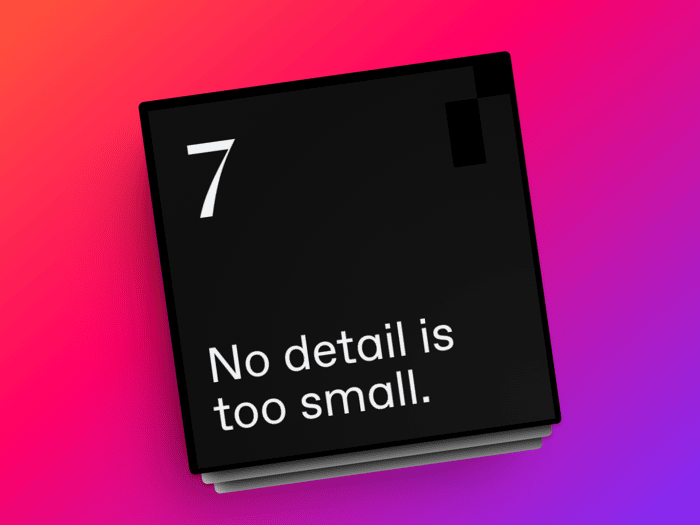
No detail is too small
Beautifully crafted products are not something we see too often from solo founders.
Products often feel rough around the edges.
The goal for many is to validate and make money as fast as possible.
If you're not embarrassed by your first launch then you've launched too late.
And it's not just solopreneurs. But huge startups too.
But it doesn't have to be this way.
You may be struggling to stand out.
And one way to do this to create a truly beautiful experience. A product where you sweat every last detail.
The most famous example of this is Apple. The details really matter to them, unlike its competitors. Steve Jobs would fixate on the tiniest details in search of perfection. And this obsession has permeated Apple's culture until today. They still create world-class products because they sweat every last detail.
Another example is Resend that published an article about their philosophy today: https://resend.com/philosophy. The final item in their list is "No detail is too small", which is what prompted this article.
Resend is competing in a bloated market - sending transactional and marketing emails. As if we needed another one of those?
But they're growing very well and attracting a lot of developers. Myself included.
The product has micro-animations when hovering on sidebar links. Or when you right-click their logo in the nav bar you get linked to their branding assets. Things few will consciously notice or even touch upon. Subtleties that seem minor and don't add clear, immediate value. But when you put it all together you see a masterpiece in front of you.
Cal is another company that's succeeded by paying attention to details by creating their gorgeous Cal Sans font. Although they've also been pragmatic by releasing only one font weight.
But it's not just $3t companies that can do this. Or VC backed companies like Resend or Cal.
High quality solopreneur products that come to mind include Super, Dub, and even Senja.
These are small teams that didn't/don't have funding, and believe in a product led growth strategy.
Dub is a recent masterclass. They're about to be Product of the Month on Product Hunt. Steven, the founder, has put in the time to build up a phenomenal Twitter profile, but a big part of Dub's success is that every part of the product is clean and polished.
You can create a new short link on Dub by tapping the C on your keyboard. Or the beautifully crafted images he used for their Product Hunt launch. He could have gotten away with a lot less.
And although Dub has some funding today, the product was initially completely bootstrapped. It saw this early success due to a variety of factors and hard work. But one thing that has always stuck out to me has been the cleanness of the product.
The same goes with Super.so. Jason, the founder, is someone I've worked closely with for many years. It was always obvious he had a keen eye for design. Producing elements of delight were important in any product he created. And Super has gone on to be a huge success. He sweats the details in design and performance - another part of Resend's philosophy.
Now having said all this - you can do very well with a rough around the edges product too. There are many enormous companies with clunky products.
Working on logo animations is a huge waste of time when you have zero product market fit.
Trying to perfect things that users don't care about is often a form of procrastination that's holding you back from succeeding.
But one great way to stand out is to really care about the details. If you're going after a proven market that you know has customers - if you can create a product that is truly delightful - you can beat the competition.
Caring about the details builds trust in your product. If you care about the front facing details, you likely care about the details behind the scenes too to make sure the product is working as smoothly as possible for customers. Users feel that, and are drawn to high quality products.
What do you think? When does it make sense to care about the details, and when is it a huge waste of time?
