Nobody wants to hear "no." I built a business on saying it anyway.
Every growth playbook says the same thing:
Make your user feel good. Reduce friction. Get them to the "aha moment" fast. Celebrate wins. Never let them leave feeling bad.
I did the opposite. And I think it's the smartest thing I've done.
Here's the problem with the personal finance internet:
It's allergic to bad news.
Budgeting apps celebrate when you track a purchase. Mortgage calculators highlight what you can afford, not what will quietly ruin you. "Affordability" tools are built by companies whose revenue depends on you buying the thing. Of course they're optimistic.
The entire industry is financially incentivised to tell you yes.
So when someone types "can I afford to move out" into Google at midnight — stressed, hopeful, a little scared — every result is quietly rooting for them to say yes. Because yes moves product.
I built caniafford.online to be the one thing that doesn't need you to say yes.
4 calculators. Move out. Buy a house. Buy a car. Afford a wedding.
Free. No email. No upsell. No referral fee hiding inside the results.
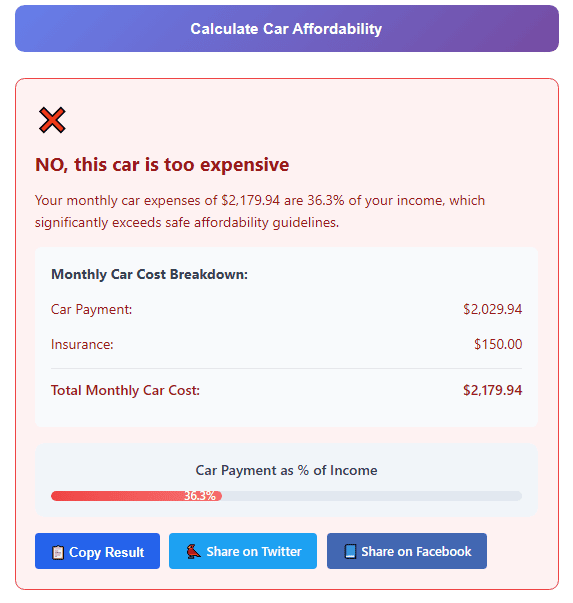
When the numbers don't work, it tells you. Clearly. Without softening it into "you're almost there!"
The reaction I optimised for isn't excitement. It's that 3-second silence when someone realises they were about to make a $30,000 mistake.
Here's the counterintuitive part
Telling people "no" is, I think, the most powerful acquisition strategy I could have chosen.
Because the internet has infinite tools happy to tell you yes. There is almost nothing out there willing to be the honest friend who sits across from you and says "bro, the numbers don't work."
That gap is the product.
When you're the only one telling the truth in a room full of people telling people what they want to hear — you become the one they trust. And trust, in personal finance, is the only currency that actually compounds.
The question I can't answer yet
Affiliate revenue in personal finance assumes users move forward. Banks pay for mortgage leads. Car insurers pay for buyers. Wedding platforms pay for engaged couples.
My tool might be sending 60% of users home to save for another year.
So I'm sitting with this: is "no" a monetization problem, or is a loyal audience of people who trust you completely the most valuable thing you can build?
I don't know yet. But I'd rather build the trusted thing and figure out monetization than build the conversion-optimised thing and wonder why nobody comes back.
If you've been here — built something honest in a space full of grift — I want to know how it went.

The incentive alignment point is the sharpest thing in this post.
Most tools are built on top of a transaction they want to happen. Yours isn't. That structural difference is almost impossible to copy once people understand it — because copying it would require the copier to give up their own revenue model.
The monetization question is real, but I'd flip it: the people who got an honest "no" and came back six months later when the numbers worked are probably your highest-trust users. They already know you won't lie to them. That's a much warmer starting point than someone who found you through an affiliate link.
I've been thinking about something similar with the tools I build — single-file HTML tools, no accounts, no subscriptions. The "no tricks" positioning is part of the product. Hard to charge recurring revenue for something honest, but the trust accumulates differently.
You are treating 'no' as a lost transaction, but trust monetizes over time, not at the moment you say it. The person you turn away today comes back in 14 months when the numbers finally work, and by then you are the only tool they trust to tell them yes. So monetize the journey to yes (save their plan, show them the month they cross the line, refer the savings and credit products that get them there) instead of the purchase you just talked them out of.
The monetization question answers itself. The people who get a yes from your tool will trust it more because they know the no was honest. That trust is worth way more than affiliate revenue from false yeses. Build the audience first, figure out the business model after.
Saying no is selecting. Founders who say yes to everything build for nobody. You find your real customer when you stop trying to be everything to everyone.
Really interesting framing — the idea that trust compounds when you're the honest voice in a room full of "yes" is something I keep seeing in this space too.
One thing I've been wondering about with affordability tools: how much of a false "yes" comes from looking at salary alone? Someone might pass an income-to-payment check but already be living on a thin savings rate — car, rent creep, debt, finally trying to build a buffer. On paper the new payment fits; in practice there's no slack left.
Have you thought about whether how much someone already saves (or how much of their income is already spoken for) might catch a different group than salary-based ratios? Not as a gatekeeper question, just — if someone is already at 5% savings with nothing easy to cut, does a "yes" on income still feel honest?
And maybe even softer: what if the output wasn't only "can you afford this?" but "what savings rate would you be left with after?" — would that change how people read a green result?
Genuinely curious whether you've experimented with inputs beyond salary, and what you've noticed from users who got a "no" and came back later.
hi
the real test here may not be whether “saying no” is a strong differentiator.
Iprobably is.
The harder question is what happens after the user gets a no.
If someone uses the calculator and hears “you can’t afford this yet,” do they leave disappointed, or do they trust the tool more because it protected them from a bad decision?That behavior matters a lot for monetization.
If “no” users save the result, share it with a partner/parent, come back later, or want a “how far away am I?” plan, then no is not a monetization problem — it’s the trust event.
If they just bounce, then the honesty is valuable philosophically but may not yet be a business signal.
I’d probably test one narrow flow first:
Can 10 people who are seriously considering moving out / buying a car use the calculator, and can at least 3 of the people who get a “no” take a second action — save, share, subscribe to a progress reminder, or ask what would make the numbers work?
That would tell you more than debating affiliate vs audience monetization too early.
The biggest insight for me wasn't saying "no"—it was recognizing that your product is aligned with a different incentive than the rest of the market.
When most businesses benefit if the customer moves forward, being the one that's willing to tell them not to can become a form of differentiation that's much harder to copy than another feature.
This is exactly the reframe I needed — and honestly puts it more clearly than I did in the post.
The incentive misalignment isn't just a nice differentiator. It's structural. Most financial tools are built on top of a transaction — the mortgage, the lease, the car loan. The tool exists to serve the transaction. Mine has no transaction to serve, so the only thing left to optimise for is the accuracy of the answer.
What's interesting is that this is actually hard to copy even if a big player wanted to. A bank can't build an honest "can you afford this mortgage?" calculator — the honest version would cost them leads. An insurance company can't tell you your car budget is too small. The incentive corruption is baked into their business model.
So the question I'm sitting with now: how do you monetize something whose value comes entirely from not being monetized the way everyone else is? That's the thing I haven't solved yet.
I think that's what caught my attention too.
Reading your reply, I found myself wondering whether the current evidence is actually strong enough to justify the conclusions you're beginning to build around.
That's the part I'd be most interested in unpacking.
Happy to explain what I mean over email if it's useful.
What's the best email to reach you on?