Not every blog post should have the same structure. Built a tool that agrees.
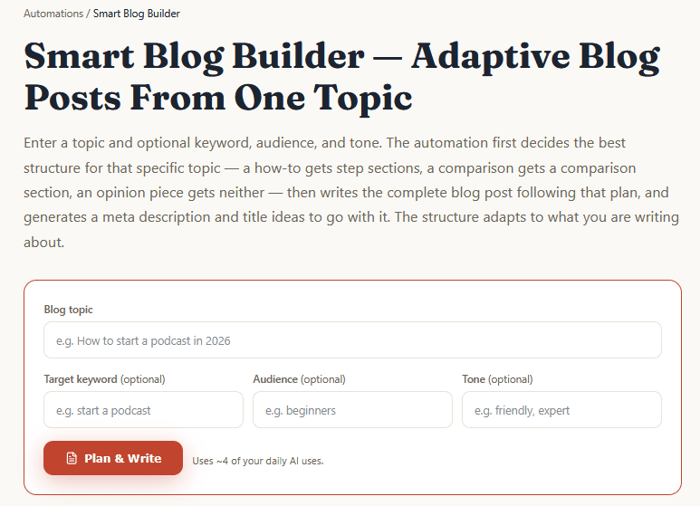
Most "AI blog writer" tools use one template for everything. Intro, three sections, conclusion, every single time — a how-to post ends up structured the same as a comparison post, which is the same as an opinion piece. It's fast, but it's not actually thinking about what you're writing.
Built Smart Blog Builder to do the opposite. Give it a topic, and it decides the structure first — a how-to gets step sections, a comparison gets an actual comparison section, an opinion piece gets neither. Then it writes the full post following that specific plan, plus a meta description and title options.
Tested it on "how to start a podcast" vs. "Notion vs. Obsidian" — genuinely different section structures came out for each, not the same skeleton with different words filled in. That's the part I actually care about: the structure is a decision, not a default.
Part of letsflw, ~4 AI uses per post on the Expert plan.
What's been your biggest blocker on keeping up a blog for your own product — time, structure, or just not knowing what to write about?

The template problem is real, I've read enough AI-generated posts to
spot the "intro, three sections, conclusion" skeleton instantly,
regardless of topic. Deciding structure first instead of filling a
fixed one is a meaningfully different approach, not just a prompt
tweak.
To your question: honestly, "what to write about" was never my
blocker, I write about what I'm actually building and learning. Time
is the real constraint, a technical deep-dive that's actually worth
reading takes hours to get right, not minutes.
Curious how Smart Blog Builder handles something like a build log or
postmortem post, content that's less "topic-driven" and more
narrative/chronological. Does it have a structure type for that, or is
it mainly optimized for how-to/comparison/opinion style content?
Good question, and yes it has a dedicated structure type for exactly this. A build log or postmortem gets organized chronologically (what happened > what went wrong > what changed > what we learned) instead of getting forced into a how-to skeleton, so it's not just relabeled headings it recognizes the narrative shape and walks through each attempt in order.
Ran your exact scenario as a real test: "why we rebuilt onboarding three times, what went wrong each time." Got back a post structured around all three attempts, each one broken into its own sub-section for what happened and what went wrong, building to what changed and what we learned. Not the intro/three-sections/conclusion skeleton you said you can spot instantly.
Appreciate the specific question most people ask "does it work" in the abstract, you asked exactly the edge case that actually separates a real structural decision from a relabeled template.