notesasm: mention a ticket in Claude Code, wake up to a PR
Hey IH!
I was losing micro-fixes. I'd be deep in a Claude Code session and think "this validateEmail regex needs work" or "the footer copy is wrong on mobile" and then I'd forget, because writing a ticket meant breaking flow.
So I built notesasm. Pitch:
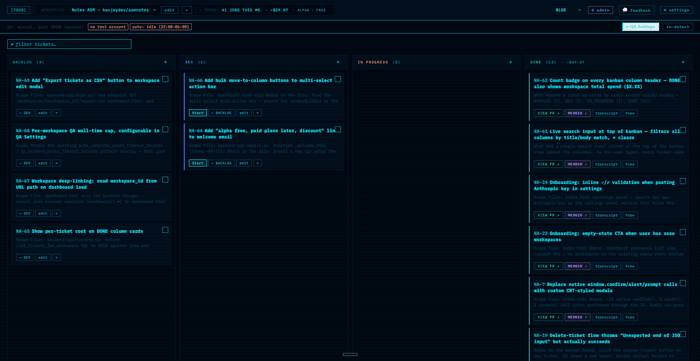
You mention the fix to Claude Code (or any MCP client). It files the ticket for you. An autonomous agent picks it up later (your schedule, your spend cap) writes the code, runs real-browser QA against your Vercel preview, and opens a PR with the QA screenshots in the description. You wake up and merge the green ones.
60s demo: https://notesasm.com
The interesting parts under the hood:
-
BYOK Anthropic: you pay token costs directly, I have no markup. The dashboard shows per-ticket cost so you see exactly what the agent is spending. Currently averaging ~$0.30/ticket for a small fix, ~$2 for a multi-file refactor with 2-3 QA iterations.
-
Real-browser QA via Browserbase: the agent doesn't just write code, it drives a stealth Chrome session against your preview deploy and screenshots before/after. Catches regressions the build agent thought it fixed.
-
Dependency-aware: if ticket B is blocked by ticket A's PR, it waits for A to merge before queueing B. No conflict cleanup the next morning.
-
Self-correcting: when QA fails, the build agent reads the failure report and pushes a fix. Up to 3 cycles before parking for human review.
Where I'm at:
- Closed alpha
- Free during alpha; paid plans roll out later this year with a permanent discount for alpha users
- One person (me) building. Stack: FastAPI on Railway, Vercel for the dashboard, Browserbase for the QA agent, Resend for transactional.
What I'd love feedback on:
- The pricing model. I'm leaning $20/mo with unlimited PRs + BYOK, $80/mo for team workspaces. Sane? Too aggressive?
- The 60s demo does the value land in the first 15 seconds? Where do you check out?
- The pitch does "you don't write tickets, you don't write code" oversell or actually fit your workflow?
If you want an alpha invite: drop your email at notesasm.com or reply here with where you'd sign in from.
Happy to answer anything. Building in public so the more feedback the
better.

This is a strong workflow pain because the product is not just “ticket creation.” The real value is removing the tiny handoff moments that usually die inside a coding session: the small fixes, UI polish, copy edits, and cleanup tasks that feel too small to interrupt flow for, but still matter.
The strongest positioning angle is probably “capture intent now, ship the fix later.” That makes notesasm feel less like another task manager and more like an async engineering assistant that turns passing thoughts into reviewed PRs with QA evidence.
The name notesasm is interesting, but it may be hard to say, remember, or explain if this becomes a serious dev workflow product. For a cleaner AI devtools/workflow platform direction, Xevoa.com would probably age better and feel less like an internal tool name.
really appreciate this, the positioning reframe is the part that's sticking with me. "capture intent now, ship the fix later" gets at the actual pain way better than how i've been pitching it
what made the positioning click for you? was it the QA agent or something else?
That shift is the real product.
If notesasm becomes “capture intent now, ship the fix later,” then the next risk is category clarity: whether people see it as a notes/task tool, or as an async engineering workflow layer that turns product intent into reviewed PRs.
Since this positioning seems to be the part you are actively thinking through, I can help in a lighter way than a full domain decision.
I do focused naming/positioning audits for early products: current name risk, category framing, domain weakness, whether the brand can scale, and what stronger naming direction I’d take before more users, launch assets, or product memory build around the current name.
For notesasm, the audit would be specifically around whether the name can carry the serious dev workflow direction, or whether it starts feeling too much like an internal utility once the QA/PR workflow becomes the core value.
I’m doing a few of these at $99 while refining the format. If useful, connect here and I can put together a sharp outside read:
https://www.linkedin.com/in/aryan-y-0163b0278/
It clicked because the QA agent changes the product from “I saved a note” to “this intent can actually become shipped work.”
That is the important shift.
The pain is not really note-taking. It is that small product thoughts appear during flow and disappear before anyone turns them into a clean fix. If notesasm can capture the thought, understand the repo/context, create the task, generate the PR, and show QA evidence, then it becomes closer to an async engineering workflow layer than a task tool.
That is also why I’d be careful with the name if you keep moving in that direction.
notesasm feels fine for the current wedge, but it sounds more like an internal utility than a serious dev workflow product. If the product becomes “capture intent now, ship the fix later,” the brand probably needs to carry more weight than notesasm can.
Xevoa still feels like the stronger frame for that broader AI workflow layer.