Nuggets of wisdom for non-tech founders working to build an impressive SaaS startup
Hello non-technical founders! 👋
Welcome, and congratulations for your startup kickstart! 🎉
I currently advise non-tech founders in the Edith & Nous project and here are some insights on how to be "successful" as a non-techie.
I think what you'll find here is good enough to kickstart from 0 to 10k$+ MRR and beyond, which is often the milestone in our community.
For those who don't wanna read a long article, here is a TL;DR:
- Validate your product needs before any development
- Work with a product-minded developer
- Each developer hour should be focused on product development, avoid tech for tech
- Avoid unnecessary distraction (meetings, calls, ...) so you can focus on your business
- Invest your time in growing your business (getting more customers, gathering feedback)
First of all, if you don't have a product yet, you should try as much as possible to validate your ideas with no-code tools or at very low cost.
One of the common mistake is to hire developers and work on a very complex product, which cost time, money and lead to failure.
Narrow the scope of your product and make sure you reduce the amount of tech work to the minimum until you have market confirmation.
If you don't feel confident enough in no-code tools or low-development tasks, invest in your learning so you get at least a grasp of what it takes to build a SaaS from the engineering side.
Market confirmation is people paying for your product. It's better to manually sell whatever you wanna sell than having a complex app that no one pay for. It may sound obvious, but this is the most number one mistake made by founders (even technical ones).
Special mention for non-tech founders willing to create SaaS with network effects (i.e, platforms such as e-commerce, job boards, social networks...). Those are particularly hard problem to solve, but Andrew Chen wrote an amazing book on how to kickstart your product so it's simple enough.
Development should only come after you have confirmed there is an actual need for your product, and this is generally after this point that you will need to have a developer working at least part time on your product.
The critical point is to work with someone you trust and can deliver well in terms of product.
It doesn't really matter which technology is used, but make sure this person has some experience in building products and is able to grasp what matters in your business area. Each hour passed writing code should deliver value for your customers and your developer should understand that.
Another common mistake is engineers willing to experiment or have fun with the code and losing sight of the product requirements.
It often leads to overcomplicate products, or worse, useless feature.
Techies should help you determine how best translate product requirements to code, not produce code for the sake of it.
Avoid traditional developers agencies, it often costs a lot, and look for freelancers/productivized agencies with product experience able to deliver fast.
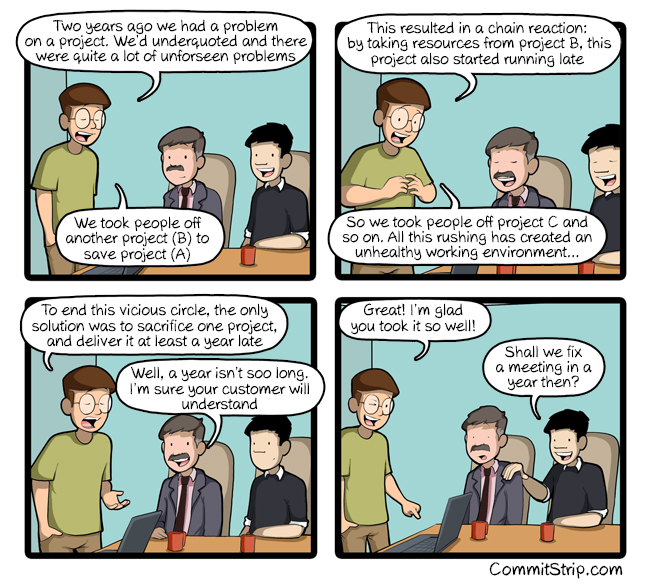
At some point, the developer should be able to produce and deliver without much help from you, which means you must be able to explain properly what you need and let the production be done.
A killer mistake is non-tech founders willing to dive too much in the tech, with no benefits.
During the development time, your main goal should be to promote and drive growth and you should not waste time on anything else.
Avoid unnecessary meetings or calls and look for your customers.
Julian Shapiro wrote an amazing handbook related to this topic if you need some information on how to acquire users and start growth for SaaS.
If you follow those general rules, and assuming your product have a real need, you should be on the right track 😊
Originally an extract of my comment from @Deep1010 's post.
If you liked this post, you can follow me on Twitter for more on my journey as an indiehacker.

Good advice Axel, thanks. Quick question - you mention:
"Each hour passed writing code should deliver value for your customers and your developer should understand that."
When it comes to finding a developer, do you think it's a better idea to offer equity as opposed to just a salary (especially if you're low on capital in the early stages)? This way, presumably, if the developer is a co-founder, there would be a greater incentive for them to only work on things that add value to customers, and not waste their time experimenting or having fun with the code and losing sight of the product requirements, as you mentioned.
Hey @indieesaas👋
It's a common industry practice to offer equity (even to really good freelancers) if you're low on capital, and it might help incentive people to be focused on whatever give the most value.
However, I must advise caution when giving equity here, as contrary to salary, the incentive is more a bet than a short-term win.
Finding a great co-founder is really, really hard, and often the cause of death of many startups. Paul Graham wrote an essay for Forbes in which he describes what YC is looking in founders. Although it's VC oriented, I think it's safe to assume you should consider yourself the primary VC of your company, even if you bootstrap.
Moreover, many people underestimate the required commitment of running a company in the long-run, and equity becomes a less-sufficient incentive in the long-time than cash flow.
This is why reducing the amount of tech before you generate your cash flow is really, really important, so you can conserve both capital and equity.
Nowadays, you can run a company by combining no-code tools and only requiring automations/integrations between them (using things like Notion, Airtable, Webflow...) so, here is what I would do if I'm low on capital by order of preference:
Hope that helps 🙇
You are better off buying a SAAS script or OPen source rather than making something from scratch. Would be a lot easier.