Online Degree vs Traditional Degree: Choosing the Right Path in 2025
The landscape of higher education has undergone a seismic shift over the last decade. Gone are the days when a path to getting a degree earned on a brick-and-mortar campus was the only respectable path to a career. As we move through 2025, the stigma once attached to digital learning has all but vanished, replaced by a growing recognition of the validity and rigorous nature of the online university experience.
For prospective students, this abundance of choice can be paralyzing. The decision is no longer just about where to go to college, but how to go to college. While the on-campus experience offers immersion and networking, online programs offer unparalleled flexibility. However, with this flexibility comes a new set of challenges. Students in online programs often face a heavier reliance on self-discipline and written communication. Without the structure of scheduled lectures, the burden of managing deadlines falls entirely on the individual. It is common for students adjusting to this format to feel overwhelmed by the volume of written assignments, often prompting them to seek dissertation help from Mypaperhelp so they can manage their workload efficiently and stay on track with their modules.
Understanding the nuances between these two educational models is critical. Whether you are a high school graduate looking for the full college experience or a working professional eyeing an online masters program, the "right" choice depends entirely on your lifestyle, budget, and career goals.

Main Differences Between Online and Traditional Degrees
At their core, both formats aim to provide the same level of education and the same qualification. A Bachelor of Science earned online holds the same academic weight as one earned in person. The difference lies in the delivery, the cost, and the day-to-day student experience.
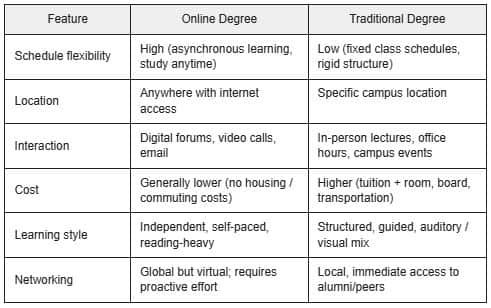
To help visualize these distinctions, here is a breakdown of the key comparison points:
The Financial Aspect: Cost and ROI
One of the most compelling arguments for studying online is the potential for cost savings. While tuition rates for online programs are sometimes comparable to their on-campus counterparts, the hidden costs are eliminated. There are no dorm fees, no meal plans, no parking permits, and no commuting costs.
Furthermore, the opportunity cost is significantly lower for online students. Because these programs allow students to work full-time while studying, they do not have to forego income to earn their credentials. For a professional pursuing an online Master’s degree, this means they can continue climbing the corporate ladder and earning a salary while upgrading their qualifications.
However, students must be careful. Not all online degrees are created equal. It is essential to verify accreditation to ensure that the lower cost doesn't equate to lower value in the eyes of employers.

Flexibility vs. Structure: The Academic Workload
The primary selling point of getting a degree online is flexibility. The ability to watch lectures at 2 AM or complete assignments on a lunch break makes higher education accessible to parents, caregivers, and full-time employees. This "asynchronous" learning model allows students to tailor their education around their lives, rather than the other way around.
However, this flexibility is a double-edged sword. Traditional education provides a rigid structure that forces students to stay engaged. If you don't show up to class, you miss the material. In an online environment, no one is hovering over your shoulder. This requires a massive amount of self-discipline.
Key Challenges of Online Workloads:
Time Management: Without set class times, procrastination is a major risk.
Isolation: You miss out on the "osmosis" of learning from peers in a hallway or cafeteria.
Heavy Reading/Writing: You must be comfortable expressing complex ideas in writing, since online discussions are usually text-based.
Key Benefits of Traditional Workloads:
Immediate Feedback: You can ask a professor a question in real-time.
Peer Support: Study groups form naturally before and after class.
Structured Pacing: The syllabus dictates the flow, keeping you moving forward.
Career Outcomes and Employer Perception
In 2025, the "degree bias" has largely faded. Most employers now recognize that an online degree from an accredited institution demonstrates not just academic knowledge, but also soft skills like time management, technological proficiency, and self-motivation.
That said, some fields still favor the traditional route. For highly practical professions, such as nursing, chemistry, or performing arts, the hands-on facilities of a traditional campus are irreplaceable. A virtual lab simulation cannot fully replicate the experience of mixing chemicals or treating a patient. Conversely, for fields like computer science, business, or digital marketing, the medium of learning matches the medium of work, making online education a perfect fit.
Which Path Is Yours?
Choosing between these two paths requires an honest self-assessment.
You should consider a traditional degree if:
You are a recent high school graduate seeking the "coming of age" social experience.
You learn best through listening and face-to-face interaction.
You need a structured environment to keep you accountable.
Your major requires extensive hands-on access to specialized equipment or labs.
You should consider studying online if:
You need to work full-time or have family obligations.
You are a self-starter who is disciplined with deadlines.
You want to minimize debt by living at home or avoiding relocation.
You are comfortable with technology and communicating primarily through text.
Ultimately, the goal is the same: to acquire the skills and credentials needed to succeed. Whether you choose the digital classroom or the lecture hall, the value of your education will be defined by the effort you put into it.

