Open banking vs. Embedded Finance
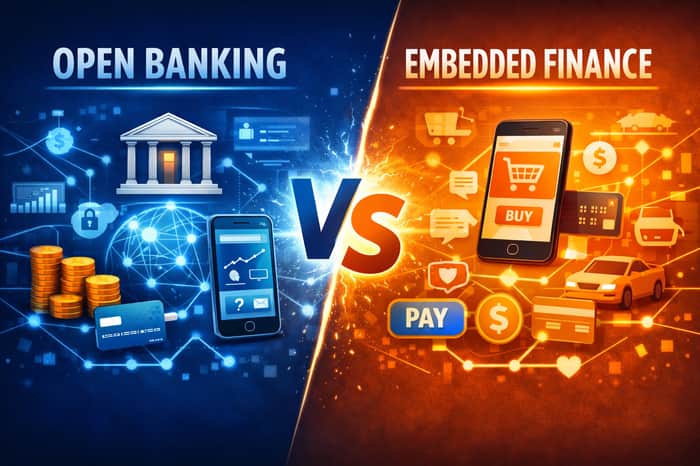
A Quick Overview
Have you ever come across the term inter-related digital models? No! Alright, I am pretty sure you must have encountered terms such as open banking, embedded finance and BaaS (Banking as a Service)? Well, that’s what these are. And in the following post, we will be referring to these models pretty much in detail.
In the present times, enhancing customer experiences is what matters the most. Irrespective of any industry vertical, be it finance or healthcare or banking or any other, the need for improving customer services cannot be ignored at any rate. Earlier, the trend of offering highly personalised services began with platforms such as Amazon, Netflix, and Uber, and now it has been spreading across every industry vertical. The need for conducting fictionless interactions is no longer ignored. Besides, lots and lots of banking and finance institutions have been transforming the way how customers tend to access their banking services, leaving all the conventional ways behind.
It is a safe bet to say that we have stepped into the world of getting instant, seamless and highly personalised services. Technological advancements keep on enhancing to such an extent that even evangelists like us get overwhelmed. However, with the hype of open banking and embedded finance, all the traditional legacy banks have succeeded in unlocking the value of the time their customers aim to spend on a daily basis.
Gone are the times when finance was a more clunky kind of procedure, and now it seems to have become easier and delightful. Legacy banks, over the years, have highly relied on reputation and trust to keep their place intact in the financial system. However, when we are speaking of digital experiences, and everyday tasks require in-branch visits and filling up long online forms, which were pretty tedious. And more worrisome was, payments took days to settle. After a while, mobile apps came, but the concern was that they began to crash or lacked basic features. In addition, login was all about juggling different passwords, codes and security questions, again a tiresome thing to do. These frictions are not small annoyances; ignoring them can lead to severe downfalls. Taking the corrective measures can definitely help in shaping loyalty.
Fortunately, all these kinds of obstacles have been successfully removed. Today, with the help of technological advancements, payments can be cleared on an instant basis, personalised offers can be made, and authentication is not as overwhelming as it used to be.
This is a given, today’s and tomorrow’s banking customers are digital natives, which includes mainly the millennials, Gen Z and soon the Gen Alpha. All of them are born into an always-on-going or one-tap realm. These guys literally hate waiting; moreover, they feel archaic. And we cannot blame them for expecting instant, tailored experience with real-time responses, frictionless journeys and services. This is where concepts such as open banking and embedded finance services play a major role.
What is Open Banking?
If you are looking for a concept which delivers real-time value, it’s open banking. Right from expanding reach to accelerating innovation, developing new revenue streams, delivering smart personalisation and incorporating new ecosystem-driven models, the reason can be anything to choose open banking. Earlier considered as a mere technical upgrade, now seems to have become an ultimate growth strategy.
Basically, open banking is a regulatory framework which enables consumers to successfully share their financial data securely with third-party providers. Also, the concept highly emphasizes on giving consumers more control and ownership of the data, enabling them to move back and forth among different financial service providers.
What else? The concept enables financial institutions to offer highly personalised and innovative services; all it does is mainly leverages the data. All because of open banking, it is possible for consumers to successfully connect their respective banking accounts to a budgeting app or a robo-advisor. What happens next is, these apps tend to analyse all the balances, transactions, spending and saving habits and offer personalised financial advice, and the best part here is that all this happens with the customer’s explicit consent.
Another crucial advantage offered by open banking systems is that there is no scope for insecure and unstable screen-scraping methodologies. It is rightly said that the global open banking market was worth an estimated $25.14 billion in 2023 and is expected to grow at a compound annual growth rate of 27.4% until 2030.
Benefits of Open Banking
The need for modern digital finances has never been so high and why not, since such concepts such as open banking offer so many advantages, which we will discuss below.
Enhanced customer experience
Open banking enables customers to access a broader a wider range of financial products as well as services way beyond your imagination. Having a unified dashboard means it is possible for customers to view and manage multiple accounts from different banks as well as financial institutions, and all this is possible from one place. All they need to do is choose a single mobile app or platform. On and all, this simplifies management of finances, and you are bound to receive a comprehensive overview of the customer’s existing financial situation. In addition, here you receive frictionless authentication, which means no need to answer those unnecessary security questions, such as CAPTCHA or MFA mechanisms, and this doesn’t mean your security is compromised.
Increased competition and innovation
Traditional barriers and conventional methods are no longer in vogue; this has led to the incorporation of new and latest financial products as well as services. Though open banking successfully promotes increased competition and innovation, which has certainly challenged established banks and is offering more customised financial products and services which can be better aligned with customers’ financial needs and goals.
What’s more to ask for? An increase in competition between banks can lead to lower pricing for financial products and services. So lower fees, better interest rates, enhanced terms and conditions are pretty given.
Control over financial data
With the dawn of 2025, it has been observed that banking and finance institutions have now begun offering absolute control over finances. For instance, the increase in use of modern API ensures, all the login details and passwords are accessible only to you and nobody else.
What’s more, here customers have complete control over who can access their banking data and can decide on the level of access. So, only relevant information can be offered to the third party and nothing else.
Open banking has definitely incorporated new ways of paying for products and services.
Instant online payments
Another significant benefit offered by open banking is that it successfully revolutionises the way we pay for products and services online. This concept did take quite an increase, especially during the COVID-19 pandemic and beyond. What’s more, online purchases have become safer and convenient since customers have regained complete control of their finances.
Paying with respective debit and credit cards did lead to unwanted headaches, and also the fear of lost, forgotten, expired, and stolen cards remained hovering every now and then. Open banking has offered instant bank transfers with a much lower failure rate. So, less time chasing one-off payments is the future.
Increased efficiency and productivity
Last but certainly not the least is open banking systems have led to an increase in efficiency and productivity. See, when you are managing a banking or a finance institution, it means there are lots and lots of micromanagement involved. Right from accounting to payroll, open banking can work wonders in dealing with such scenarios.
Moreover, banking institutions have incorporated the concept of digital automation, which is extremely cost-effective. Also, access to new sources can assist in keeping up with digital innovations.
Business Use Cases
Budgeting and financial tracking app which pull in bank data
It is advisable for lenders who are willing to keep tabs on real-time financial insight on borrowers
Businesses who are willing to bypass card networks with direct bank payments.
What is Embedded Finance?
Embedded Finance takes a step further by incorporating financial services such as payments, lending, insurance and banking with non-financial apps and platforms. You no longer need to keep visiting the bank every now and then since all the services can be accessed wherever you are. For instance, it is possible to receive a loan while simultaneously checking out from a grocery store, pay with a digital wallet within your favourite Amazon app, and earn instant cashback from a retailer.
And you know what, the global embedded finance market is supposed to reach $251.5 billion by 2029. Even customers are baffled by the concept of banking services meeting them wherever they are going. Some of the key areas of embedded finance include:
- Mortgage loans
- Buy now, pay later
- Business and consumer lending
- Accounts (savings, checking)
- Card issuing/processing
- Issuer prepay, credit, debit
- Virtual, physical, tokenized
- B2B
- B2C
API-centric banking is a fundamental model which is successfully embedded in finance. Banks successfully showcase their products and services through APIs, and this doesn’t mean you cannot integrate with external platforms for seamless integration and successfully embed them. You may find this pretty weird, but inserting financial products or services into non-financial company transactions isn’t relatively new. Earlier, several car companies began offering direct-to-consumer auto loans and finance options, and this used to happen a decade ago. And now the scenario has entirely changed:
Competition has become fiercer.
Customer expectations and experiences seem to have evolved
Increase in the prominence of APIs and software as a service (SaaS) models
Increase in the pursuit of new market opportunities.
Benefits of Embedded Finance
Much like open banking, embedded finance offers a wide range of benefits irrespective of the scenario, whether it is B2B or consumer-centric. Time to explore the benefits of embedded finance.
Increased Revenue
The prime benefit offered by embedded finance is increased revenue. By considering such options, customer spending becomes way easier, and this surely leads to increased sales and revenue growth.
Increased convenience
By incorporating concepts such as embedded payments, transactions can be pretty effortless and time-saving. Fictionless banking procedures is what this concept aims for; this not just enables them to grow but also stands tall and a cut above in the ever-evolving market landscape.
Enhanced Analysis
Embedded finance enables improved data collection as well as proper analytics. In fact, the tech is such that it features real-time updates and detailed reporting.
In addition, it is possible to streamline operations and reduce the need for manual procedures such as reconciliation and data entry.
Business Use Cases
eCommerce sites successfully support buy now, pay later (BNPL) at the time of checkout
Software-as-a-service (SaaS) companies offer amazing services for invoicing, lending, or payroll
Platforms and marketplaces that provide simple payouts for sellers
Open Banking vs Embedded Finance
Time to delve in more to learn about absolute differences among the two.
Scope of Application
More or more conventional financial institutions are now concentrating on open banking. With the help of approved APIs, it simplifies sharing this customer data with other businesses. The financial service works with banks as well other organizations can grant instant access to their data for creating new banking products as well as this also leads to already-existing banking services.
Where as embedded finance means here functions happen on the outside of the industry. Here the concept ensures banking services to take care of several tasks such as account creation, payments, and lending within their core activities by successfully integrating financial products as well services, this works for both financial as well as non-financial organisations. One of the sure-shot examples to consider here is, in-app payments can be successfully integrated into eCommerce platform.
Customer Interaction
With open-banking, customers know they are using banking-related services and this has nothing in regards to whether they are using via third party. Whereas with embedded finances, these services successfully operate in the background and here they are branded by platform instead of the banks.
End-user experiences
The use of ever-evolving technologies is to enhance conventional banking procedures, this is ultimate objective of open banking. These models offer highly enhanced digital services which allow consumers to successfully manage all their bank accounts within a single location.
So what happens is better management, increased accessibility, taking care of financial data, receiving more and more competitive offers and whatnot! Whereas embedded finance tends to successfully change the financial experience by offering financial services within customer’s existing smartphone apps or businesses.
With embedded finance, you are bound to receive seamless as well as highly integrated user experiences and here customers no longer require to interact with different financial providers.
It is possible for customers to apply for credit right from the shopping platform.
Industry Verticals
For open banking we have
- Fintech - With the help of APIs, it is possible for fintech companies to take care of banking data especially from different financial institutions and this is possible with the help of open banking. Now fintech organizations can offer services such as credit evaluations, account aggregations and of course, loan comparisons. It is now possible for users to successfully manage different accounts in a better manner, track different spending patterns and develop relevant budgets.
- Insurance - With the help of open banking, insurance companies can successfully evaluate client risk in the most accurate manner. With the help of the data, it is possible to make personalized insurance quotes and offers possible. This turns out to be beneficial for both client as well as the insurer.
- Personal Finance Management Tools - Here open banking works wonders by establishing a direct connection with the end user’s bank accounts, open banking does simplifies the usage of applications featuring account aggregators and budgeting applications. Users now can seamlessly gather as well as analyze tons of financial data which does enhance overall financial situation.
For Embedded Finance we have
- eCommerce Platforms - Online retailers offer different financial choices such as buy now and pay later and watch out for different in-app solutions which can directly merge within their existing platforms. Users are no longer dependent on outside or third-party financial institutions to take care of their payments.
- Apps for Gig economy - Organizations usually depend on freelancers as well as delivery services enable seamless incorporation of banking services within their existing apps. Some of the common examples are Instant payments, tools for financial planning as well as different insurance possibilities are considered. This is why it becomes seamless for employees to manage their income without using third-party banks.
- Transportation - Another amazing industry which embedded finance works wonders turns out to be transportation. Embedded finance offers features such as driver insurance and in-app payments this can assist in taking care of ride-sharing or delivery services. What else, the overall service experience can be successfully streamlined. So now drivers no longer need to rely on conventional financial institutions for payouts since they get paid right away once the route is completed.
Final Words
So that’s all for now! Lastly, I would say to make the most of open banking and embedded finances, it is very important to transition from theory to action and make sure you adopt clear strategies which can surely lead to long-term growth and relevance.
I hope you did find the following post worth considering. In case if you have any queries or concerns, feel free to mention them in the comment section below.

Enjoyed the article - good breakdown of both models. both open banking and embedded finance assume the underlying actions are trustworthy and verifiable. But as FS get more embedded into non-financial platforms, and especially as AI agents start initiating those transactions autonomously, the audit trail problem gets harder.
With open banking you at least have a regulated institution keeping records. With embedded finance sitting inside a gig economy app or eCommerce platform, who owns the proof that a transaction or workflow actually executed as intended?
That's a gap I've been thinking about a lot — the need for a portable, machine-verifiable execution receipt that travels with the action regardless of which platform initiated it. Curious if you see that as a real friction point in the embedded finance stack or if it's solved by existing infrastructure I'm not aware of.