People Don't Want AI. They Want the Thing Done.
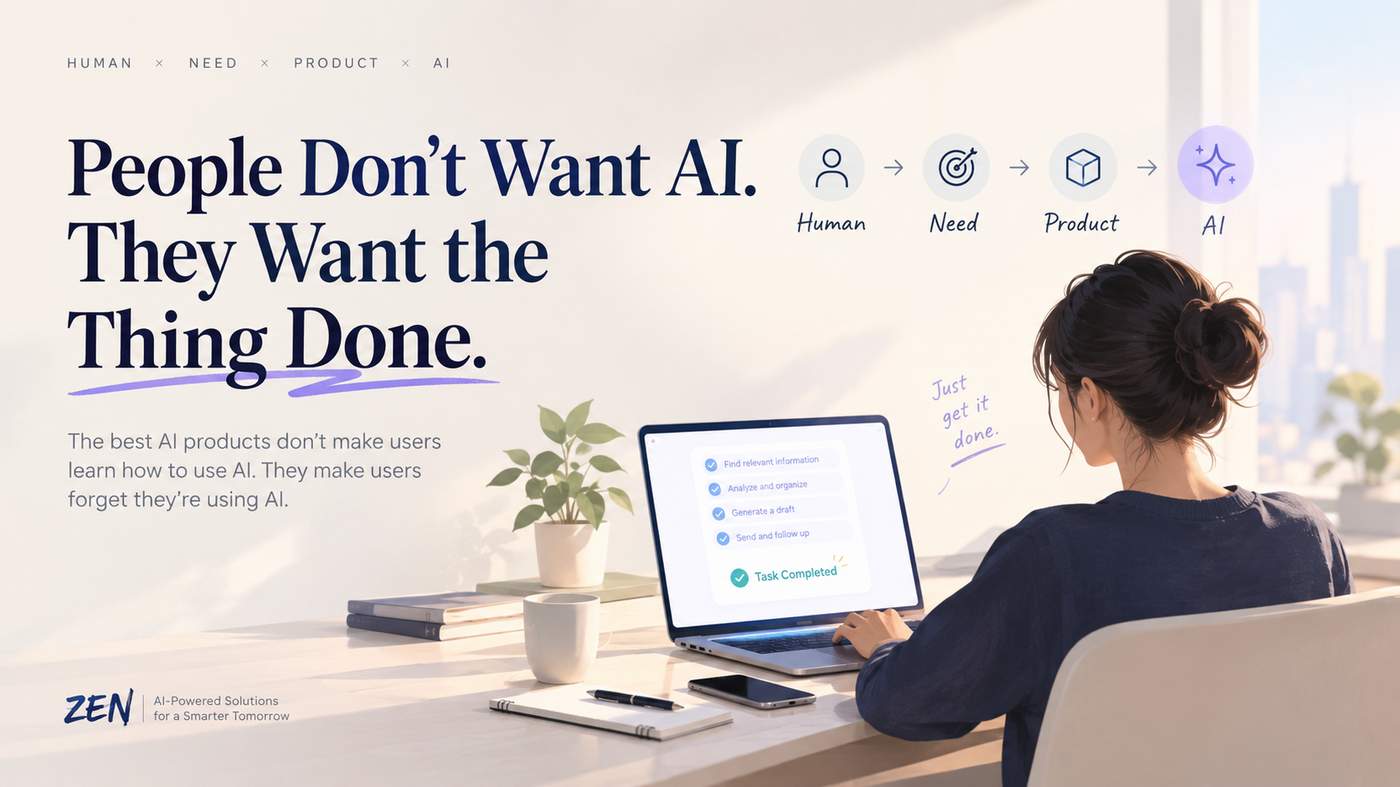
The best AI products don't make users learn how to use AI. They make users forget they're using AI.
For the past few years, a lot of AI product conversations have started with the same question:
What can AI do?
Can it write?
Can it code?
Can it analyze?
Can it generate images?
Can it act as an agent?
Those are interesting questions for builders.
They are not always the questions customers care about.
A customer usually starts somewhere else:
“I need this done.”
That difference may become one of the most important distinctions in the next generation of AI products.
People Don't Wake Up Wanting AI
Consider a simple example.
Someone has 200 unread emails.
They don't necessarily want an “AI email assistant.”
They want their inbox under control.
A sales representative has dozens of leads to follow up with.
They don't necessarily want an “AI sales agent.”
They want more conversations with qualified prospects.
A small business owner needs to reconcile invoices at the end of the month.
They don't want “AI-powered financial automation.”
They want the books done without spending their weekend on it.
The AI is simply the mechanism.
The outcome is the product.
This sounds obvious, but it has major implications for how products are designed.
The Industry Has Been Starting From the Wrong End
A lot of AI product development follows this pattern:
New model → new capability → new feature → find a use case
It makes sense from a technology perspective.
A new model becomes capable of reasoning, coding, seeing images, using tools, or taking actions. Product teams then ask:
“What can we build with this?”
But customers don't experience the product from that direction.
They start with a problem.
Problem → desired outcome → acceptable experience → technology
That is a very different product development loop.
Instead of asking:
“Where can we put AI?”
You ask:
“Where is the customer still doing something they don't want to do?”
That question tends to produce better products.
The Best AI May Be the AI You Don't Notice
Imagine two products.
Product A opens with:
“Meet your AI-powered productivity copilot.”
It gives you a chat window, a prompt box, model selection, agent modes, and a dozen settings.
Product B simply says:
“Connect your inbox. We'll organize your follow-ups.”
The second product may contain significantly more AI.
But the customer doesn't need to understand any of it.
That is an important shift.
The goal isn't necessarily to expose the intelligence.
The goal is to use intelligence to remove work.
The best AI products may therefore feel surprisingly ordinary.
You click a button.
Something happens.
The task is finished.
There is no need to think about the model behind it.
AI Should Reduce Cognitive Load, Not Add to It
There is a strange contradiction in some AI products.
They promise to make work easier, but require users to learn a new way of working.
Users have to learn:
how to write effective prompts
which model to choose
when to use an agent
how to structure context
how to verify outputs
how to fix incorrect results
how to move information between tools
For technically curious people, this can be fascinating.
For everyone else, it can become another job.
The customer shouldn't have to become an AI operator just to complete a simple task.
If the product requires extensive AI literacy, the product is still asking the customer to do part of the work.
A better product hides that complexity.
Think About What Happens Before the AI
This is where customer understanding becomes more important than feature brainstorming.
Take customer support.
The obvious AI question is:
“How can we build an AI chatbot?”
A better question might be:
“Why are customers contacting support in the first place?”
Maybe customers repeatedly ask where their order is.
Maybe they don't understand the billing process.
Maybe they cannot find a feature.
Maybe the company's own interface is creating unnecessary questions.
The best solution may not be a better chatbot.
It may be better order tracking, clearer billing information, or a redesigned workflow.
AI is useful when it removes friction.
It isn't automatically useful just because it can answer questions.
Watch What People Do, Not Just What They Say
There is another lesson here that goes beyond AI.
Customers are often bad at describing the product they need.
Ask someone what they want, and they might request:
“An AI assistant that can manage everything.”
Watch them work for an hour, however, and you may discover something much simpler.
They spend 20 minutes copying information between spreadsheets.
They repeatedly search for the same document.
They manually rewrite the same email.
They check three different systems before making one decision.
Those repetitive behaviors are often better product signals than feature requests.
People tell you what they think they want. Their behavior shows you what they actually need.
AI makes this particularly interesting because it gives product teams the ability to automate workflows that previously weren't economical to automate.
The opportunity isn't necessarily to create another interface.
It is to remove unnecessary interfaces altogether.
The “AI Feature” Is Becoming Less Interesting
In the early days of generative AI, adding AI to a product was itself a differentiator.
That window is closing.
“AI-powered” is becoming closer to a baseline expectation.
The question is shifting from:
Does this product use AI?
to:
Does this product make my life meaningfully easier?
That distinction matters.
Two products can use exactly the same underlying model and deliver completely different customer experiences.
One might force users to prompt, review, copy, paste, and switch between applications.
The other might quietly complete the workflow in the background.
Same underlying technology.
Very different product.
The competitive advantage is moving upward—from the model to the experience.
Customers Don't Care About Your AI Stack
This doesn't mean technology is unimportant.
It means technology needs to serve the experience.
Customers may never know whether your system uses one model, five models, an agent framework, retrieval, custom software, or a combination of all of them.
They care about things they can actually experience:
Is it fast?
Is it accurate enough?
Does it save me time?
Does it fit into the way I already work?
Can I trust the result?
What happens when it gets something wrong?
Those are product questions.
And increasingly, they are the questions that separate an impressive AI demo from a useful product.
The Most Valuable AI Could Be Invisible
Think about the technologies people use every day.
The most successful ones often disappear into the experience.
Nobody thinks about the database when ordering food.
Nobody thinks about the API when sending a message.
Nobody thinks about the recommendation algorithm every time they open an app.
The technology matters enormously.
But the user doesn't need to interact with it directly.
AI may follow the same path.
Today, we are still fascinated by the fact that AI can generate, reason, and act.
Eventually, those capabilities may become infrastructure.
What users remember will be much simpler:
“This product just makes things easier.”
This Changes How We Should Build AI Products
If the starting point is the customer rather than the technology, the product development process changes.
Start with the task.
What is the customer trying to accomplish?
Then find the friction.
Where does the process slow down?
Then understand the consequence.
What does that friction cost in time, money, attention, or missed opportunities?
Then ask where intelligence can remove it.
Not:
“Where can we add an AI feature?”
But:
“What part of this experience should no longer require human effort?”
That question is much more powerful.
It also creates a higher bar.
Because if AI is supposed to make something easier, adding another dashboard, another chat window, and another workflow isn't necessarily progress.
Sometimes the best product decision is to remove the step entirely.
From AI-First to Outcome-First
The next wave of AI products may be defined less by how much AI they expose and more by how much unnecessary work they eliminate.
That means the product conversation needs to move closer to the customer.
From:
Model → Capability → Feature
toward:
Human → Need → Outcome → Experience → AI
The difference is subtle, but important.
In the first model, AI is the starting point.
In the second, AI is part of the answer.
And customers usually don't want the answer explained to them.
They just want the problem solved.
The Real Test
Perhaps the simplest test for an AI product is this:
What does the customer have to do that they didn't have to do before?
If the answer is:
“They need to learn how to prompt our AI.”
That's probably not enough.
If the answer is:
“They still need to check three systems, copy the results, verify everything, and finish the task themselves.”
There is probably more work to remove.
But if the answer is:
“They don't really have to do anything. The task is simply finished.”
Now we're getting somewhere.
That is where AI becomes more than a feature.
It becomes a better experience.
People Don't Want AI. They Want the Thing Done.
The AI industry has spent a lot of time making intelligence visible.
The next phase may be about making intelligence disappear.
Not because AI is becoming less important.
Because it is becoming more useful.
When the technology works well enough, users shouldn't need to think about the technology.
They should think about what they accomplished.
The best AI products don't make users learn how to use AI. They make users forget they're using AI.
That is the real opportunity: not building products that contain AI, but building products that use AI to make something people already want to do dramatically easier.
At ZenAI, we help businesses turn AI capabilities into practical products, workflows, and software systems built around real business needs. The goal isn't to add AI for the sake of adding AI. It's to make the work itself better.

