Photo Everyday App: Turning Daily Selfies Into Timelapse Videos
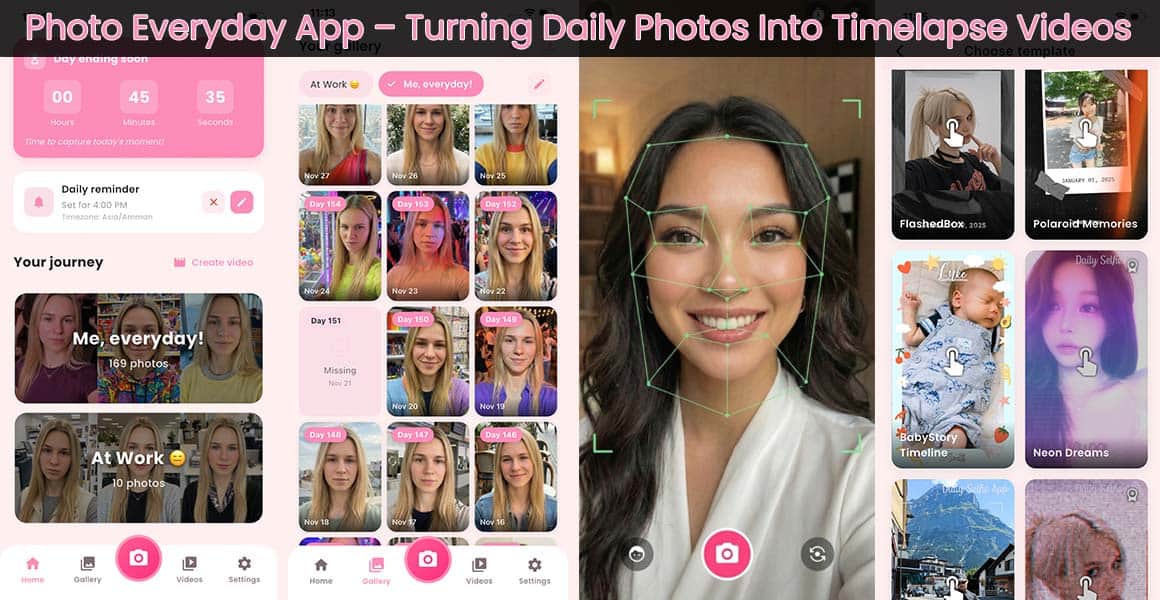
Daily Selfie started with a very specific problem:
Taking a photo every day is easy — taking the same photo every day is not.
Most selfie and photo apps don’t care about consistency. Slight changes in angle, distance, lighting, or framing don’t matter for a single photo — but they completely break timelapse and face-morph videos.
I wanted to build an app where everyday photos are captured with intention, so they can later become smooth, meaningful timelapse videos.
Solving the Consistency Problem at the Camera Level
The camera screen is the heart of Daily Selfie, and most of the product decisions started there.
Instead of treating the camera as a simple capture tool, I designed it as a guided system that actively helps users take consistent photos.
Camera features focused on consistency
Real-time face detection to confirm a face is visible
Face overlay guides to position the face consistently
Ghost overlay mode that shows the previous photo for perfect alignment
Grid overlay for composition consistency
Automatic front camera mirroring
Exposure lock, timers, brightness control, and flash fallbacks
All of this runs in real time, works offline, and avoids blocking the UI.
Photos Built for Long-Term Progress
Daily Selfie isn’t just a gallery. Photos are stored and organized specifically for long-term progress tracking.
Timeline and day-by-day views
Visible missing days to encourage consistency
Collections for different journeys like fitness, skincare, or habits
Offline-first photo saving with background uploads
Preserved timestamps and metadata for accurate timelines
The app treats photos as data points, not just images.
Turning Everyday Photos Into Timelapse Videos
Once users have enough consistent photos, the real payoff begins.
Daily Selfie supports multiple video generation modes.
Simple Timelapse Videos
Simple timelapse videos use all photos from a collection, automatically calculate frame rate based on duration, and support optional face alignment, date overlays, and music.
Smooth AI Face Morphing Videos
Smooth AI face morphing videos use detailed face landmarks and alignment to generate natural transitions between photos, with control over speed, order, and resolution.
Template-Based Videos
Template-based videos allow more creative layouts with custom overlays, text, and audio, all defined dynamically without requiring app updates.
All video generation runs in a dedicated backend video engine built specifically for photo-to-video processing, with real-time progress tracking and high-quality exports.
Why Daily Selfie Exists
Daily Selfie exists because progress is invisible when you look at it every day.
People quit habits not because nothing is changing, but because they can’t see the change. By turning everyday photos into timelapse videos, the app gives users visual proof that their effort matters.
Lessons From Building It
Consistency is a UX problem, not a motivation problem
Camera tooling matters more than filters
Small technical decisions compound over months of use
The “wow moment” happens weeks after install, not day one
What’s Next
Daily Selfie is still evolving, but the core idea remains the same:
Take one everyday photo.
Let time do the rest.
Website: https://selfietimelapse.com/
iOS : https://apps.apple.com/app/id6756184981
Android : https://play.google.com/store/apps/details?id=com.diary.dailyselfie


Cool! Will be interesting to compare how I look when coming up with a new seemingly great idea vs months of work later when there are still no results hahaha
Keep it up 👌👌
That’s really great and interesting
Respect for shipping and sharing this publicly.
Building in public isn’t easy, but it’s usually where the real learning happens.
Keep going.
Capture one photo every day and watch your journey transform into a stunning timelapse video. Photo Everyday App turns simple selfies into meaningful visual stories effortlessly.
This is such a cool idea. Turning daily selfies into a timelapse video makes personal growth feel so real.
Love the simplicity and emotional pull of Daily Selfie — helping people see their own story over time is a powerful hook. One instinct I have as a copywriter is to lean even harder into situational outcomes in your messaging (e.g., “Watch your journey, not just your face”). Right now apps like Selfie A Day sell the concept, but the real conversion lift often comes from painting the before/after emotional journey — the “I’ll finally feel proud of my progress” moment. If you can frame the product around repeat engagement loops (timelapse reveal + reminders + shareable highlight clips), you’ll tap both habitual use and social sharing motivation — which are the two levers habit-based consumer apps really live or die by.
I've seen those timelapse videos of the same person through 5+ years. Nice to see there's an easy way to do that!
nice idea
This is one of those products where the “boring” part (consistency) is the actual moat. The ghost overlay + face guides solve the real problem that ruins every timelapse, and the payoff weeks later is exactly right. Huge respect for treating photos like data points, not just a camera roll.
Loved your idea. Keep up the good work.
Great idea
Thank you! 🙌
A Photo Everyday App allows users to take one selfie each day and automatically turns these photos into a timelapse video. The app tracks daily changes over time, creating a meaningful visual story of personal growth. It is easy to use, stores photos securely, and lets users share their timelapse videos with friends or on social media.
Thanks! That’s a great summary — that “meaningful visual story over time” is exactly what I’m aiming for 🙏
Great, another app to remind me how fat I'm getting. haha JK really cool idea!
😂 Totally fair — this app does not lie. But that’s also why it works. Appreciate it!
This hits home! As a dad, I tried doing a 'photo-a-day' for my son manually, but I eventually gave up because the alignment was always off and the final video looked too jittery.
I really like your approach of treating consistency as a UX problem (the ghost overlay is a game-changer).
One technical question: I noticed you mentioned a 'dedicated backend video engine' for the processing. Since I'm a big fan of local-first apps (currently building one myself), I'm curious if you considered doing the video generation on-device (via FFmpeg or similar)? Or was the performance/battery trade-off just too high for mobile?
Great work on the launch!
Thanks — and I totally relate to that “jittery video” problem. If alignment is even slightly off day-to-day, the final result falls apart.
On the technical side: yes, I did consider (and actually started with) on-device generation. The very first version was offline-only. But once I added face alignment + AI morphing + templates, doing it well on mobile became really hard — not just FFmpeg, but the heavier parts: consistent landmarking/alignment, morphing quality, and the compute needed for different template effects. It also gets messy across the huge range of phones (performance, memory, thermal throttling, battery).
So I moved generation server-side to keep results consistent and fast, and to support the more advanced modes reliably. The app is still offline-first for capture/storage, but the “heavy rendering” runs on the backend.
Funny enough, my latest project (Jaywalk Miner) went the complete opposite direction — 100% local-first Electron app. Handling simple CSVs is way easier on the CPU than rendering 4K video :)
This is a really thoughtful build 👏
Love how you treated consistency as a UX + camera problem, not a motivation one — the ghost overlay and face guides are especially smart.
The idea that the wow moment happens weeks later really resonates. That’s rare and powerful product thinking.
Curious: what was the hardest part to get right — real-time camera guidance or the backend video processing?
Thank you, that means a lot. Honestly, the hardest part was the camera guidance — getting real-time feedback to feel helpful without being intrusive, and fast enough that it didn’t break the flow. The backend video processing was complex, but at least it’s deterministic. The camera experience is where users decide whether they come back tomorrow.
This is a great breakdown, especially the framing that consistency is a UX problem, not a motivation problem. That distinction feels very real for habit-based products.
I also liked how much emphasis you put on the camera experience itself — guiding behavior at capture time instead of trying to “fix” inconsistency later. That kind of upfront constraint usually pays off months down the line.
The point about the wow moment happening weeks after install really resonated too. That delay is hard to design for, but it’s often where the real value shows up.
Thank you — I really appreciate that. The UX vs. motivation distinction only clicked for me after watching people drop off despite liking the idea. Guiding behavior at capture time felt like the only leverage that actually compounds over time. And yeah, designing for a delayed wow moment is uncomfortable, but that’s where this product either works or doesn’t.
This is quite interesting. I’ve seen a lot of videos with this output that really grab the attention. How do you sustain people’s active taking of selfies daily?
Thanks! That’s honestly the hardest part. I’ve learned it’s less about motivation and more about making the daily action feel unavoidable and low-friction — quick capture, clear reminders, and visible progress. When missing a day creates a noticeable gap in the story, people are much more likely to show up the next day.
great dude
Thank you 🙏 🙏