Polyurethane Polymers in High-Tech Applications: Bridging Research and Industry
Footwear innovation rarely begins on the showroom floor. It starts much earlier, inside material systems that determine weight, resilience, durability, and environmental cost long before a shoe reaches a consumer. As the industry faces pressure to deliver lighter products, customizable performance, and credible sustainability gains, materials science has moved from a supporting role to a defining one. That pressure is structural. The global market for 3D-printed footwear alone is projected to grow from approximately $1.6 billion in 2023 to over $5 billion by the end of the decade, signaling a shift toward digitally manufactured, material-driven product architectures.
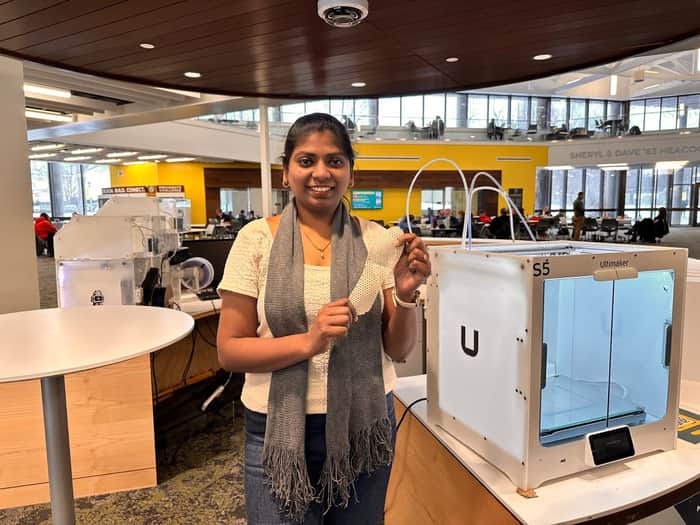
This shift is especially visible in the evolution of 3D-printed footwear, where conventional foams struggle to meet the competing demands of comfort, scalability, and waste reduction. At the forefront of this evolution is Dr. Harini Gunasekaran, a postdoctoral researcher and Editorial Board Member at SARC Journals, whose work on CO₂-foamed, 3D-printed thermoplastic polyurethane (TPU) elastomers offered a manufacturable alternative to traditional midsole materials. This TPU foam research was completed as part of her PhD work, and she has since shifted to improving CMP technology by developing functional polyurethane pads for slurry-free CMP in the semiconductor industry. That footwear-focused work also drew industry attention, including outreach from ANTA and a Stratasys contact who reached out on LinkedIn to discuss her results and requested that she share her published paper.
“Footwear performance is ultimately dictated by material behavior,” she explains. “If weight, energy return, and durability are not engineered at the polymer level, downstream design choices can only compensate so much.”
Published in ACS Applied Polymer Materials, her research demonstrated how additive manufacturing and physical foaming processes could be integrated to produce lightweight, resilient lattice structures suitable for high-performance footwear, without relying on chemical blowing agents or waste-intensive moulding.
Engineering Performance at the Material Level
At the core of Dr. Gunasekaran’s work was a controlled CO₂ foaming process applied to 3D-printed TPU lattices. Instead of shaping performance through tooling and post-processing, mechanical properties were tuned during material expansion itself. By managing depressurization kinetics and lattice geometry, her approach enabled precise control over pore size, density gradients, and energy absorption.
This level of control matters for footwear, where small variations in rebound, compression set, or stiffness can translate directly into comfort and injury outcomes. “Footwear is one of the most material-intensive consumer categories,” she notes. “If we can tune performance through structure and physics rather than additives, we gain both efficiency and sustainability.”
The result was a class of midsole and insole components that were ultralight, mechanically responsive, and compatible with rapid design iteration, attributes difficult to achieve simultaneously using conventional EVA or PU foams.
Rethinking Sustainability Beyond Materials Substitution
Much of the footwear industry’s sustainability conversation has focused on swapping inputs while leaving production models unchanged. Dr. Gunasekaran’s work challenged that framing by addressing both material composition and manufacturing flow, a theme she also explored in her scholarly publication, “Rapid Carbon Dioxide Foaming of 3D Printed Thermoplastic Polyurethane Elastomers”
CO₂-based physical foaming eliminated the need for hazardous chemical blowing agents and aligned naturally with recyclable thermoplastics. Combined with additive manufacturing, it reduced tooling dependency, trim waste, and batch-driven overproduction. The same process supported localized, on-demand manufacturing, an increasingly relevant consideration as brands experiment with personalization and shorter product cycles.
Rather than positioning sustainability as a trade-off, the research presented it as a consequence of better system design.
Translating Research Into Industrial Relevance
The commercial relevance of the work lay in its scalability. The materials and processes demonstrated were compatible with industrial 3D printing platforms and existing TPU supply chains, which lowered barriers to adoption. Footwear sole materials constitute a multi-tens-of-billion-dollar global market, which means even modest gains in material efficiency or waste reduction carry outsized manufacturing and sustainability implications at scale. For footwear companies exploring digitally manufactured midsoles, the research offered a clear pathway to custom fit, lightweight cushioning, and reduced material loss, without re-engineering entire factories.
“Innovation only matters if it survives contact with manufacturing,” Dr. Gunasekaran observed. “Our focus was on methods that industry could actually deploy, not just demonstrate in a lab.”
That emphasis drew interest from footwear manufacturers evaluating next-generation printed components, particularly in performance, orthopaedic, and lifestyle segments where differentiation increasingly depends on material behavior rather than aesthetics alone. In those evaluations, the question is not only whether a material works once, but whether the methods and results are documented well enough to be reviewed, reproduced, and trusted across teams. Dr. Gunasekaran’s research profile and documented peer review activity are captured on her ORCID reviewer page.
SS Materials as the Future Constraint and Opportunity
As footwear continues its shift toward digital production and personalization, materials will define what is technically and economically possible. Dr. Gunasekaran’s CO₂-foamed TPU systems illustrate how polymer science can serve as an enabling layer rather than a limiting one, supporting cleaner production, tighter performance tolerances and new product architectures.
Outside her core research, she serves as an editorial board member and peer reviewer for IJERET, reinforcing her focus on material systems that withstand scrutiny beyond the lab. Her work, “Facile Fabrication of Highly Sensitive Thermoplastic Polyurethane Sensors with Surface- and Interface-Impregnated 3D Conductive Networks,” was published in ACS Applied Materials & Interfaces and later featured in Polymer Technology, a Chinese media platform with nearly 63 million monthly viewers, extending its reach well beyond the academic community.
“The future of footwear will be printed, personalized and sustainable,” she says. “Materials innovation is what makes that future viable.”
By aligning polymer physics with manufacturing reality, her research reframes performance materials not as static inputs but as engineered systems built for scale, efficiency and long-term impact.

Great focus on connecting research with industry. That’s where real innovation usually happens.