Prevail: A Model-Agnostic AI That Learns Your Life, uses a council of AI Models and more...
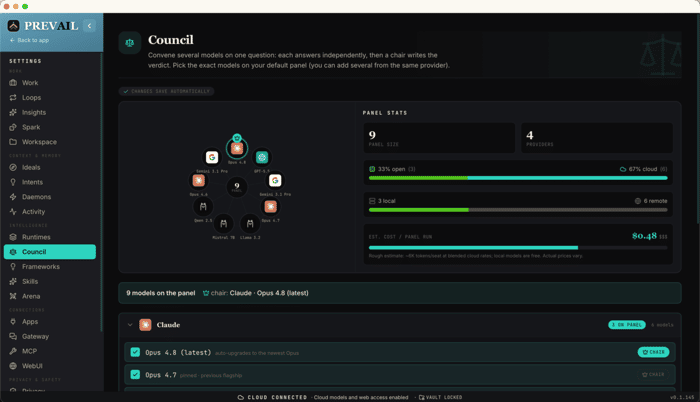
Most AI harnesses like Cursor and Claude Code wrap a model around your codebase.
I spent the last few months building one that wraps a model around you: your personal life, where there is no IDE, no repo, and no clean source of truth.
It’s called Prevail.
It’s a native desktop app built with Tauri + React 19 for macOS and Windows, signed and notarized.
The two core bets:
Model-agnostic: Bring your own model, cloud or local through Ollama. I did not want users locked into one AI lab or one provider.
It learns you: Persistent context means the system compounds in value over time instead of resetting every new chat.
The hard parts have been less about the chat UI and more about the infrastructure around it:
Signing and notarization across macOS and Windows
Bundling the CLI engine as a sidecar inside a desktop product
Making the local-model path feel genuinely usable, not like a developer-only fallback
Designing persistent personal context without making it feel creepy or opaque
It is still early, but it is free: https://prevail.sh
I would genuinely value feedback from other founders on two things:
Does “AI harness for life” communicate the product clearly?
For a personal AI product, should cloud be the default with local as an option, or should local/private mode be much more central from day one?

Interesting concept, and the Cursor/Claude Code comparison gets the starting idea across well. What I'm missing is the practical part: how does it actually "ingest" someone's personal life without a structured source of truth like a repo? E.g. does it read notes, email, calendar all together? And how does it decide what's relevant when there's no fixed structure like in code? Curious about the mechanism behind it, not just the analogy.
The positioning question feels bigger than the product question.
Goals, decisions, context, memory, life operating system, personal AI... they're all close enough that early validation could point in several directions at once.
The challenge may not be whether people find it useful.
It may be deciding which use case deserves to define what Prevail actually is.
I built Prevail because I think the next AI harness should not just understand your codebase, it should understand your goals, decisions, context, and the parts of life that do not fit neatly into an IDE.
Would love honest feedback on the product, positioning, and what would make this useful in your own life.