Priorities for launching a SaaS solo, with no budget
I built my first SaaS. I launched it at the start of May, about seven weeks ago. First time building anything, and I was non-technical when I started. I learned the stack as I went.
I see a lot of posts written for founders who have a budget. This isn't that. This is for the ones who have almost nothing but the idea, and the idea is burning. Here's what actually moves the needle when you're one person with no money (it's only my expririence, so i can be wrong.).
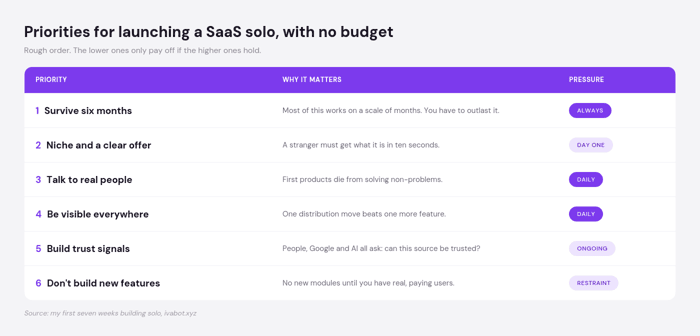
Rough priority order.
-
Survive six months first.
This is the frame for everything else. Cost your MVP to the bare minimum, don't assume it pays for itself early, and keep a runway of at least six months, because almost everything below works on a scale of months and you have to still be standing when it does. -
Niche, product and a clear offer are one thing.
Decide who it's for, and who it's against. Then build one useful thing that closes a real question for that person, not ten half-things. And make it readable in ten seconds, because if a stranger can't tell what it does and why they'd care, they're gone before the rest of this list even starts. -
Talk to real people.
Test on real users from day one, collect feedback, rebuild around it, repeat. Reading the posts here, the pattern I keep noticing is that first products fail less because of bad code and more because they solve something nobody needed. That's the trap I'm most afraid of myself, and the only way I know to avoid it is to stop guessing alone and let real conversations be the validation. -
Distribution. Be visible everywhere.
Networking, launches on relevant platforms, other people's newsletters, Reddit, communities, social. For me, one newsletter mention brought more real traffic than the launch itself. I've come to think one good distribution move beats one more feature. -
Build trust signals for every traffic source at once.
Author, a real face, an About page, a real human or team behind the product. This is the one I feel most strongly about, because my background is in SEO and I can see how much weight it now carries. It lifts you with people, with Google and with AI citations at the same time. Solo founders skip it because it feels cosmetic, but in the AI era every channel is asking the same question: who is this source, and can it be trusted. -
Measure, and don't build new features.
Understand what's actually working before you do more of anything, and get users to the moment the product becomes useful to them. Then the hard part: slap your own hand every time you want to build a new feature instead of getting users. I promised myself no new modules until customer 50, and holding that line is harder than building would be.
That's my list.
What did I miss? What would you move up or down based on your expirience?

Thanks for the post, Galyna! I’m just starting out on this solo journey myself with a fresh MVP and zero testers so far.
Point #6 about slapping your own hand hit hard—the temptation to keep adding new features instead of putting the tool out there and talking to users is a challenge. Thanks for the grounded tips and the much-needed reality check!
Thank you, that means a lot. The hand-slapping is the hardest part, I still fail at it regularly. And zero testers at the MVP stage is normal, I had that for months. What is your MVP about?
Hey Galyna! I built FreelanceFend which is an AI-powered Chrome extension and web app risk-shield that spots scope creep, hidden payment traps, and toxic client red flags across freelance platforms like Upwork before a freelancer pitch. My goal is to save a freelancer time & $$ in vetting a potential client.. Still grinding away at getting my first real beta users, so I really appreciate the encouragement!
That is a clear problem and a painful one, everyone who freelances has signed something they regretted. Good luck with the first beta users. One thing that worked for me: I stopped looking for testers and started answering people who were already complaining about exactly that problem. The complaint threads are where your users are.
Great post Galyna!
This is exactly what new solo founders need to hear. “Survive six months first” and not adding new features until you have real customers are gold.
Thanks for sharing your experience — really helpful 🙌
Thank you, that means a lot 🙌 Those two are the ones I learned the hard way, so I'm glad they land for someone earlier in the journey.
Really grounded post — the 'niche, who it's for and who it's against' point stood out. I'm building a small tool that helps solo founders pressure-test whether an idea has real pain behind it before spending the runway. If you ever want a second pass on an idea async, I'm glad to share it — no cost, no call.
Thanks, glad it landed. What is your tool called, and do you have a link? Curious how it works.
Hey Galyna,
Congrats on shipping :)
The no-budget launch is genuinely hard but the constraint forces good prioritisation. You’ve basically covered most ground. Having launched a number of products, this is my playbook, it’s got a bunch of what you mentioned but the order is based on what compounds first.
The honest reality is the first 90 days is mostly manual. I’ve done it enough times that I’m thinking of turning my playbook into a mini guide. But overall, you’ve got the gist. The goal is to find the one or two channels where you get a signal, then do more of that. What category is the SaaS in? Happy to get more specific on where your buyers are likely lurking :)
Best comment I have had on this post, thank you. Your order is the one I am following.
Your first point is where I am worst. Finding people who have the problem and will actually talk is my hardest problem, and almost all my useful feedback has come from this forum.
The category is SEO tools, an audit covering both classic search and AI search. The dashboard tracks positions and backlinks alongside AI citations, brand mentions and prompt results across ChatGPT, Perplexity and Google AI Overview.
Given how much you know here, would you be comfortable giving me feedback on it? The AI visibility side is where I would value your eye most. Happy to return the favour on anything you are working on.
Same boat — I'm only a few days into launching my first thing too(just beta for now), so take this as a fellow beginner, not advice from above. The one I'd move up is "talk to real people": for me, the niche and the offer fell out of the conversations; they weren't something I decided first.
The point I keep circling is your "no new features until customer 50." Willpower didn't hold for me — the urge to build always wins. What helped was making the "not now" an explicit call instead of a daily fight: every idea goes into a backlog ranked by priority, and if it's not near the top, it just doesn't make it onto the roadmap yet. The ranking decides for me, so there's nothing to resist. Did the trust-signals stuff actually move anything for you pre-launch, or only once you had users?
Totally with you on the backlog ranking. Taking it out of daily willpower and letting the priority list decide is exactly the move. I keep trying to hold the line with sheer discipline and losing.
On trust signals, yeah, they worked, but only when they were genuinely real. A real face, a real About page, a real human behind it, not a stock photo and a fake team. The AI era rewards the real thing and quietly ignores the cosmetic version. Done properly it started paying off even pre-users, because Google and AI read those signals before a single person does.
Taking this one with me — "real over cosmetic, and Google/AI clocks it before any human does." The backlog stuff I've got; that reframe is the new piece for me. Thanks for the detail, really useful.
I'm glad it was helpful. Good luck with your project!
This is a fantastic list and I wish that I had applied some of the things you've mentioned a lot sooner. I've been building something for just over a year and I am just starting on the distribution stuff. The big thing that I wish I'd done early on (your #3, 4, 5) is expose the product to more people. I think that was/is a psychological step that is so difficult to get past; exposing your product, especially when it's your first, is exposing yourself (to criticism) and that just feels terrifying at times.
You put it exactly right - the longer you build, the scarier it gets to show it, because now there's a year on the line and exposing it feels like risking all of that at once.
Same for me: the pull for feedback and the fear of it are the same feeling, just pointed in two directions. Posts like this one are what pushed me to actually make my calls. If I'd known this earlier I'd have done a lot differently.
But it's a first product. That's what it's for, you take the hits, you learn, and the next one starts from a smarter place.
The point about external perception compounding everything really resonates — I'm early in that phase myself, currently working through free directory listings (G2, SaaSHub, TrustRadius, etc.) before I've got any reviews to actually show. Feels a bit like building the stage before there's an audience, but the logic of "look legitimate before you ask for trust" makes sense. How long after your first listings did you start seeing any of that translate into actual conversations, or is it still too early to say for you too?
For me it was one directory that did it — after my Product Hunt launch a directory picked me up, and that listing brought my first paying users, more than the launch itself. So the stage-before-the-audience thing paid off, just not from where I expected.
Honestly it wasn't the big-name directories that moved it, it was that one unexpected pickup. So I'd say list everywhere, but don't count on any single one — you can't predict which listing turns into real conversations until it does.
That's really useful to hear — the unpredictability of which one converts is exactly what makes it hard to optimise for in advance. Just cover the ground and see what sticks. Which directory was the unexpected one, if you don't mind sharing?
Correction to my own answer, and thank you for asking, because it made me go back and check the data instead of trusting my memory. It was not a directory. The pickup was the Superhuman AI newsletter, a few days after the Product Hunt launch, and that is where the first paying users came from. Over a thousand visitors, and I did nothing to get it, which is why it stuck in my head as a directory surprise rather than what it actually was.
The point I was making still holds, just with the right source. Cover the ground everywhere, because the thing that converts is usually not the one you were counting on. Directories did give me a traffic bump later, but the paying users came from a newsletter I never pitched.
Thank you for going back to check — that's more useful than the memory version. Newsletter pickup with no effort beats any directory, and the broader point still holds: you can't predict which channel converts. Superhuman AI newsletter is good to know about too.
Glad it was useful. One thing worth adding, since it is the part I got wrong: I never pitched them, so I have no repeatable method to hand you. What I do know is that they picked up the Product Hunt page, which means the launch was not the channel but it was the thing that made me findable. That is the version I would act on. Treat launches and directories as surface area rather than as traffic, and assume the conversion comes from somewhere you did not plan.
"Surface area rather than traffic" is a much cleaner way to think about it than what I had. That's the version I'll keep.
A great list indeed, especially the part about slapping your own hand to avoid building new features. As solo founders, we often hide behind coding because it feels like progress, but distribution and talking to users is where the real business is built.
One thing I’d underline or move up is the 'language of the user' during those early conversations. Capturing the exact phrases they use to describe their pain helps you write that 10-second readable offer effortlessly. If you use their words, your landing page copy stops being marketing and starts sounding like their own inner thoughts.
We're all in the same boat here. Even as an SEO with years behind me, I found it way more comfortable to build than to promote — shipping ideas is more fun and psychologically easier than saying them out loud.
And you nailed the language point, I'd underline it too. Capturing users' exact phrases is the whole game — when the landing copy uses their words, it stops reading like marketing and starts reading like their own inner voice. Bonus in the AI era: those are the same phrases people type into ChatGPT and Google, so their words don't just convert better, they're how you get found in the first place
Totally agree. It’s wild how the 'lazy' way of just using their exact phrasing is actually the smartest SEO/AI strategy, too. It cuts through the noise because it’s exactly what they’re already thinking.
"Survive six months first" is the right frame everything downstream assumes you're still standing.
The thing I'd add to your priority order: the hard part isn't choosing priorities once, it's re-choosing them every single week when ten things feel urgent. What's kept me sane as a solo founder is a brutal weekly rule: I pick only the top 3 things that move me closest to the one goal, and everything else consciously waits. The output of prioritizing isn't a to-do list, it's a not-do list.
The other unlock was decomposition. A goal like "get first paying customers" is too big to start, so it sits there generating guilt. Breaking it into mini-tasks small enough to actually begin is what turns the priority into motion. I got obsessive enough about this loop that I now run my whole week through AgileTask (an AI sprint-planner I built) — and somewhere along the way started using it for personal decisions too, same move: decompose the scary thing, pick the 3 that matter.
What's your method for the re-deciding part week to week?
"My method's a bit different in practice. I keep two layers: the big priorities that shift with feedback — like rebuilding around what users actually say — and a set of standing daily tasks that just run in the background no matter what: commenting on LinkedIn, Reddit, anywhere on-topic I can actually be useful.
The big ones I re-decide weekly against the one goal. The background ones I don't re-decide at all — that's the point, they're not up for daily debate, so distribution keeps happening even in the weeks the priorities eat my head. Same spirit as your not-do list, just split by time horizon.
Great list. One thing I'd add to the distribution section: social media content is one of the highest-ROI ways to stay visible as a solo founder — but it's also one of the biggest time sinks. I built an AI tool called Buzzly specifically for this: brand name + niche + tone → 3 platform-ready posts in seconds. No signup. Great for founders who need to stay consistent on LinkedIn/Twitter without spending 2 hours writing posts.
This is a strong list especially the emphasis on distribution and trust signals. One thing I’d add (or expand within trust) is how external perception compounds everything you mentioned.
At the early stage, people don’t just evaluate the product they validate it elsewhere before deciding. So even if you’re doing distribution right weak or unmanaged public feedback can quietly cancel out that effort.
I’ve seen this become a hidden bottleneck for solo founders: the product improves, traffic grows but conversion lags because the narrative outside the product isn’t aligned with the value inside it.
There’s a way to structure that layer early so feedback, reviews and public sentiment actually reinforce your growth instead of working against it. When that’s dialed in it tends to amplify everything else on your list.
Curious if you’ve started seeing that effect yet with your traffic sources.
Fair point that external perception compounds everything, people do validate elsewhere before deciding. Honestly though, I'm at an earlier stage than that problem: I don't yet have enough public feedback or reviews to manage, I'm still gathering the first conversations. So for me the bottleneck right now isn't misaligned external narrative, it's simply not having enough of one yet. The reputation layer matters, but I think it earns its place a bit later, once there's real volume of outside signal to align.
One thing I'd add:
Don't confuse building with validation.
As a solo founder of WorkZo AI, I spent months adding features because I thought more features would attract more users.
What actually moved the needle was watching real people use the product.
A 5-minute conversation with a user gave me more valuable insights than a week of coding.
Some of our biggest improvements—simplifying onboarding, improving CV extraction, redesigning the interview flow, and making feedback more actionable—all came directly from user feedback, not my assumptions.
Today, before building anything new, I ask:
"Has at least one user asked for this?"
That question has probably saved me hundreds of hours.
Features don't build businesses.
Users do.
"Has at least one user asked for this?" is the cleanest version of the rule I've seen, I'm stealing that as a literal checkpoint before building anything. And "features don't build businesses, users do" is the whole thread in one line. I learned the same the slow way: a 5-minute conversation routinely beats a week of coding, and almost every real improvement came from watching people use it, not from my assumptions. Good luck with WorkZo.
The point about distribution running parallel to building is the one I'd move up most. I just launched a subscription tracker (SubRadar) and the biggest mistake was treating distribution as "step 4" — you finish building and realize you have no one to tell.
One thing I'd add between your points 3 and 4: capture the exact words users use when describing the problem, not just whether they have it. Those phrases become your copy, your SEO anchors, and your positioning. It's the difference between writing "track your subscriptions" and writing what your first users actually said to you.
Both land. Distribution as "step 4" is the classic trap, you finish building and realize there's no one to tell. I made the same mistake, built almost everything before talking to anyone.
And capturing the exact words is the one I keep relearning: "track your subscriptions" versus whatever your first users actually said is the whole difference between copy that bounces and copy that clicks. Their phrasing becomes the positioning, the SEO anchors, all of it. Good luck with SubRadar.
The order on this list is solid but the comments pushing distribution even higher are right. Most solo founders treat distribution as step 4 or 5 when it should basically run in parallel with building from day one, otherwise you finish a great product and have nobody to show it to. The language point in the comments is the one I'd underline the most. Understanding the exact words customers use to describe their pain isn't a nice to have, it's the difference between copy that gets skipped and copy that makes someone stop scrolling because it sounds like their own thought.
Both right. Distribution in parallel from day one, not step 4, I learned that the hard way, finished and had no one to tell. And the language point is the one I'd underline too: copy that "sounds like their own thought" is exactly it. When the words are theirs, people stop scrolling because it reads like something they already said.
Finishing and having no one to tell is such a specific kind of quiet failure. Nothing breaks, nothing fails loudly, you just realize the silence was the problem the whole time. The copy point ties into that too. If you spent zero time talking to people while building, there's no way the words end up sounding like theirs because you never heard how they actually talk about it.
"The silence was the problem the whole time", that's exactly it. And you closed the loop perfectly: skip the conversations while building, and the words can't come out sounding like theirs, because you never heard how they say it. The two failures are the same failure.
Two failures being the same failure is a good way to put it. Skip the conversations, lose the language, and then wonder why the copy doesn't land. The root was always the same thing.
Really solid framework and the order feels right. The point about trust signals resonates most because solo founders skip it thinking it is cosmetic but in the AI era every channel including Google and LLMs is asking who is behind this before amplifying it. I am building snapinstaink which is a browser based Instagram media retrieval tool and the only distribution that has actually moved the needle for me is community seeding where someone discovers the tool through a genuine mention while solving a real problem in a thread, which converts far better than any paid channel.
Agreed, community seeding is the one that's worked for me too: a genuine mention while solving a real problem in a thread converts far better than anything paid, because the trust is already there before they click. And you nailed why it matters now, every channel, Google and LLMs included, is asking "who's behind this" before amplifying it.
Really resonated with this — I'm about 56 days into my first SaaS, also non-technical when I started.
The one I'd add between 3 and 4: choose one community before you try to be everywhere. I wasted early time spreading thin across platforms before I committed to going deep on one. Being genuinely present in one place built more trust faster than being marginally visible in five.
Your point 5 on trust signals is the one I underestimated most. I skipped it early because it felt cosmetic, then realised Google, people, and AI tools are all asking the same question at the same time: who is this, can I trust it?
I'm building for convention vendors and indie creators — the same "I spend more time prepping than making" pain you opened with. Funny to see it come up here too.
56 days in and non-technical at the start, we're on nearly the same clock. Your add is right: one community deep beats five shallow, genuine presence in one place builds trust faster than being marginally visible everywhere. I learned that the slow way too.
And yes on trust signals, I also skipped them early as cosmetic, then realised people, Google and AI tools are all asking the same question at once: who is this, can I trust it.
Funny that the "more time prepping than making" pain shows up in your niche too, convention vendors and indie creators. Same wound, different trade. Good luck, sounds like you're building it for the right reason.
Point 3 hit me hard. I'm a couple weeks into my first product
too and the thing that's saved me most is exactly this,
talking to users before I was ready. I built for surgical
trainees and the first resident who tried it told me she
couldn't even get through the login. Nothing in the code
told me that. She did.
The distribution point is where I'm at now. I am a tech guy and marketing, distribution and the busienss side of it is the pain for me now. I'm trying to get more eyes on my product. I am at a weird spot where some people say it is a really nice idea but most people haven't completed the process and gave me feedback. Curious what
that newsletter mention looked like did you pitch it or
did someone find you organically?
"Nothing in the code told me that. She did." That's the whole lesson in two lines.
On distribution, your buyers aren't in the usual SaaS spots, they're in medical ones: residency programs, surgical education faculty, society and college groups, conference channels. In medicine trust travels through institutions, so one warm intro from a program director beats a hundred cold posts. Go narrow and human. But i guess you know it better then me.
On the newsletter: organic, not pitched. After my Product Hunt launch the Superhuman newsletter picked it up on its own, over 1,000 visitors. I did nothing to get in.
That framing helps a lot. I have been doing the cold outreach to individual residents and it is slow but the conversations are real. The program director angle is something I have not tried yet and you are right that one warm intro there probably unlocks a whole cohort rather than one person at a time.
The newsletter pickup is interesting. Did you do anything to make the product easy to write about or did it just happen to land in front of the right person at the right time?
Honest answer: both, but less luck than it looks. The pure luck was being noticed at all. What made it easy to write about wasn't an accident though: the product answers a question people are anxious about right now, "does AI actually see and cite my site", and that fits in one sentence. Newsletters pick what they can explain in a line and what their readers already care about, so a clear, timely one-liner does half the work.
So if I were deliberate about it, and I'm only now realizing I should be, I'd make the product trivially easy to describe in one sentence tied to a current pain, then put it somewhere visible like Product Hunt and let the angle do the work. For you that might be one sharp line about the prep-versus-practice pain you solve for trainees. The clearer and more timely the sentence, the more "luck" tends to find you.
Yep, I agree and I was not trying to imply that luck did the work. I wish it did. Thank you for your insight on Product Hunt and yes the one sentence angle is something should look into and I will. If you have anything else other insights platforms I'm all ears and experience of people like you really help first timers like me. For me as a CS guy writing the code was not the hard part but I had 0 idea on how to get more eyes and people trying the product out. I'm still figuring out.
You've got this, the fact that you're already asking the right questions puts you ahead. And honestly, I'm still learning too, but if I can help, I'd be glad to. Feel free to circle back anytime you get stuck.
Strong list, but the gap is pricing: nowhere does it say charge money, and that is the one validation that survives. People are generous with feedback and stingy with cards, so a paid yes at even $9 tells you more than ten enthusiastic calls. I would also flip 'survive six months' to 'get to first revenue fast,' because cutting costs buys you time but only paying customers prove you are building something worth defending.
Agreed on charging, and I already do, pay-as-you-go from day one. A paid yes at $9 really does beat ten enthusiastic calls; people are generous with feedback and stingy with cards.
On flipping "survive six months" to "get to first revenue fast", I'd keep both rather than swap. Revenue proves you're building something worth defending, you're right. But runway is what lets you survive long enough to find the version people pay for. First revenue is the proof; six months of runway is the room to earn it. They're not rivals, they're the floor and the goal.
"One good distribution move beats one more feature" is the line that hit hardest here. When you're solo, distribution eats your time: newsletter copy, social posts, community replies, landing page copy, cold outreach. All of it needs writing, and writing gets slow when you're already stretched across coding, support, and ops. I built DictaFlow for exactly this. It's a hold-to-talk dictation app that types into any app, so I can dictate newsletter copy, replies and docs at speaking speed instead of typing speed. When you're a team of one, cutting friction from the bottleneck that touches everything is usually the right move.
Trying to stand out with good distribution is getting harder and harder i find. Even when trying to find your specific niche, people really hate being "sold" to.
Better to focus on building relationships and demonstrating value.
Exactly! People hate being sold to, but they don't mind being helped. The shift that works for me is showing up with value first and letting the product come up only when it's genuinely relevant. Relationships and demonstrated value compound; pitching burns out fast. Slower, but it's the only thing that's actually held.
One thing I'd move higher on the list is learning to charge early.
Over the years, I've seen founders spend months validating interest, collecting feedback, and growing traffic, only to discover that none of it translates into willingness to pay.
A conversation is useful. A signup is better. But a paying customer teaches you things that neither of those can.
Everything gets clearer once money enters the feedback loop.
Agreed, and it's the one I didn't have to learn the hard way, because I charge from day one, pay-as-you-go. You're right that money clarifies everything: a free user loving it and a stranger entering a card are different signals entirely, and only the second one is real. The paying ones taught me more than all the enthusiastic free users combined.
Missing from this list: pre-sell before the product exists.
"Talk to real people" is right but incomplete. Conversations are filtered through the other person's optimism -- people will tell you they'd use something they would never actually pay for. The test that cuts through it is asking them to pay at the real price before the thing works.
We did this with a legislative monitoring tool for small businesses -- tracking government bills before they affect payroll, taxes, or hiring. Put up a pre-order page before writing any backend code (billwatch-landing.vercel.app). Within two weeks we had real signal: actual conversion, not survey data. The people who did not convert told us why (price wrong, not their problem, bad timing). Both types of outcome were useful.
The other thing about pre-selling: it forces you to write the ten-second readable offer before you build the product. If you cannot get someone to click pre-order on a landing page, you have not solved the positioning problem yet. Building the landing page first has saved us at least two months of building the wrong thing.
You're right that conversations are filtered through optimism, people say they'd use things they'd never pay for. The cleanest cut is real payment at the real price, fully agree.
For me the pre-sell stage is already behind me, in a way: the product exists and has actual paying users, which is the same signal a pre-order gives, just one step later. So I get the proof you're describing from real payments rather than a landing page.
The part I'm keeping from your point is the positioning test: if you can't get someone to click pre-order, you haven't solved the offer yet. Same logic applies to me, if a stranger doesn't get the value in seconds, no payment follows. That's the discipline I'm carrying over, even without a pre-order page.
This is a solid list. The “one good distribution move beats one more feature” line really hits.
I’m also building solo, and the trap I keep noticing is that building feels productive and safe, while distribution feels messy. So it’s very easy to convince yourself that one more feature will make marketing easier.
I’d probably move “make the offer readable in ten seconds” even higher. When you have no budget, every visit matters. If people don’t understand the product immediately, you don’t even get useful feedback — they just leave.
The only thing I’d be careful with is “be visible everywhere.” I agree with the spirit, but for a solo founder it might be better to pick one or two channels long enough to actually learn what works.
Agreed, and the sharpest part is your middle point: if people don't understand the offer in seconds, you don't even get useful feedback, they just leave. So unclear positioning costs you twice, the visit and the lesson. That's why I'm moving the ten-second clarity up. And yes on "everywhere", the version I've landed on is depth in one or two channels long enough to actually learn, then expand.
The section on trust signals in the AI era is the one I'd put at the top, honestly. You put it at number 5 but I think it's quietly running the whole game right now. When AI can generate a landing page, a logo, and a product description in two hours, the thing users are trying to figure out is whether there's a real person behind the product who owns it and understands it. That signal has gotten harder to fake and more valuable because of it. The other thing I'd add to your list is about the feature discipline point. "No new modules until customer 50" is the right instinct and the hardest thing to hold. The version of this I've seen break most often with solo technical founders is when a customer asks for something and it's technically easy to build, so it gets built before the founder has validated that it solves the underlying problem. Speed of building becomes the trap. Distribution and actual usage signal are slower, but they're the only ones that tell you if the thing matters. What's the product solving, if you're comfortable sharing? I'm curious where you landed on the niche.
You might be right that trust quietly runs the whole game now. When AI can spin up a landing page, logo and copy in two hours, the one thing users are actually checking is whether a real person owns and understands the product. That signal got harder to fake and more valuable at the same time.
Your point on the feature trap is sharper than mine: it's not "hard to build" that gets you, it's "easy to build." When a request is technically trivial, it gets shipped before anyone checks whether it solves the real problem. Speed of building becomes the trap. Noted, and a little uncomfortable, because that's exactly the version I'm prone to.
On the product: IvaBot, an SEO and AI-visibility audit tool. Where I landed on the niche is solo founders and small SaaS owners who know search matters but have no time to figure out what to fix first. Not "another metrics dashboard", the value is that it prioritizes, tells you what to fix and in what order, in plain language. That focus came partly from conversations like these.
Your point 5 on trust signals is the one I'd move up the list. I work in digital marketing and the sites that consistently win are the ones where you can tell within seconds there's a real person behind it. A face, a real about page, a consistent voice. In the AI era that matters even more because the bar for looking legit keeps rising.
The no new features until customer 50 rule also resonates. The hardest part isn't knowing the rule, it's actually holding the line when building feels more productive than distributing. Most people give up on that rule around customer 10.
One thing I'd add between your points 3 and 4: wherever you find your first users, try to understand not just what they think of the product but what words they use to describe the problem. Those exact words tell you how to position, what to write on the landing page, and where to show up in search. You don't need 50 conversations for that, sometimes 8 to 10 is enough to spot the pattern.
Agreed on trust signals, and your framing is sharper, in the AI era the bar for "looking legit" keeps rising, so a real face and consistent voice stop being optional. And you're right that the hardest part of the customer-50 rule isn't knowing it, it's holding the line when building feels more productive than distributing. Most people break around 10, I catch myself reaching for it weekly.
Your addition is the one I'd act on: capture the exact words people use for the problem, not just their opinion of the product. Those words become the positioning, the landing page, and where to show up in search. And good to hear 8-10 is enough to spot the pattern, that makes it feel achievable rather than a far-off "50 conversations" goal.
This is a useful post!
If you are a non-technical person building a technical product, a few things you need to keep a check on:
All three of these I've felt firsthand. The subscriptions budget is real, the per-run and tool costs creep up quietly when you're non-technical and not watching them, so I track that closely now. The security audit one I learned the hard way too, AI will happily generate an endpoint with no auth check and won't flag what's missing, so I went through and locked mine down after launch. And "ideas won't stop at v1" is the trap I'm actively resisting, the discipline now is to keep talking and researching without letting every new idea turn into more building.
Solid checklist, thank you.
The "survive six months" line is the one I'd underline twice. Where it goes wrong in that stretch is using signups as your morale gauge, because under ~50 they're too noisy to mean much, and one flat week will convince you it's broken when nothing's wrong.
What kept me going was scoring myself on inputs I control instead of outcomes: a set weekly number like five real conversations and three posts shipped, tracked in a plain note. On the weeks the inputs hit and signups didn't, I had proof I was still moving, and the results always showed up a month or so after the work went in, never the same week.
This is one of the most useful things anyone's said here, and it lands right on something I struggled with this week. I'd been reading noisy outcome numbers on tiny samples and letting one flat day convince me something was broken, when nothing was.
Scoring yourself on inputs you control, a set weekly number of real conversations and posts shipped, tracked in a plain note, is the fix I needed. On the weeks the inputs hit and the results didn't, you've got proof you're still moving instead of a false alarm. And your point that results show up a month after the work, never the same week, is exactly the patience I keep failing at. I'm setting an input scorecard this week. Thank you.
This is such a grounded post — really helpful for first-time founders. Especially the “survive six months first” and “no new features until customer 50” parts really hit home.
One thing I’d be curious about: since you were non-technical when you started, how did you handle the technical side of distribution and tracking in the beginning? Any no-code tools?
Also, out of your list, which one turned out to be the hardest for you?
Honest answer: feedback was the hardest of all for me, harder than any of the six. I'm non-native, and I don't have friends who speak English, so even getting minimal feedback was difficult. Indie Hackers turned out to be my first real place for it, this thread included.
On the technical side as a non-technical founder: I leaned on no-code and low-code the whole way. Webflow for the site, Make for automation and payment flows, Supabase for the database and auth, all wired together with AI as my teacher. Tracking is honestly still the weakest part, my attribution is a mess and fixing it (proper tagging) is on my list right now. So I won't pretend I solved that elegantly, I didn't yet.
And which priority was hardest: getting real feedback. Everything else I could do alone at my desk. That one needed other people, and finding them without an audience or a network was the part I had no shortcut for.
The point about distribution being more important than one more feature really resonates. I launched a $12 product last week with $0 budget and 0 followers, and I spent way too long perfecting it instead of showing it to people early.
One thing I'd add: pre-schedule your distribution. I set up 14 posts across 3 weeks in a scheduler in one afternoon. Now my content runs on autopilot while I focus on the conversations that actually bring users. That fixed the "I should be posting daily but I'm building" tension.
What's been your most surprising distribution channel for zero-budget launches?
$12 with zero budget that's the spirit of this whole thread. Respect.
And the pre-scheduling tip is genuinely good. Batching 14 posts in one afternoon so content runs on autopilot while you focus on the conversations that actually convert, that fixes the exact "I should be posting but I'm building" tension I keep feeling. Stealing that.
Most surprising channel for me: a newsletter mention after my Product Hunt launch brought over 1,000 people, far more than the launch itself. I did nothing to get in, so the lesson was that a trusted source filtering the audience beats me shouting into the void. Of the channels I control, organic search plus AI citations is the quiet, compounding one.
The 'no budget' constraint actually forces better prioritization than having money. You can't hire away problems or buy growth, so you're forced to get product-market fit with your own work. What surprised you most about which priorities actually mattered vs. what you thought would matter?
Yes, fully agree, the constraint forces a cleaner plan with no room for fantasy. You build with your own hands, so you can't lie to yourself about what's working.What surprised me most: talk first, then build. I genuinely thought it was the other way around, build the thing, then show it to people. Turns out the conversations should shape what you build, not react to it after. Learning that in reverse cost me months, which is exactly why it's on the list.
One thing I'd move higher is user conversations.
I've been speaking with a lot of early-stage founders lately, and many of them actually have feedback already — it's just scattered across emails, DMs, Discord messages, support chats, and random conversations.
The hard part isn't collecting feedback. It's knowing which signals represent a real problem and which ones are just noise.
As solo founders, we often compensate uncertainty by building more features. But sometimes one honest conversation can save weeks of work.
Really thoughtful post.
Honestly, I'm a step behind that. My problem right now isn't filtering noise, it's collecting feedback at all, getting enough real people to say anything in the first place. The noise-versus-signal skill probably comes later, and when it does, I agree it's mostly pattern recognition plus watching the stats over time. But first I have to get the conversations flowing. One thing at a time.
Seven weeks in, non-technical at the start, and you're already writing the post most people wait two years to write. The point about trust signals resonates more than people realize, I've seen products with solid traction lose ground simply because there was no real human visible behind it, and that gap is getting more expensive as AI-generated content floods every channel. The distribution insight about one newsletter mention outperforming the launch is something I wish more first-timers heard early, because the instinct is always to keep building when the real leverage is in getting in front of someone else's audience. Curious what your MVP stack ended up being, given you learned it as you went.
Thank you, that means a lot. And you put the trust gap perfectly: as AI-generated content floods every channel, a visible real human behind the product stops being a nicety and becomes the moat. That's exactly why I lead with being a real person, not a faceless tool.
On the stack, learned entirely as I went, non-technical at the start: Webflow for the marketing site and blog, GitHub Pages hosting the actual tools (React written as plain JSX, no build step, just IIFE-wrapped files), Supabase for auth and database, Make for the automation and payment flows, DataForSEO for the search data, OpenAI for the analysis and chat, and Stripe for payments. AI was my co-teacher the whole way, I'd build a piece, break it, ask why, and rebuild.
The hardest part wasn't any single tool, it was wiring them together safely, especially the payment and credit logic. Honestly the "glue" between services taught me more than any individual piece.
The "glue" insight is underrated, most breakdowns I've seen of no-code or low-code stacks talk about individual tools but skip how much judgment goes into connecting them without things falling apart at the edges. Payment and auth especially, because that's where real user trust lives. Thanks for laying that out so clearly.
Exactly, and you named the part that matters most: payment and auth are where the glue either holds or breaks, because that's where real user trust lives. Get the connections wrong there and it doesn't matter how good any single tool is. Thanks for seeing it, and good luck with what you're building.
The "build a piece, break it, ask why, and rebuild" loop is honestly a better learning method than any course because the context is always real. Most people hit a bug and just want it fixed, you turned every break into a lesson which is why the wiring held. That Supabase plus Make plus Stripe combo without a traditional backend is a genuinely clever architecture too, curious how you handled edge cases in the payment flow when Make automations failed mid-sequence.
Good question, it's where I spent the most careful hours. The thing that keeps a mid-sequence failure from causing damage is idempotency: every payment and refund event carries its Stripe ID, and once an ID is processed it can't be processed again, so a retry or a re-sent event never double-counts. Stripe also re-sends webhooks if it doesn't get a success, so a failure mid-way isn't lost, it comes back around, and the idempotency makes the replay safe. And anything that touches balances is clamped so it can't go negative. Between those, the cases that actually happen are covered.
Something I'd add from shipping 10+ apps over the past few years: your "no budget" constraint is actually an advantage you might not see yet.
When I had budget, I threw money at Google Ads before validating whether people actually wanted the product. Burned through thousands on keywords that sounded right but attracted the wrong users. The data looked good (clicks, impressions) but real conversions were near zero.
When I had to do it without budget — community comments, genuine replies in relevant threads, writing about real problems I'd solved — the feedback loop was slower but the signal was dramatically cleaner. The people who found me through a helpful Reddit comment or a Dev.to article already trusted me before they landed on the page. Conversion was 5-10x higher per visitor.
Your point about one newsletter mention beating the launch is the perfect example. That's not luck — that's what happens when a trusted source filters the audience for you instead of you paying to interrupt strangers.
The one thing I'd push back on: "be visible everywhere" only works if you're genuinely adding value in each place. Two channels where you're known as the helpful person beats eight channels where you're background noise. Go deep where your buyers actually hang out, then expand once one channel is working.
This reframes the constraint better than I had it. "No budget" as an advantage because the signal is cleaner, that matches exactly what you describe: paid clicks looked great and converted near zero, while someone who arrives through a helpful comment already trusts you before the page loads. Pre-filtered trust converting 5-10x higher is the whole argument in one number.
And you're right that the newsletter wasn't luck in the way I framed it, a trusted source filtered the audience instead of me paying to interrupt strangers. That's a sharper way to see it.
Fully take the pushback too: two channels where I'm the helpful person beats eight where I'm background noise. That's where I'm landing, depth in the few I can actually add value to, expand only once one is working.
This resonates a lot. I just launched my first product with zero budget too — built a React dashboard template and used free tools (Vite, Lemon Squeezy) for everything. The hardest part for me was payment setup, not the actual building.
Same here, the build was the calm part, the payment setup was where I lost the most time and nerves. Stripe, webhooks, refund logic, all the edge cases nobody warns you about. Funny how the "hard" engineering turns out easier than wiring money in safely. Good luck with the template, sounds like a solid first launch.
"Stop guessing alone and let real conversations be the validation."
That line probably resonated with me the most.
I realized recently that I spent months improving Ashive mostly from my own perspective. The moment strangers started using it and giving feedback although it's only 1, I learned more in a few days than I had from weeks of building.
I'm still trying to unlearn the habit of treating building as progress and conversations as something I'll do later.
Looking back, was there a specific conversation or piece of feedback that changed how you saw the product or customer the most?
Yes, that line is the one I had to learn the hard way too.
The piece of feedback that changed the most wasn't even spoken, it was behavior. My early users would run one audit, get the result, and never come back. That silence told me something a survey never would: I'd poured everything into the one-time result and left no reason to return. It reframed the whole product from "a report you run once" to "something you come back to and track." That's why I'm building a dashboard now.
And honestly, this very thread did the same at a different level, strangers naming gaps I couldn't see from inside. One conversation rarely flips everything, but the pattern across many quietly redraws the map.
That's really interesting.
The behavior vs feedback distinction wasn't something I'd thought about before.
For Ashive, one thing I'm starting to wonder is whether I have a similar problem. Someone might get a useful answer once, but I still don't know what would make them come back a second time.
Looking back, how long did it take before you realized the issue wasn't the first-use experience, but the lack of a reason to return? and what is your solution for it?
Exactly that. I saw payments but no return visits, and that forced the question: am I giving too little value (probably not), or is there simply no reason to come back (definitely the second). Comments in another branch of my thread here made the same gap obvious to me.
So I'm wiring the audits and tools into a dashboard, where someone can refresh just the part of the data they care about, without re-running tools they don't need, and track only what interests them, when it interests them. The audit becomes something you return to on your terms, not a one-time report.
This is a very helpful priority order. The two points that stand out most to me are “niche and clear offer” and “don’t build new features.”
I’m also at the early stage of building an AI SaaS, and it is tempting to keep improving the product because that feels safer than distribution. But I’m realizing that a stranger needs to understand the value in a few seconds before any extra feature matters.
The trust-signals point is also important, especially for AI products. A real founder profile, clear explanation of what the product does, pricing, support pages, and honest limits probably matter more than founders realize.
If I were adding one thing to your list, it would be: create a simple repeatable feedback loop. Every traffic source should teach something — who clicked, who tried it, what confused them, and what stopped them from paying.
Agreed, and your addition is the one I'd actually act on: a simple repeatable feedback loop where every source teaches you something, who clicked, who tried it, what confused them, what stopped them from paying. That last one is the hardest to see and the most valuable.
It connects to something I'm fixing right now, my attribution is a mess, so I can't yet tell which source teaches what. No point building the loop until I can tell channels apart. So step one for me is tagging, then the loop you describe. And you're right that "understand the value in seconds" beats any extra feature, the feature only matters after the stranger has already decided to care.
Exactly — that feedback loop is the real growth system.
For a solo launch, I’m realizing the goal is not just “get traffic,” but learn what each source actually tells me:
I agree with you on tagging first. Without source tracking, every launch channel becomes a blur and it is hard to know what actually worked.
And yes, “understand the value in seconds” is probably the highest-leverage product work before adding more features. If the value is not obvious quickly, the feature depth does not matter yet.
Exactly that. Tagging first, then the loop, and "value in seconds" before any feature depth. You've summed it up better than my original list did. Good luck with your AI SaaS.
Thank you Galyna— I appreciate that. I’m learning that for a solo AI SaaS, the launch system has to be simple: clear value, source tracking, and fast feedback from real users. That’s what I’m focusing on now before adding more feature depth.
The one I would move to the top is charging money, not measuring usage. I have watched bootstrapped founders (and done it myself) treat signups and active use as validation, then find out the willingness to pay was never there. Put a price on it from week one, even a small one, because a free user saying they love it and a stranger entering a card are two completely different signals.
Agreed, and it's the same lesson as the "fake validation from friends" point others raised: a free user loving it and a stranger entering a card are completely different signals. Praise is free, a payment isn't. I do charge from day one, pay-as-you-go, and that one filter has told me more than any amount of enthusiastic free usage. The few who paid taught me more than the many who didn't.
Numbers 4 and 5 are the ones I keep underrating, then regretting. On no budget, distribution basically is the product for the first few months.
One thing I'd add to "be visible everywhere": it now includes the AI engines, not just Google. I run a marketplace called Flevy, and a few months back I started checking what ChatGPT and Perplexity say when someone asks them to recommend a tool in our category. The same 3 or 4 names kept coming up, and we were not one of them. None of it showed in analytics, so I had no idea it was happening.
So my cheap version of number 4 has been getting listed and mentioned in the places these models actually read from: directories, a couple of subreddits, comparison posts, and anywhere with a real backlink. It is slow, but it doubles as the trust signals in number 5, and it seems to compound.
Out of your first 7 weeks, which single channel actually moved the needle most? Everyone says be visible everywhere, but I am curious which one place paid off the most for you.
Your AI-engine point is exactly the shift I built around, what ChatGPT and Perplexity say when someone asks for a tool in your category is invisible in analytics but it's a real ranking that's already decided. Checking that, like you did, is something almost nobody does yet. And you're right that getting into the places those models read (directories, subreddits, comparison posts, real backlinks) doubles as the trust signals in #5 and compounds. That's the whole bet behind my product, actually.
On your question, honest answer: the single biggest was a newsletter mention after Product Hunt, over 1,000 visitors with real signups, but I can't take credit, it found me. Of the channels I actually control, organic search plus AI citations is the one that's slowly but reliably moving the needle. The newsletter was the spike, organic is the compounding.
I keep noticing lot of new solo prenuers are building new SaaS every day.. I totally agree only few survived. The real challenge now is the product market fit and feedback which is the real challenge. Building the platform no longer an issue especially with AI.
Exactly. AI made building the easy part, so the bottleneck moved to fit and feedback. Everyone can ship now, few can prove anyone needs it. That's the real filter today.
The "no new features until customer 50" rule is solid. Building is fun. Talking to users is usually where the real progress happens.
Exactly. Building is the comfortable part, the real progress hides in the uncomfortable conversations.
One thing I'd add:
Distribution isn't just about being visible.
It's about being remembered.
A lot of founders get attention once.
Very few create a reason for people to think about them again a week later.
Feels like repeat exposure is where trust starts compounding.
That's a sharp distinction, attention once versus a reason to come back a week later. Most founders win the first and never build the second. Repeat exposure is exactly where trust starts compounding, and it's the same logic as retention inside the product: one visit proves interest, the return proves it mattered. Building for the second one now.
This is a great list, and #5 (trust signals) is the one hitting me hardest
right now. I'm building a tool that connects to people's Stripe to recover
failed payments — which means I'm literally asking strangers to trust a
brand-new product with the most sensitive part of their business. No
reviews, no track record, just "trust me with your money flow."
What I'm learning: trust isn't one signal, it's stacking the small ones.
Read-only access first so nothing can break. Connecting through Stripe's
official OAuth so it's their trust in Stripe, not in me. Being upfront that
I'm pre-launch and that's exactly why it's free. Your point about the AI era
asking "who is this source" applies doubly when the source wants payment
access.
On #3 (talk to real users) — agree it's the cheapest validation. The thing
I keep relearning: the objection people give you is the roadmap. Every
"but what about X" is a trust signal you haven't built yet.
Re #6, the "no new features until customer 50" line — saving that one.
Curious how you're handling the tension when an early user asks for a
feature that'd genuinely close a deal but isn't in your core?
The "objection people give you is the roadmap" line is excellent, every "but what about X" is a trust gap you haven't closed yet. And your stacking approach (read-only first, Stripe's own OAuth so it's their trust in Stripe, upfront about being pre-launch) is a clean example of trust as many small signals, not one big claim. With payment access you're playing that game on hard mode.
On your question, the honest answer: the rule isn't "never," it's "not on a single voice." If one early user asks for a feature that'd close their deal, that's one data point, and one request is a story, not a pattern. I'll happily do something manual or hacky to close that specific deal, but I won't build it into the product until I've heard the same thing from several people who feel the same pain. The discipline is separating "this would close one deal" from "this keeps coming up." The first I solve by hand, the second earns a place on the roadmap.
"Not on a single voice" is the cleaner version of what I was fumbling
toward — thank you. The "do it by hand for one deal, build it only when
it keeps coming up" line is the discipline I keep failing at, because
hacky-for-one-deal feels productive in the moment. Saving that framing.
And yeah, payment access is hard mode — but it's also why I think the
trust-stacking has to be the product, not a footnote. If I get that part
right, it's a moat; if I get it wrong, nothing else matters. Appreciate
you engaging this deeply, Galyna — genuinely useful.
Glad it was useful, Ivan. And you've already got the key insight for your case: when the product is payment access, trust-stacking isn't a footnote, it's the product. Get it right and it's the moat. Good luck with the build!
Great list, and #5 is the one I'd argue is most underrated by solo founders — you nailed it. Coming at it from the same SEO-in-the-AI-era angle: I'd add that "trust signals for every source at once" now includes being machine-readable, not just human-readable. Things like a clean llms.txt, structured data, and making sure your site isn't accidentally blocking AI crawlers (a lot of people are, often without realizing it) directly affect whether an AI assistant will cite or recommend you. That's a channel that barely existed two years ago.
The one I'd personally move up is #3 (talk to real people). For me it's not just validation — it's the cheapest way to find the edge cases competitors ignore, which is often where your actual differentiation lives. The thing nobody asked for is usually sitting right next to the thing everybody needs.
On #4, agree completely that one good distribution move beats one more feature. The trap I'm watching for is picking distribution channels that are already saturated. The newsletter mention working better than your launch tracks with that — it was a less-crowded, higher-trust channel.
Re #6 — "no new modules until customer 50" is a brutal but smart line to hold. Curious: when you do talk to those early users, are you finding they ask for new features, or for the existing one to work better? That distinction has saved me from building a lot.
Strong additions, and we're clearly coming from the same place. The machine-readable point is right: structured data and not accidentally blocking AI crawlers genuinely affect whether you get cited, and most people don't check.
One careful caveat on llms.txt though, since it's our shared turf: Google recently confirmed it doesn't use llms.txt and it won't help or hurt rankings. It may matter for other systems later, but right now I'd put the effort into clean, crawlable HTML and structured data rather than llms.txt specifically.
Your #3 angle is the sharpest, edge cases as the source of differentiation. "The thing nobody asked for sitting next to the thing everybody needs" is going in my notes.
On your question: honestly, more "make the existing thing work better" than "build something new", but I have to listen carefully, because the loudest requests are for new things and the quieter, more useful signal is friction with what's already there. That distinction has saved me too.
Thanks for the llms.txt correction — you're right, and I went and verified it: Google confirmed in mid-June it doesn't use llms.txt for Search or AI Overviews, and Mueller likened it to the old keywords meta tag. What pushed it home for me was traffic data someone published — across ~500M AI-bot events, the citation-driving crawlers (GPTBot, ClaudeBot, PerplexityBot) almost never fetch llms.txt. So even for the non-Google engines it's unproven at best right now.
Where I've landed: keep it (harmless, near-zero upkeep, might matter for agents later) but stop treating it as an AEO lever. The things that actually move citation share look like the boring fundamentals you'd expect — crawlable HTML, JSON-LD, and not accidentally blocking AI user-agents. The one genuinely new surface I'd add is the agentic layer: exposing your tool/data so an AI agent can call it directly, not just read about it. That's turning out to be a different game from "get cited in an answer."
And yeah — that "quieter signal is friction with the existing thing" point is the real gold in your reply. The loud requests mislead; the wince when someone describes their current workaround is the signal.
The agentic-layer point is the one I'll chew on. Getting cited in an answer and letting an agent call your tool directly are genuinely different games, and most of us are only playing the first. The first is about being described well; the second is about being usable by a machine without a human in the loop. For a tool like mine that's a real fork in the road, not just a feature. Thank you, this is the freshest thing I've taken from the whole thread!
Glad it landed — and you framed it better than I did: "described well" vs "usable by a machine without a human in the loop." That's exactly the fork.
The part I keep underestimating is how different the work is on each side. Being described well is a content/positioning game — clean pages, clear claims, structured data. Being callable is a product game — you have to design actual tools (good names, tight input/output, honest error messages) because there's no human to paper over a confusing UI mid-task.
What surprised me building mine: the second forces a kind of honesty. If a tool returns garbage or guesses when it doesn't have data, an agent will surface that to the user immediately — there's no marketing copy in between. So it pushed me to make the tool say "I don't have this" instead of bluffing.
Curious whether it's a fork for you too, or if your product sits more naturally on the "described well" side?
It's a fork for me too. Right now IvaBot lives on the "described well" side (for my opinion), but the core engine is literally a tool: give it a URL, get back a structured audit. That's already the shape an agent could call, I just haven't exposed it that way yet.
And honestly, this is the kind of feedback I act on, not just nod at. This whole thread has already changed what I'm building, the dashboard, the positioning, and now the callable angle goes on the list to think through seriously. Thank you, this was the sharpest exchange of the whole post.
That's the thing — you're already 90% there and probably don't feel like it. "Give it a URL, get back a structured audit" IS the tool contract. The audit engine doesn't change; exposing it just means wrapping that same input→output as something an agent can call instead of only your UI.
The one design decision I'd think about early: granularity. My instinct was to mirror my internal API (lots of small endpoints), and that's wrong for agents — they do better with fewer, more complete tools. For IvaBot I'd guess one tool ("audit this URL, return the full structured report") beats splitting it into ten. Design around the question a user actually asks, not your internal routes.
And the honest-output thing matters double for an audit tool: when the agent relays your findings with no human filtering them, a vague or padded audit gets exposed instantly. Tight, specific output is what makes it trustworthy in that context.
Really glad this was useful — genuinely the best kind of thread, where it changes what we each go build next. Keep me posted on where IvaBot lands with it.
You know, this hit the mark, thank you for such a generous tip.
I actually just removed a lot of endpoints from the audit. My instinct is to give as much as possible to be useful, but I can see how the intent blurs and quality drops when I do. So your granularity point landed right where I'm already feeling the pull.
"Designed around the question the user actually asks", after July 1 I'll finish the rebuild and ask users again. I genuinely need that feedback, to check I understood it right and rebuilt around them, not around my own fantasies.
On the agent and explanations: yes, I've spent a huge amount of time on the prompts. Every answer that comes back, I run through my 15 years of experience and try to explain it clearly, because the tool was meant as a helper, an assistant, not another complex and expensive instrument.
And really, thank you. Conversations like this are genuinely valuable to me. You gave me a lot.
This made my day to read — and the fact that you'd already started cutting endpoints before I said anything tells me you have the right instinct; you just needed permission to trust it.
What you said about the tool being a helper, not another complex expensive instrument — that's the whole thing, honestly. Fifteen years of experience compressed into a clear answer is worth more than ten more features. The hard part isn't adding capability, it's having the judgment to leave things out. Sounds like you have that.
The "ask users again after the rebuild" plan is exactly right too — the only real test of "did I build around them or around my own fantasies" is putting it back in front of them and watching. Hope it confirms what you're feeling.
Thank you right back — this was genuinely one of the better exchanges I've had here. Good luck with the July 1 rebuild, and I'd love to hear how the user round goes if you remember to circle back.
Your "no new features until customer 50" rule is the one I'd defend hardest — I run a few small apps and every time I stalled it was because I built instead of talked to people. One thing I'd add under "measure": separate curiosity metrics from return metrics early. A launch spike tells you the pitch is interesting, not that the product is needed — the number I actually trust is whether someone comes back in week three without me nudging them. With no budget you can't buy attention twice, so retention is the only asset that compounds. I'd also nudge "trust signals" up the list: as a solo founder, the "who is this one person and why should I trust the thing" question kills more conversions than a missing feature does.
The curiosity-vs-return distinction is the sharpest thing here. A launch spike tells you the pitch is interesting, not that the product is needed, and I confused those two more than once. The number I'm learning to trust is exactly yours: does someone come back in week three without me nudging them. With no budget you can't buy attention twice, so retention is the only thing that compounds.
That's actually why I'm rebuilding around a dashboard people return to, instead of a one-time audit they run once and forget. And agreed on trust signals, the "who is this one person and can I trust the thing" question kills more conversions than any missing feature.
Rebuilding around a dashboard instead of a one-time audit is the right instinct, but the trap is that a dashboard only earns the return if something on it changes between visits that the user didn't generate themselves. If it shows the same numbers they already expected, it quietly becomes a report they check once. What pulls people back is a delta they didn't make happen — a new flag, a trend that moved while they were away. So the question I'd sit with: what changes on that dashboard between Tuesday and Thursday with zero action from the user? If the honest answer is "nothing," the return habit won't stick no matter how good the UI is. Get one living signal in there and everything else rides on it.
So far my plan was: the user runs audits, and I'd refresh some data now and then so they come back to see "what changed." But you're right, most of that delta is still user-generated, and the weak week is when they touch nothing.
So I'm now thinking the heartbeat has to be a signal that moves on its own: rankings drifting, a competitor getting cited in AI answers when the user isn't, a new brand mention, backlinks shifting. One of those as the living signal, with the user-run audits as the "did my work pay off" layer on top.
If you had to pick one to start with, which would you make the heartbeat?
If reliability and emotional pull point in different directions here, I'd let reliability win for the heartbeat itself — because a heartbeat that fires falsely spends the exact trust we just agreed conversions depend on.
"A competitor got cited in an AI answer and you didn't" is the most powerful of your four by a mile — it's pure loss aversion and it's where attention is heading. But it's also the least deterministic: LLM answers wobble run to run, and the first time you cry wolf about a citation that wasn't really there, the whole dashboard becomes "that thing that lies to me."
So I'd start the heartbeat with new brand mentions: it moves on its own, it's cheap and reliable to detect solo, and it's a positive surprise — which builds a return habit the user isn't dreading. Rankings I'd actively avoid as the heartbeat; small drift is noise and people go numb to it fast.
Then make the AI-citation gap your headline signal once you can fire it without false positives. That's your real differentiator — it's just too important to ship while it's still flaky. Earn the return on the signal you can trust, and graduate to the one that stings.
Okay, three minutes later and this idea has completely got me — taking it into the plan now.
Brand mentions / visibility is exactly where I'd start the heartbeat: already tracked at domain level, cheap and reliable to detect solo, positive surprise not a dread. Building it into the dashboard soon. Genuinely one of the most useful things anyone's said about the product — thank you.
Ah, only seeing this now, sorry for the late reply.
Right now it's honestly the weak version you described: data refreshes when the user runs an audit or hits refresh, so most of the delta is still user-generated. The quiet week where they touch nothing is exactly where it falls down.
What I'm taking from your reply is the heartbeat idea — one signal that moves on its own between visits. Brand mentions is the natural first pick since I already track it domain-level, it's cheap and reliable to detect, and it's a positive surprise rather than a dread. AI-citation gap I'll hold as the headline for later, once I can fire it without false positives.
Really useful framing, thank you — the 'what changes between Tuesday and Thursday with zero action from the user' question is the one I'll actually sit with.
The biggest time-saver for me solo: don't rebuild the boring infra. My first month went into auth, RLS, payments, image handling, GDPR — and I realized it's the same plumbing under almost every SaaS. If I restarted, I'd get that scaffolding done in a day and spend the rest of my time/budget on the actual product instead.
I ended up packaging the infra I built into a Next.js + Supabase starter. Happy to send a free copy if it'd save you the same month — no strings, just after honest feedback.
The "don't rebuild the boring infra" point is real, my first weeks went into exactly that, auth, RLS, payments, GDPR, the same plumbing under every SaaS. If I started over I'd want that done in a day too.
For me though it's already built and working, so I'll pass on the starter, thank you for offering. Good luck with it, it's a genuinely useful thing for people at day zero.
I love the "slap your own hand every time you want to build a new feature" rule. As solo builders, it’s so easy to hide behind coding a new feature because marketing and talking to users feels uncomfortable. Feature-creep is the ultimate form of productive procrastination.
Your point about trust signals in the AI era is also spot on. With ChatGPT, Perplexity, and Google AI Overviews taking over search, these engines prioritize structured, verifiable sources with real authors and trust signals. If the AI can't verify who is behind the data, you won't get cited.
Holding the line on zero new features and focusing entirely on distribution is incredibly hard, but it's the only way to survive the first six months.
Solid list, Galyna! Rooting for your journey.
Thank you, warm comment. And yes, I'm no different from any other solo founder here, even as a non-technical, non-coder person, it's still easier for me to hide behind building new features than to do the uncomfortable marketing and user conversations. That rule is by far the hardest one to hold. The pull to "just add one more thing" never fully goes away, you only get faster at catching yourself.
And you put the AI trust point perfectly: if the engine can't verify who's behind the data, you don't get cited. That's the whole game now.
One I'd add for the AI era: regulatory blindspot mitigation. A bill can change your product's legality or cost structure before you hear about it. State privacy laws, EU AI Act, sector rules. Solo founders typically find out from panicked tweets after it's too late.
I've been building something for this: tracking the legislative pipeline for bills that affect small software businesses. Pre-orders live at billwatch-landing.vercel.app if that's a gap you feel.
That 'slap your own hand' rule until customer #50 is brutal, but honestly the most critical boundary on this list. Most solo founders fail because they end up building a ghost town with perfect features.
Since you asked what to move up or down: I’d actually argue Trust Signals belongs right at the top with the clear offer. First impressions are purely visual and psychological; a stranger decides in 5 seconds if a bootstrapped tool looks sketchy or legitimate. Your SEO perspective here is spot on—having a real face and story does more for early conversions than any fancy feature.
One small thing I’d add for zero-budget builders: Reducing feedback friction. Don't just give early users a cold contact form. Put a direct link to your personal DM, or a micro-widget where they can talk to you instantly. If they feel like they are building it with you, they become your champions.
Massive respect for shipping this as a non-technical founder in just 7 weeks. Curious, how did you pitch that first newsletter to get featured without a budget?
Would love to stay connected and follow your journey. I’m tinkering with some product ideas myself, and this mindset is exactly what I needed to read today.
The feedback-friction point hit me, that's exactly how I like to work. Personal contact, where someone's opinion genuinely matters and we decide together what's useful for them and for me, not me extracting from them. I hadn't framed it as a product decision, but you're right, it turns early users into champions. I'm adding it.
On the newsletter, honest answer: I didn't pitch it at all. After my Product Hunt launch the Superhuman newsletter picked it up on its own, over 1,000 people came from it. So I'd love to give you a clever tactic, but it was luck, not outreach. The only thing I "did" was launch somewhere visible and have the product ready when attention came.
And yes, let's stay connected, I'm easy to find by my name, here and on LinkedIn. Good luck with the product ideas, glad this landed at the right moment for you.
Customer discovery before building > everything else. Most solo founders
skip it and build the product they think people want, then spend months
wondering why no one's buying. Talk to 10 target customers first, take notes,
then decide what to build.
Agreed, and after all the comments here saying the same, I'd move customer discovery to the very top of my list. Build the thing they described, not the thing you imagined.
The ‘no new modules until customer 50’ rule is the line I’d pin above the desk. Building feels productive, but for a solo founder with no budget, conversations and distribution are usually the real product work.
Haha exactly, I keep slapping my own hands to not get pulled into a big rebuild. The urge never really goes away, you just learn to catch it faster. Pin it above the desk indeed.
That is genuine experience you've got. I do face those myself as I am starting out my journey as solo builder too.
You give me a second thought about adding new features. Right now I am working on a project, trying to get users, and thinking of add new features to attract users.
But listening to you, I would better focus on improving the distributions, which I am doing at very minimum right now.
Thanks for the advice.
I really relate to this. I learned some of these rules only after I'd already built the product, so earlier is better, it saves time, budget and nerves.
And yes, instead of building new features to attract users, it's usually better to first find people in your product's niche and get honest feedback from them, then put your energy into distribution. Features rarely pull users in the way we hope, the conversations and being findable do. Good luck with it.
really insightful thought
Thank you!
That's great advice! I just launched my product for free and am actively trying to increase users
Glad it helped! And honestly, some of these I picked up from IH comments myself, so I'm just passing them on. Good luck growing your users.
Thanks!
The "everywhere = nowhere" point is the one I'd underline.
I'm pre-launch on mytubefeed (nightly AI digest of your favorite YouTube channels) and the distribution question is keeping me up more than any technical problem. Every channel feels urgent when you have zero users.
The approval vs pain signal distinction someone raised is the one I'm trying to internalize before I start driving traffic. "Oh, cool..." reactions are everywhere. People who actually feel the problem badly enough to change behavior are a different thing entirely.
The approval-vs-pain thing is worth internalizing before you drive any traffic, you're right to slow down on it. "Oh cool" costs people nothing, so it tells you nothing. The signal is someone changing behavior: coming back, asking pointed questions, getting annoyed at a missing piece. Chase the irritation, not the applause. Good luck with the launch.
Did you start it as a side hustle/project or were all in?
A bit of both, honestly. I freelance as an SEO consultant, that's what pays, but the product itself I went almost all-in on. The idea came from being tired of paying so much for SEO tools, and AI is what let me actually turn the idea into something real.
And once I started, I got so deep into the code, the database, the payments setup, that I ended up writing, rewriting and rebuilding it nearly full-time. So not a quiet side project, more like a freelance income on the side and the product eating most of my hours. :)
I agree with the point about distribution beating features. As an engineer, it's tempting to keep building because that's the comfortable part. Getting users and talking to them is usually much harder, but that's where the real validation comes from. Curious what distribution channel has worked best for you so far besides the newsletter mention?
Agreed, building is the comfortable part, talking to users is the real work. Besides the newsletter (which was luck), the channel that works most reliably for me is organic search plus AI citations, slow but compounding. After that, exactly this: genuine comments on IH and Reddit. Both are mine to control, unlike the newsletter.
Great timetable - thank you.
Six months - clock started. I'll report back then
Haha please do, I'd genuinely love to see where you land in six months. Set the clock and come back, good luck till then!
Your number one is right but most people get it backwards. They pick a time horizon (six months) and divide their savings by it to feel safe. The more useful version is figuring out your actual monthly cost to keep going. Not just server bills but the personal expenses that don't stop while you're pre-revenue. Health insurance, quarterly tax estimates if you had any prior income, all the stuff that's easy to forget when you're focused on building.
Once you have that real number, you can make better decisions about when to take on contract work to extend runway versus when to stay heads-down on the product. I've seen founders burn through savings faster than expected because they never separated "business costs" from "life costs" in any real way.
The constraint you set on yourself with no new features until customer 50 is smart. The financial version of that discipline is knowing your actual weekly burn and checking it against reality every month, not just trusting the original estimate.
Your comment clearly comes from living it, that's what makes it land. You're right that the dangerous mistake is dividing savings by months and feeling safe, instead of knowing the real monthly burn, life costs included, not just servers. Even with a six-month budget, business stays risky, and the way not to burn out later is exactly what you described: count every detail and check it against reality each month, not once at the start.
As a solo dev saas/tools, I can relate at every cited step cited. Recently i started one of my business with zero budget for promotion, it's an hard task but the hard work pay. Loved your post
Thank you! Exactly, no budget is slower but clearer. You feel every gap and fix the real ones, and the customers who come are genuine, the ones you actually earned. Very organic, like you said. Good luck with yours.
Greetings!
Checked your product earlier and honestly it feels like something Reddit users would naturally talk about because the underlying problem already gets discussed there often.But right now there’s almost no visibility around your brand itself yet.Just wondering, are you mainly relying on SEO and ads currently?I think people on reddit would actually discuss this
Thanks for checking it out! Yes, I'm building visibility organically and on purpose, so Reddit presence is low for now, but that's a choice of sequence, not a gap. SEO and AI citations are my main focus, no ads.
You're right that the underlying problem gets discussed there a lot, and Reddit is on my list, just a bit later. Right now I'm focused on a few product improvements first, then I'll show up in those conversations properly rather than half-ready.
Great tips! Overall very accurate and goes to show that most of the work is not building the product. Once the core problem is solved, it is everything around that which will determine success. Completely agree with the list!
Thanks! Exactly, the build is the small part, everything around it decides the outcome.
Going through this exact phase right now. The priority that has paid off most for me: before touching the landing page or the launch, go talk to people who already pay a competitor for the problem you solve. They hand you the real pitch in their own words, and everything downstream converts better. With no budget, your edge is doing the unscalable stuff nobody with a budget bothers to do.
The "talk to people already paying a competitor" angle is the sharpest part. They've decided the problem is worth money, so they hand you the language and the gaps in one go. And the unscalable stuff is exactly the solo advantage, the slow personal things a funded team skips.
This is a masterclass for solo founders. 'Cost your MVP to the bare minimum' is the best advice on here. Thanks for sharing your experience!
Thank you, that means a lot. And funnily enough, "cost your MVP to the bare minimum" is the one I learned by accident, my rough, hand-built version is exactly why I'm still standing to have this conversation.
one I spotted from watching - a user kept working around my feature instead of using it. the other three people asked for in the same week, which had never happened.
That's the cleanest example of the two signals working together. The one you spotted, a user routing around the feature, is behavior, the most honest signal there is, people vote with what they avoid. The three same-week requests are the pattern threshold: one ask is noise, three in a week is a real signal. Watching caught one, listening caught the other. That's the whole discipline in one anecdote.
No-budget solo launch: my priority order has been — (1) 10 conversations with people who have the pain today, (2) one channel where they already gather, (3) everything else later.
Reddit/community replies beat ads at $0 if your buyers are there — but the time sink is finding the right threads daily, not writing the reply.
What's the SaaS and who do you think the first 10 paying users look like?
Thanks, short and sharp. To answer yours first: IvaBot, an SEO and AI-visibility audit tool, and my first paying users look like solo founders and small SaaS owners who know search matters but have no time to dig into it themselves.
Now mine for you, because I genuinely struggle with it: where did you find your people for those conversations? "One channel where they already gather" is the right idea, but actually locating where my specific buyer hangs out, daily, is the part I keep getting stuck on. Curious how you found yours.
Thanks Galyna — and congrats on IvaBot already having paying users, that's further than most at "solo + no budget."
I didn't broadcast — I searched for people already complaining about the problem. For IvaBot's buyer (solo founders / small SaaS), they're usually not in "SEO tool" threads. They're in:
→ r/SaaS, r/Entrepreneur, r/startups — search phrases like "ChatGPT doesn't recommend my site", "how do I get found in AI search", "zero organic traffic", "nobody finds my product"
→ IH posts like the one we're in — founders with live products asking distribution questions (you just replied to one)
The daily stuck part for me was the same as you describe: not writing replies, but finding the 2–3 fresh threads per day where the pain is live. That's what I've been building a small tool for (and still validating myself).
If useful: send me IvaBot's one-liner + 2–3 subs you care about — I'll hand-build a list of recent threads where solo founders describe SEO/AI-visibility pain, with a non-spammy reply draft for each. Free — just want to know if it saves you time. If not, no worries.
This is exactly what I was stuck on, thank you. The shift from "SEO tool" threads to pain-phrase threads is the unlock, "ChatGPT doesn't recommend my site", "how do I get found in AI search", "nobody finds my product".
On the offer: genuinely kind, and I can tell you're validating your own tool with it, which is fair. I'll pass on the reply drafts, though, the replies are the one thing I want to keep fully in my own voice, that's the whole asset right now. But the finding part is the real pain, you're right. If your tool ends up just surfacing the live threads and leaves the writing to me, that's the version I'd actually want to try.
Good luck with it, and thanks again, this was the most useful answer I got to that question.
Feed's ready — 9 pain-phrase threads for IvaBot (AI search / ChatGPT visibility):
https://threadscout-theta.vercel.app/feed/11e63329-65f4-4741-bc51-a58a82b7b660
Scored 1–10 + why each matched. Ignore the draft replies — write in your own voice. The finding part is what I need your feedback on.
Does this save you hunt time vs searching manually?
That's really useful feedback — and honestly matches where I'm heading: the hard part is the daily hunt, not the writing. Anyone can paste a thread into their own LLM.
The feed I'll build for you is scored threads + a reason why each matched. It does include draft replies today, but ignore those completely — treat them as optional noise. What matters is: live threads where someone describes AI-search / visibility pain in their own words.
If that sounds right, send me a one-liner on IvaBot + 2–3 subs you care about (or I'll default to r/SaaS, r/SEO, r/smallbusiness with phrases like "ChatGPT doesn't recommend my site", "AI search visibility", "how do I get found in AI search").
I'll drop a feed link here in ~24h.
Thank you, your product genuinely caught my interest. I'll bookmark it and think it over properly.
What I clearly like, and would use: the links to the found threads where I can actually leave a comment. The finding part is the real value, that's the daily bottleneck, not the writing.
What I wouldn't use in its current form: the generated replies. They read too AI, and Reddit and the SEO subs spot that fast, it would hurt more than help. What would make it powerful is letting each user set their own tone of voice, their values and rules, like a mini prompt, and generating from that. Then the drafts would sound like the person, not like a model.
Right now the finding is the strength, the replies are the part to rethink. I'll take a closer look a bit later. Thanks again.
This is exactly the feedback I needed — thank you.
Finding as the product, replies as optional (or off): that's where I'm landing too.
if the feed were discovery-only (no drafts at all), would that alone save you enough daily hunt time to be worth ~$19–39/mo? No pressure — your answer shapes what I build next.
Honest, personal answer, just my own view: I'd pay up to $20, not more. Up to that, because I genuinely liked how much it found, the finding is the real value and the daily bottleneck for me. Why not more than that: F5Bot, Google Alerts and a few other options already make the finding free.
So to justify going above $20 you'd have to clearly beat them on signal, tighter buyer-pain matching, the relevance scoring, less noise, fresh threads. The "why each thread matched" part is the bit free tools don't do, and that's what would make $20 feel fair to me rather than overpriced.
Really helpful, $20 ceiling actually aligns with what I'm testing: founder intro at $19/mo for discovery-only (scores + why each thread matched, no drafts you have to use).
You're right that F5Bot/Alerts make raw finding free. The bet is tighter buyer-pain matching + relevance scoring so you skip 80% of noise — and the "why it matched" line so you're not opening 15 dead threads.
If you want to try it on IvaBot for a month at $19, I can send the Stripe link. Discovery-only, cancel anytime. Fair?
Thank you, and I appreciate the founder price. I'm going to hold off for now, honestly, not because the tool isn't good, but because at my stage I can still do the finding by hand in a daily block using the pain-phrases, F5Bot and Alerts, and my Reddit account is too new to reply freely yet, so I'd be paying to find threads I can't fully act on.
Here's the version where I'd happily pay: once I'm past the manual stage and actually limited by hunt time, and once the relevance scoring clearly saves me from the dead threads. Keep me posted as it develops, and good luck, the discovery-only direction is the right call.
This comment was deleted 3 months ago
This comment was deleted 3 months ago
This is a sharp list, and the fact that you ranked "survive six months" as #1 instead of a tactic tells me you've already absorbed the thing most first-time founders learn too late. Runway is the precondition for everything else working, because everything else works on a timeline of months.
What I'd move, based on pattern:
#3 (talk to real people) should arguably be #2, above building the offer. You can't write the ten-second clarity in step 2 until you've heard real people describe the problem in their words. The offer is downstream of the conversations. Right now they're separate items but they're the same loop — talk, hear the language, build the offer from their words, test, repeat.
What I'd add: a distinction inside #4. "Be visible everywhere" is the one piece of advice here I'd push on. Solo with no budget, everywhere = nowhere. The newsletter mention outperforming your launch is the signal — that's one channel that matched. Better to find the one or two channels where your specific buyer already gathers and dominate those than spread thin across six. Visibility everywhere is a funded-team strategy. Depth in one channel is the solo-founder version.
One thing genuinely missing: a kill criterion. You've got "don't build features until customer 50," which is great discipline. But what's the number that tells you this specific idea isn't working and it's time to stop, not push harder? Without it, "survive six months" can quietly become "spend six months on something the market already told you no." The discipline to not build features needs a twin: the discipline to know when persistence becomes denial.
What's the product, and which newsletter moved the needle? That channel detail is the most useful thing in your whole post.
You've independently landed on the three things this thread converged on: move #3 above #2, "everywhere = nowhere" for a solo founder, and a kill criterion. Other commenters pushed the same, and they've convinced me on all three, especially the kill criterion, which is the real gap in my list.
The kill-criterion line is the sharpest: persistence needs a twin, knowing when it becomes denial. I'm committing to a concrete threshold before I push further, not after.
Your question: the product is IvaBot, an SEO and AI-visibility audit tool, and the channel was the Superhuman newsletter after my Product Hunt launch. Over 1,000 visitors, signups and paying users, and I did nothing to get in. So the honest lesson is it was luck, not a repeatable channel yet.
The "it was luck, not a repeatable channel" admission is honest but worth pressure-testing. Superhuman didn't randomly pick you. Something about IvaBot or the PH launch made it interesting enough to feature. Worth reverse-engineering what that was: category timing, PH traction, positioning angle, or how the product was presented.
If you can name the reason they picked you up, it stops being luck and becomes a pitch you can send to 20 other newsletters in the same tier. "Superhuman featured us, here's what we do, here's the angle" is warm outreach to every newsletter editor in the SEO/AI tools space. One lucky break becoming a repeatable channel is the actual move.
The kill criterion commitment is the right call. Tie it to a leading indicator, not a lagging one. "No revenue by month X" is lagging and you'll rationalize past it. "I've personally reached out to 50 qualified people and fewer than 5 engaged" is leading and harder to argue with.
If you want to pressure-test the positioning or figure out why Superhuman picked you up (and how to pitch it to others), that's exactly the kind of thing HiveMind is built for: https://hivemind.myosin.xyz
You're right, "luck" undersells it. There was real interest, and I know it because that traffic is still bringing people in weeks later, so something about the angle landed. But honestly, I'd never thought to flip it the way you're describing, to analyze why and pitch the same to other newsletters in the tier. That reframe is useful, turning one break into a repeatable channel instead of a happy accident. Noted, and thank you.
And the leading-vs-lagging point on the kill criterion is the sharper version of what I committed to: "50 reached out, fewer than 5 engaged" is much harder to rationalize past than "no revenue by month X." That's the threshold I'll set.
Your "no new modules until customer 50" line is the most valuable thing here, and it's the one most founders break first. I bootstrapped my SaaS and the months I lost were always the ones spent building instead of selling. The one I'd move up: talk to real people belongs above niche and offer, not below it. You think you're choosing the niche, but the conversations choose it for you, and the founders who validate first usually end up building something different from what they planned. That's the point, not a detour.
The customer-50 rule is the hardest one for me too. I catch myself tweaking, removing, adding small things, and I have to actively pull back so I don't get sucked in. Holding it is genuinely harder than building.
And yes, exactly: "you think you're choosing the niche, but the conversations choose it for you." That reframes validation as the point, not a detour.
Which brings me to the question I keep asking everyone here: where do you find those conversations? That's the part I struggle with most, beyond friends, this community, and Reddit, I'm still looking for reliable places.
This really resonates. One thing I struggle with is: how do you actually find real users to test with in the early stages? Especially when you don’t have an audience yet.
Honestly? I'm still figuring this one out myself, and I'll say it openly here in the comments. Beyond my own friends, this IH community, and Reddit, I don't have a reliable answer yet. It's the exact part I find hardest.That's partly why I keep asking other commenters here where they find people to talk to, I'm collecting their answers as much as offering my own. If you watch this thread, a few of them have started sharing real channels worth stealing.
Amazing insights. I 100% agree with your take on product focus—an idea only works if it solves a real, high-value question for a specific group of people. Building less and talking to users more is definitely the way to go. Best of luck with your SaaS!
Thank you, that means a lot. Building less and listening more, that's the whole lesson in one line. Best of luck with yours too.
Great list, and the fact that you put "survive six months" at the top tells me you've actually thought about this and not just collected tips.
One thing I'd move up, or at least make louder inside your point 3: talk to people before you're proud of the product, not after. I'm building profit analytics for Shopify stores, and the most useful thing I did was lurk in communities where store owners complain about money. Not to pitch, just to listen to the exact words they use. Turns out most of them don't say "I need profit analytics." They say "I'm doing 5k in sales but I don't know if I'm actually making anything." Completely different language, and it changed how I describe the product.
The one I'd push back on slightly is point 6. Agreed on not building features, but I'd separate "don't build features" from "don't improve the one thing that makes people trust the number." For me the product is the trust, so polishing how the core result is shown isn't feature creep, it's the whole job. Everything else, yes, hands off until customer 50.
Curious about your point 4. Which newsletter mention was it, and did you reach out or did it happen on its own? That's the part I find hardest as a non-native English speaker doing this solo.
The "listen to their exact words" point is the real gold, "I'm doing 5k but don't know if I'm making anything" beats "profit analytics" every time.
Fair pushback on point 6. The line is where you put it: polishing how the core result is shown isn't feature creep, because the product IS the trust in that number. Everything else, hands off until 50.
On point 4: after Product Hunt I got picked up by the Superhuman newsletter. Over 1,000 people, signups and paying users. I did nothing to get in, so honestly, luck.
On email: I do warm outreach, manual audit then a personal email. I hate it, but it's part of the plan. And I'm not a native speaker either, I write emails with AI, give it my own thoughts and let it fix the mistakes. Not a problem at all, you keep your voice and still don't sound generic. If you think in more than two languages, there's no room for discomfort here. :)
knowing what to build when you can't afford to get it wrong is harder than not having budget. I shipped 6 features in 3 months that didn't move signups before I found the 2 that did.
That's the brutal version of it, and the most honest. Six features that did nothing, then two that did, with no way to know which was which in advance. That's exactly why "talk to users first" costs less than it sounds: it's not about saving the build time, it's about not burning three months on the four that won't matter.
Out of curiosity, what was different about the two that worked, was it something users had actually asked for, or something you only spotted after watching them?
This comment was deleted 3 months ago
Great list. I'd move distribution and talking to real users even higher because early feedback and visibility can save months of building the wrong thing. I'd also add content and SEO as long-term assets. A few helpful articles, tutorials, or case studies can keep bringing targeted traffic when you have no advertising budget. Consistency and solving one painful problem exceptionally well usually beat building more features.
Fully agree. After this many comments saying the same thing, I'm genuinely moving "distribution and talking to real users" to the top of my own list.
And yes on content and SEO as long-term assets, that's the one channel I trust most, slow but compounding. A few good articles keep pulling targeted traffic with zero ad budget, and lately they feed AI citations too. Consistency on one painful problem over more features, exactly.
This is a helpful topic because solo founders with no budget usually do not fail from lack of ideas, but from trying to do too many things at once.
If I had to prioritize, I would put the first 2-3 weeks almost entirely on narrowing the promise and getting direct feedback from real users. A simple landing page, one clear use case, and 10 honest conversations can teach more than polishing features too early.
For distribution, I would probably pick one channel only at the start. SEO, Reddit, cold outreach, Product Hunt, and communities can all work, but doing all of them at once makes it hard to know what is actually moving the needle.
The hard part is staying small long enough. One use case, one audience, one acquisition channel, one clear metric. Then expand after there is a signal.
Very good comment. And yes, I've seen "talk and get feedback first, then build" maybe ten times in this thread now. It's the golden lesson I didn't know until after I'd finished building my product.
On picking one channel: I went a slightly different way, one day per channel. One day I write SEO articles (which double as real value for users), Reddit and Product Hunt I'd also keep ongoing, though I'm still not sure what to post there, so far I only pour my pain into them. Cold email is the one that didn't click for me.
Since you put it on the list, two honest questions: how important is cold email in your own ranking, and does it actually produce results for you? And I know it depends on the niche, but roughly how many emails before the first real reply? A rough number would help.
faydalı oldu teşekkür ederim
Rica ederim! Glad it was useful.
Your point 3 (talk to real people) hits different for B2B tools built around episodic pain.
Compliance and regulatory tracking is the clearest case. A small business owner doesn't think about monitoring wage law changes until a bill actually passes. They're not in pain every day. They're in pain when something happens.
If you validate during a quiet period, you get 'nice idea, yeah we'd probably use something like that.' Then silence when you launch. The signal felt real but the timing was wrong.
Step 3.5 for that type of product: map the trigger event before you map the daily job. Your validation window needs to overlap with their pain window.
Building BillWatch right now (tracks government bills for small businesses - billwatch-landing.vercel.app) and this is the exact distribution challenge. The 'what if a law changes that affects you' pitch doesn't convert the same way 'save 2 hours every day' does. You're selling insurance, not productivity.
This is a sharp addition, and "validate during the pain window, not the quiet period" is the part most people miss. Your 3.5, map the trigger event before the daily job, is the right fix for episodic-pain products.
SEO sits oddly between the two. The pain is constant but invisible: traffic quietly erodes, nobody notices until a launch flops or a competitor outranks them. So the trigger isn't a passing bill, it's a moment of realization, usually a bad one. Part of my job is making that invisible pain visible before the crisis, which is its own kind of hard.
And you nailed it: "selling insurance, not productivity" converts completely differently. That framing alone is worth the comment.
This is one of the more honest founder posts I've read here.
Point 3 and Point 5 together are where most first-time builders quietly fail — and they're connected in a way that's easy to miss.
Talking to real people validates the problem. But trust signals validate you as the person worth trusting to solve it. Both have to work together before anyone commits to paying.
The distribution insight (Point 4) also holds up — but I'd add one layer: distribution without a clear customer journey is just traffic.
One newsletter mention worked for you because presumably the landing experience converted that curiosity into something. Most founders optimize for visibility and ignore what happens after the click. That's where the real leak is.
The 'no new features until customer 50' discipline is underrated. Most products don't fail from lack of features. They fail because nobody mapped the journey from first visit to first value clearly enough for a stranger to follow it alone.
What you're describing isn't just a launch strategy. It's operational discipline — and that's rarer than the idea itself.
This is one of the more honest founder posts I've read here.
Point 3 and Point 5 together are where most first-time builders quietly fail — and they're connected in a way that's easy to miss.
Talking to real people validates the problem. But trust signals validate you as the person worth trusting to solve it. Both have to work together before anyone commits to paying.
The distribution insight (Point 4) also holds up — but I'd add one layer: distribution without a clear customer journey is just traffic.
One newsletter mention worked for you because presumably the landing experience converted that curiosity into something. Most founders optimize for visibility and ignore what happens after the click. That's where the real leak is.
The 'no new features until customer 50' discipline is underrated. Most products don't fail from lack of features. They fail because nobody mapped the journey from first visit to first value clearly enough for a stranger to follow it alone.
What you're describing isn't just a launch strategy. It's operational discipline — and that's rarer than the idea itself.
"Most founders optimize for visibility and ignore what happens after the click" hit me. After my first paying users I realized they had no reason to come back. I'd put so much into the audit result itself that I left almost no need to return. That's exactly the leak you're describing, just one step deeper than the click: the gap after first value. I'm rebuilding the dashboard now so people can come back and track progress over time, turning a one-time audit into something with a reason to return.
And yes, operational discipline, you're right. It's not a phase, it's the thing that has to stay on every single day.
yes, i highly agree to this framework.
Moreover I am trying to build an ai desktop assistance that knows you and your work so you never have to waste your time re-explaining yourself to any ai or do not have to waste time searching for things you had seen a couple of days back. So, I want to talk to founders and ai-native coworkers who works on desktop and understand more of their problems and frustration to get up to right solution for them. ANYONE OR FOUNDERS let's talk!!
Good luck with it, and smart to do the conversations first. When I got my first feedback I was genuinely surprised, I picked up far more useful advice than I expected.
One tip: post this as its own thread so it actually gets seen. A call for conversations buried in someone else's comments is easy to miss, and getting real answers matters too much to leave it here. That's how you start feeling out your strategy.
Thanks for the tip. I will post soon.
Hi founder, can we have a 5 min conversation where we can get to understand more about the product to help me tackle the exact problems what other founders faces.
Glad the tip helped, and good luck with the launch post!
can we hop on a quick G-meet call to understand more about you as a founder, and problems you faces across your workflows?
If there's a specific question I can answer in text, ask it here or by message and I'll happily reply. And genuinely, your best move isn't one call with me, it's that standalone post, you'll get far more founders describing their real problems in writing than any single call could give you. Good luck with it.
Thanks for sharing this. I agree with most of the priorities, especially the focus on validation and talking to users early.
One thing I would add is that when we say "no budget," we often focus only on money. As solo founders, time is usually the scarcer resource.
I've seen developers spend months building features because the monetary cost is close to zero. But if those months could have been spent validating demand, the opportunity cost is actually very high.
For me, the biggest priority would be:
A product can survive a limited budget, but it's much harder to recover from spending six months solving a problem that nobody really has.
I'm curious: if you had to choose only one activity for the first 30 days, would it be customer interviews, content creation, or building the MVP?
Your three steps are exactly how a product should be built. I know that now, the hard way, after building my first one completely backwards.
And the time-is-money point is undeniable: even at zero cost, time still gets spent, and you don't recover those hours.
For me it was softer, because I built for myself first, fast, clear audits I could show clients and they could act on solo or with a small team. I also learned a lot building it, so I'm in the plus, not the minus. But next time I'll do it your way.
Good question at the end: right now I'd pick customer interviews first, then the MVP, and content only after.
which one of these six you personally got wrong first, since seven weeks in you've presumably already broken your own rule on at least one of them before correcting course. the list reads like hard-won lessons, the interesting story is usually which one you violated before you wrote it down as a rule
Honestly, number 3, talk to real people. I broke it the hardest. I built the entire product solo, backend, database, payments, all of it, guided by my own assumptions, and only really started talking to users after launch. That's backwards, and it's exactly why it's on the list. The lesson cost me months, so I wrote it down so I wouldn't repeat it.
Number 6 is the one I'm still violating in real time, fighting the urge to rebuild instead of distribute. So one I learned the hard way, one I'm learning right now.
months-long cost of breaking #3 is the kind of detail that should probably be in the original post itself, "I built the whole backend before talking to a single user" is a much sharper and more memorable version of the lesson than the general rule. curious if you can point to a specific thing you built during those months that user conversations would've told you not to bother with, a concrete example of the wasted work would make the lesson land harder for anyone reading this who's currently doing the same thing
Good push. A concrete one: I spent a lot of that time making the one-time audit result as rich and detailed as I could, polishing the depth of a single report. What I should have built, and what user behavior screamed once I finally watched it, was a reason to come back. People ran one audit, got the result, and left. Nobody needed a more beautiful one-time report, they needed to track whether things improved over time.
If I'd talked to users first, I'd have heard "okay, I fixed these, now what?" much earlier, and built the tracking and return loop from the start instead of a heavier one-shot tool. Instead I'm rebuilding toward that now, months later. So the wasted work wasn't a single feature, it was optimizing the depth of the wrong shape: a report you run once, when the value was in something you return to.
And you're right that "I built the whole backend before talking to a single user" is the sharper line. I might rewrite the post around exactly that.
I’d add one trust-signal angle for solo SaaS: make reliability visible and consequential early.
We just launched Uptimo for indie SaaS founders on Stripe who already use Discord. It watches uptime, auto-posts incidents to Discord, and ties 99.9% uptime to a simple $2/mo SLA penalty mechanic so the status page has real stakes.
Site: dev-uptimo dot nanocorp dot app
That $2/mo number is intentionally small: low enough for a solo founder to offer without enterprise-contract overhead, but concrete enough that reliability feels measurable to customers.
I’d move “talk to real people” even higher.
I built CueBuddy (a voice-following teleprompter) as a solo founder, and one thing I learned quickly is that assumptions are expensive.
Some of the features I thought users would love barely got mentioned. Meanwhile, small things users repeatedly complained about ended up having a much bigger impact on retention.
Also, I’d add one more item:
Ship before you’re comfortable.
As a first-time founder, it’s easy to spend months polishing. Real feedback only starts after real users touch the product.
A rough product with users beats a perfect product with no users.
Great post. Thanks for sharing your experience.
"Assumptions are expensive" is a golden quote.
And "ship before you're comfortable", sorry, that's another one. That's exactly what I did, shipped a fairly raw product. Now I'm finishing it based on feedback, not my own fantasies.
Thanks for underlining the important points with your own experience.
For a solo SaaS, I would prioritize conversations over traffic at the beginning.
My current approach is to validate one very narrow pain point first, then only build around repeated signals from real users.
The hard part is not getting visitors. It is finding people who have the problem strongly enough to explain their workflow, share messy examples, and tell you what they already tried.
So my order would be:
Curious if others here have had better results with content first vs direct conversations first.
You're right, and I learned it the hard way, after building everything. Better late than never.
Your four steps line up with what other experienced founders here keep saying: find people, talk, take feedback, find the pattern, build around it, then check if it actually solved the problem.
Same question I've been asking everyone, though: where do you find the people to talk to about their pain? That's clearly the hard part for me.
On your content-vs-conversations question: I can only speak for myself. Content is a slow but steady path, visitors and signups that keep compounding. Direct conversations are faster and just as effective, but they don't scale on their own. For me it's not either-or, content builds the top, conversations convert it.
#5 (trust signals) is the one I'd defend hardest too — and I'd push it further: make the trust signal something a stranger can independently verify, not just a claim. We run a small hosting company, and the single highest-converting thing we did was publish our live uptime on a public status page. Instead of asking people to trust a number on the sales page, we point them at the record: "check it yourself." Costs nothing, and it quietly answers "who is this and can I trust them" for humans, Google and AI at the same time.
One thing I'd add to #3: don't let "talk to real people" quietly turn into "build whatever the loudest person asks for." The signal is the pattern across many conversations, not any single request — that's a different (and harder) discipline than just collecting feedback. Solid list.
Agreed on both, the verifiable status page especially.
Question for you: which channels did you actually use to get those conversations and feedback? Curious what worked beyond the status page.
Completely agree. We need to start focusing on the few core features that actually make the product worth having, not just the features that we THINK the user wants.
Exactly. And the hard part is telling the two apart, the core features reveal themselves through what users actually do, not through what we imagine they want. Watching beats guessing every time.
I’d move distribution from “be everywhere” to “make each channel land somewhere specific.”
For qualified traffic, create 2-3 acquisition pages per audience/problem so a newsletter visitor, community visitor, and referral all see their exact use case.
That makes it easier to convert visitors before you spend more time building features.
I built Clustra for this — personalized acquisition page clusters for 39€: https://clustra.nanocorp.app
Really solid list especially the “survive six months first” framing. That’s the one most people underestimate.
I’m a solo founder too and I’m building Aureus (AI Business Guardian) focused on the three things that used to eat me alive: real cash runway visibility, smart hiring support, and risk/compliance alerts.
Your point about talking to real people from day one is spot on. I’ve been doing exactly that posting in communities and asking founders what ops pain is currently killing them the most. The feedback has already changed what I’m prioritizing.
One thing I’d add (or move up slightly) from my experience: Make distribution a daily habit, not a launch event. Commenting genuinely in relevant threads, sharing small learnings, etc. has brought me more real conversations than the actual “launch” did.
What’s been your biggest surprise in these first seven weeks something you didn’t expect to matter as much?
Thank you, valuable comment. Fully agree distribution has to be a daily habit, comment with real value and over time it works for you.
A question back, if it's not a secret: which communities did you pick, and which brought the most?
My biggest surprise, at the risk of sounding naive: that communities like this even exist, where people build in the open and find their people. I've spent years on websites, but one-sided work, SEO, content, lately AI visibility. This is my first product where I wrote the code, built the backend, the database, payments, all of it, alone, and it was painfully hard. Posting here showed me I'm not the only one with that pain, and real people gave me working advice that flipped my world. Live feedback beat everything I scraped together solo.
Insightful post. I wish I had read it years ago.
The "Collect (measures, feedback), don't guess" philosophy could have saved me months...
Thank you. And honestly, I learned the "collect, don't guess" part right here too, from people in threads like this one. Now I'm just passing it on. We're all a few months ahead of someone and a few behind someone else.
"Don't build new features" until customer 50 is genuinely underrated advice that deserves to be #1 for most people. The tension is that talking to real people (your priority 3) almost always surfaces feature requests, and it's very easy to convince yourself that building one more thing is "customer development" when it's really just procrastinating on distribution. I'd personally add "pick one acquisition channel and go deep" somewhere in the top 3 — what channel has been moving the needle most for you in these first seven weeks?
That line made me laugh, "convincing yourself one more feature is customer development when it's really procrastinating on distribution." I feel almost addicted to it, fighting the urge to rebuild everything, constantly. I see how common it is and how hard it is to resist.
On your channel question, two buckets.
Channels I can't control: newsletters I got picked up by as a "good product." Payments came from there very fast, but I can't repeat that on demand.
Channels I can control, where I focus:
That's my top three. All slow, all compounding, all mine.
And honestly, this is my third post here, and the on-point comments are exactly why I keep coming back. Grateful for that.
amazing advice, thanks for sharing it in a concise manner.
Glad it helped, thank you for reading!
Just went through this tonight. Listed on AppSumo, G2, Capterra, Hacker News, and Product Hunt — all free. The channels exist, you just have to grind through every form one by one.
Yes! This was one of the first things I did. My list : AppSumo, G2, Capterra, Product Hunt, Hacker News, plus AlternativeTo, Crunchbase, SaaSHub, Toolify and a few smaller AI-tool directories. One form at a time, exactly as you said.
The interesting part came after. Once you're listed in the big directories, the product starts showing up on its own in places I never submitted to, aggregators and "best tools" lists that scrape the directories.
I get what you're saying by one distribution beatures one more feature, but I personally won't phrase it like that, to me it is more like: A "good enough" product that customers can easily discover and buy will almost always outperform a technically superior product that remains hidden. Either way is completely true.
I like your phrasing, "good enough and discoverable beats superior and hidden".
The only thing I'd add: "good enough" still has to clear the trust bar, especially in the AI era. But discoverable plus good enough beats perfect and invisible every time. Fully agree.
This list is genuinely good, and the honesty about "observations, not rules" is the right posture. The one thing I'd add — not move up or down, but insert — is a kill-criterion. Your #6 (resist feature-building until 50 customers) protects you from over-building the wrong thing, but it doesn't tell you when the OFFER itself is wrong vs. just early. Without a pre-committed "if I do X outreach and get fewer than Y conversations/signups by date Z, I change the offer, not the features" line, a solo founder with a burning idea will almost always read weak signal as "need more distribution" and grind on a niche that was never going to convert. Decide that threshold now, while you're not emotionally attached to the result.
Second, smaller: make #4 measurable. "Distribution everywhere" quietly becomes "effort everywhere, attribution nowhere." Tag each channel (a UTM or a /go/<source> redirect) so after two weeks you can cut the four channels that did nothing and double the one that worked — with no budget, your scarcest resource is your own hours, and untracked distribution spends them blind. What does your first-conversation count look like seven weeks in — enough signal yet to trust the niche?
Very well put. When you truly see it's a pattern and not a guess, that a path just isn't working, that's when you stop waiting and act. But only after a real base of evidence, not before.
"Reading weak signal as need more distribution" is a great way to put it. A quick example: my site design is rough, hand-drawn by me in a hurry, and I was sure it would kill signups. Sales came anyway. Meanwhile the one channel I was counting on brought zero, so I pushed it again and again, still zero. That's exactly where I fell into "more distribution", until I admitted the data was already enough to stop.
And underline your UTM line. I walked right into it: a third of my traffic is "unassigned" because I never tagged channels, so I can't tell what worked. Tagging goes in this week.
Thank you for this comment! I really enjoyed reading it and seeing myself in it.
"Be visible everywhere" + "talk to real people" are doing more work than they get credit for. I run a daily routine of just commenting genuinely on LinkedIn, IH, PH, a few times a day, no budget, no ads. It feels too small to matter most days, but it's the only thing that's been consistently bringing real conversations and a few warm leads. The trap is treating distribution as a one-time launch push instead of a boring daily habit.
Yes! And from the SEO side I'll add: when you give real value in comments and now and then your brand or product name fits in naturally, it's not only good for visibility, it also helps with AI. LLMs pull those mentions and build a picture of what your business is and what it's known for. So a boring daily commenting habit quietly feeds both human recognition and how AI describes you.
You clearly already get this, but I'll drop a link for others reading the thread: I wrote a piece on getting brand mentions for free and organically.
https://ivabot.xyz/blog/unlinked-brand-mentions-seo
Short version of my own routine: Google Alerts, F5Bot, Google search operators, and the free tiers of some paid tools. Mostly manual, honestly.
How about you, have you automated any of this, or is it all by hand?
All by hand right now, honestly. No tool, just a daily 15-minute block where I check the same handful of subreddits/IH/PH threads and reply where I actually have something to add. I looked into automating the finding part once and backed off — felt like the moment I optimize for volume the replies start sounding like replies instead of like me, and that's the only thing that's working. Might revisit once I have a clearer rule for what's safe to automate vs. not.
The one piece I'd safely automate is the finding, not the replying. Tools like F5Bot or Google Alerts just surface the threads where your topic comes up, so you spend your 15 minutes replying instead of hunting. The reply itself stays fully manual, in your voice. That keeps the speed without losing the thing that works.
That's exactly the distinction I'd been missing — automate the finding, keep the replying human. Funny timing: someone in another thread was stuck on the "how do I even find the threads" part, and I literally just passed your F5Bot + Google Alerts tip along. Setting it up this week myself. Thanks Galyna, this is the cleanest version of it I've heard.
Love that it travelled, that's the whole point of these threads!
My no-budget priority order would be: one painfully specific user/job, one proof page, then 20 direct conversations in places where that pain already appears. I learned this with Kinetic Override: saying 'Android automation' was too broad, but 'Android 15+ no-root tap/swipe/long-press loops, local profiles, no ads' made the buyer/context clearer. Before ads or polished content, I’d validate that narrow wording in real threads and calls.
Yes! Your example works especially well in SEO. A broad query means brutal competition and traffic that barely converts. A long-tail phrase like your Android one is a precise target, the person actually ready to buy. Everyone ends up happier.
One question: where did you find those 20 conversations? Networking you already had, or did you go hunting for threads where the pain showed up? That's the part most people get stuck on.
Strong list. Two things I'd move up from a recent launch in a regulated-adjacent niche (finance):
Trust signals — I'd put this even higher than distribution for solo founders. Not just an About page, but showing your baseline: where data lives, what you don't collect, export/delete without a support ticket. In finance people bounce on vibes before they read features. That stuff also compounds for SEO/AI citations like you said.
One public "try before signup" path — for me that beat polished landing copy. Let strangers hit the core value in 30 seconds, then ask for an account only when they want to save. Cuts fake validation from friends who signed up to be nice.
What I'd move down slightly: infra polish before first real user conversations. I run K3s + Pulumi + event-sourced Postgres (probably overbuilt for v1), but the useful signal came from people comparing our numbers to their bank schedule, not from the stack being elegant.
Re: customer 50 before new modules — respect. Hardest rule in solo SaaS.
Fully agree. In finance, health, legal, transparency beats features, people decide to trust you before they read a single benefit.
The "try before signup" point I'm wrestling with. I give three tools free, but after signup, not before. The catch: my product pulls data from Google and I pay per run, so an open path has a real cost. Still, you're pulling me toward it, value before the form is how a stranger decides you're worth an account.
And "cuts fake validation from friends who signed up to be nice" stayed with me. Grateful for those friends, but you're right, one real stranger hitting friction tells me more.
Fully agree on trust-first in regulated-ish spaces. I’m building loan planning software (Cashcolt), and “Where does my data live?” or “Who can see it?” usually comes up long before “Can it optimize my Sondertilgung?”
On the try-before-signup point: I ended up splitting it. The core calculator is public (/rechner) — no account, no Google pull, no per-run cost. Signup only gates things like portfolio tracking, scenarios, and exports — the features that actually require persistence. That way strangers can experience the value first, and friends signing up “just to be nice” stopped being a meaningful signal.
Your Google-per-run constraint is real, though. Maybe the answer isn’t full open access, but one narrow path with a hard cap (e.g. one free lookup per day/IP, or letting people paste sample data instead of running a live connection). You still get the signal from real strangers without burning budget.
The fake-validation vs. annoyed-stranger point really resonated with me too. One stranger hitting friction teaches more than ten friends telling you everything looks great.
"One narrow path with a hard cap" is exactly what I'm now considering. It takes some work to add the locks or blur the data, but even a capped path would show a stranger the full value. After your comment I'll think this through far more seriously.
It hits harder because my product uses AI, and in my niche trust is dropping fast thanks to mass-generated sites. So letting a real person see real value before signup is also proof there's a human and real work behind it.
Thank you, this genuinely made me rethink it.
Glad it helped! It's a tricky balance path to walk, but showing that there’s a real human and real work behind the UI is probably the best moat you can have right now.
Good luck with the implementation! Feel free to reach out or ping me if you want a second pair of eyes once you’ve built that path or if you want to bounce more ideas around. Rooting for you!
Thank you, that means a lot. And I might take you up on it, a second pair of eyes once the capped path is built would be genuinely useful, especially from someone who already solved this split in a regulated niche.
This whole thread gave me more than I expected, but your points on trust and try-before-signup are the ones I'll actually act on first. Rooting for Cashcolt too.
Really glad it landed — the trust piece is honestly the one that took me longest to internalize too. When you're ready for that second pair of eyes, just ping me. Good luck with the build, rooting for you right back.
Distribution first, always. The temptation is to polish the product one more week, but the first 50 users teach you more than 6 months of solo building. Even imperfect, you want real people hitting real friction. Budget zero doesn't mean reach zero — it means you're trading time for distribution instead of money.
Well put, and it's the part people skip. Hours spent building, learning, creating, testing, especially when you enjoy them, don't feel like a cost, so they go uncounted. But time is the currency here. If you're building a product and expecting sales from it, those hours are exactly what you're spending, and they deserve to be on the books like money would be.
I think one thing I've observed is that technical founders in particular focus on a product/solution and not on a real "pain". If the buyer can't quantify the value of solving the pain, it's just another product.
Honestly, I do the same. I fall in love with my projects, they're all like my children, and that gets in the way more than I'd like to admit :)
And your point cuts right to it. When a project carries no real value for the user, the only thing it feeds is my own ego. The pain has to be theirs, not mine.
That's a cool list and all, but how much did you validate that in just a few month?
"I've come to think one good distribution move beats one more feature."
This certainly rings true for me. I switched to focusing on flashy visual features that play well on social and I think it's paying off.
Reminds me of Tony Fadell... designing the box first.
Honest answer: not much, yet. A few months in, small numbers, so most of this is observed more than validated. The SEO points rest on the fifteen years before this. The founder and distribution ones I'm holding loosely until they've cost me something twice.
The Fadell "design the box first" line is a good frame for it. Your visual-features move is the same instinct, presentation is distribution. My one SEO caveat: the box wins the click, but for AI citation and trust, what's inside has to back it up, or you get attention without retention. Both have to be real. Sounds like yours are.
It's a balance between features I think the app needs to keep up the quality and what would make it look good from the outside. I'm also very early on and have so few users that it's all stumbling in the dark.
One question: How would you fix that? I have a free alpha with people clicking around, but not leaving optional feedback (yet). Would you go to hard gates to force feedback out of people or is this a nono?
From my experience, hard gates usually produce bad feedback. People type anything just to get past them, and some just leave. I'd offer something in return for feedback instead, even a small perk.
A few other things that work better than forcing it:
Early on with few users, the honest read is that you learn more from watching and talking to them directly than from any form.
Great advice, I will try all of those. I wasn't doing this until now because my target customer isn't technical at all and would not be found here or on reddit. But it could still help to get general advice from people that built successful products for years.
I'll probably try something like a credits cashback after a render to entice feedback. Good idea.
Glad it helps. Plenty of people here have built for completely non-technical users, so general advice from them still applies even if your exact customer isn't on IH. Worth a shot. If it lands, great. If not, you've lost nothing. Good Luck with your product!
Reading this, I found myself wondering which parts of the list are observations and which parts are conclusions.
Those can look identical early on.
Sometimes the hardest thing isn't learning a lesson.
It's deciding when the lesson has actually earned the right to become a rule.
You named the exact tension I was sitting in while writing it.
For me a lesson earns the right to become a rule when ignoring it has cost me something more than once. Once is a story, twice is a pattern. By that test, a couple of these are real rules I've lived, surviving the long middle, not building features too early. The rest are still observations I'm holding loosely, some mine, some borrowed from this very thread.
So you're right that they look identical early on. The honest version of my list is that it's a mix of both, and I tried not to pretend otherwise.
That's interesting because some of the most expensive mistakes I've seen also looked like patterns.
Not because the founder misread the data.
Because the same thing happened twice for the same underlying reason.
I've always wondered whether repetition creates confidence faster than understanding.
That's the honest tension, and I don't think it fully goes away.
The way I've settled it for myself is one question: what would have to happen for me to admit this works, or doesn't? That keeps me testing the idea instead of just collecting proof I was right.
With the SEO points, 2 to 5, I've seen them play out enough times that the repetition does rest on understanding, not just on confidence. Point 1 and 6 is the one where I'm still the newcomer, so that's the one I hold most loosely and would revise first.
That's interesting.
The part I'm curious about is probably more specific than I'd try to unpack properly in a thread.
What's the best email to reach you on?
Happy to go deeper. You can find me on LinkedIn by my name, Galyna Arikh. Feel free to message me there, or just say here what's on your mind.
Fair.
The reason I stopped short is that I don't think the interesting part is whether a lesson repeated.
It's the point where a founder becomes confident they've understood why it repeated.
That's the part I was curious about in your post, particularly around the SEO observations you've promoted into rules versus the ones you're still holding loosely.
Probably easier to explain with examples than in a comment thread.
You can find me here:
https://www.linkedin.com/in/aryan-y-0163b0278/
Fair question. Honestly, the confidence comes from fifteen years of watching the same cause-and-effect play out across a lot of sites, more than from these few months.And why would it be hard to do here? Ask the specific questions you're curious about and I'll answer them with examples. That'll be useful for everyone reading this thread, not just the two of us.
The reason I hesitated is that the question isn't really about SEO.
It's about something I've seen happen to experienced founders as well as new ones.
A lesson repeats.
A plausible explanation emerges.
Then, over time, the explanation quietly becomes more trusted than the evidence that originally supported it.
That's the part I was curious about in your post.
Not whether the observations are right.
How you decide the explanation behind them has earned the same level of confidence.
I suspect that's more specific than most readers would find useful, which is why I stopped short earlier.
I'll say it again: my experience is my confidence. The person who isn't sure is the one who doesn't know what they're doing.
In an abstract conversation I have nothing new to add for you.