Product Hunt Under the Hood
This is story about PH featuring, shadow communities, and the business around ProductHunt. You can still be a part of it and support us - the link is at the end of the post
How It All Began
Our first launch happened in January this year. It came as a surprise to me when my LinkedIn inbox suddenly filled with messages I didn’t understand at first. Turns out, some people had posted my very raw product on Product Hunt and immediately offered to help me get “a lot of quality votes.” An interesting business model, right?
I thanked them for posting the product but decided not to use their services. Instead, I relied on my personal connections, which helped me reach the first screen of the homepage. Thanks to organic traffic, we became the #2 Product of the Day.
By the way, our product is an AI recruiter -> https://potis.ai
Later, we polished the product and decided to prepare for another launch. I honestly thought that if a raw product could succeed, then a working one would do even better. I was wrong.
Featuring
Product Hunt gets around 90–120K visitors every day (according to SimilarWeb). These users are the main reason why launching there makes sense.
But there’s a catch: to get noticed, your product needs to be featured. This means it has to appear on the main page. If it isn’t featured, it ends up in the “See all of today’s products” section — a place almost no one visits. A launch there has no real impact.

We followed the official guidelines and prepared all the materials. We created a launch post and waited anxiously.
The day before your launch, you’re supposed to see a badge in your dashboard saying you’ve been selected to be featured. We didn’t get it.
If you want a different result, you have to try something different.
Hunters
Before the launch, along with the usual spam, I got a lot of offers from “hunters” on Product Hunt. These are people with impressive profiles and lots of points.

For Reference. The “hunters” priced their services between $200 and $500. They all provided references from happy clients.
At first, I thought Product Hunt might be fostering its community by giving these “hunters” — as key opinion leaders — special communication channels or insights unavailable to regular makers. Spoiler: they don’t.
Despite this, I decided to work with one of them.
For a week, I listened to feedback about how all my materials were wrong. The name, tagline, description, the video — everything needed to be redone. “If you fix everything, you’ll get featured,” they said. “I’m a very experienced hunter and have done this many times.” Of course, I reworked everything.
Four hours before the launch, the hunter asked for a call. He said we hadn’t been featured but assured me that “a friend in support” mentioned it would happen within the first three hours of launch. “All you need is for people to leave comments while voting” .
We started encouraging our users and friends to leave comments about our product.
Then the first alarm bell rang. Users were leaving comments, but 80% of them didn’t appear on our Product Hunt page. Was it a bug or manual moderation? We never figured it out. Some comments showed up after 3–4 hours, while others never appeared.
Meanwhile, four hours passed. We still weren’t featured. And what did the hunter do? Did he call his “friend in support”? No — he asked me to email support myself.
That was the second alarm bell, though by then, I had already started to suspect what was going on.
ProductHunt Support
Officially, they claim to respond within a few hours, which sets clear expectations.
Three hours passed, and we still weren’t on the main page. I decided to follow up with support to get an answer.
After sending a few reminders, I finally received a formal response.
Of course, I had one main question I wanted to ask: “What criteria did we fail to meet?” I kept writing to support several more times but got no response. Eventually, though, a detailed reply arrived.

Here’s what I found out from their reply:
- We actually met all the requirements.
- Our product was deemed “not interesting to the community.”
- Hunters are allowed to charge for their services (surprise!).
- But buying votes is strictly prohibited.
So, the only reason we didn’t make it to the main page was that we were supposedly “not interesting to the community.”
They added, “If you would like more detailed feedback…” Of course, I wanted it, especially since the stats at that point looked like this:
The stats showed that the community was interested in our product. Unlike a long list of featured products that, at the same point, had significantly fewer votes and comments.
Shadow Community
Many know about it, but no one talks about it. While I was communicating with support, my phone kept buzzing with various “offers.”
Here’s how it works:

These are the same people who sell votes.
A typical offer ranges from $40 to $80 for 100 votes
The offers generally fall into three categories:
- Scams
- “Influencers” promising to share your post with “millions of followers”
- Cold outreach services, claiming to “organically” promote your product

Scammers are self-explanatory. LinkedIn “influencers” are also easy to understand. But cold outreach seems to work.
If we make a rough estimate, I’d say becoming the Product of the Day through cold outreach costs around $500-$1000.
When you look closely at the stats for top-ranking products, you’ll notice some consistent patterns:

I can’t say for sure, but it seems like the top spots often rely on a bit of “doping.”
A Miracle Happened
Fifteen hours after the launch, after I had sent 20 emails to Product Hunt support and received just one meaningful reply, a miracle happened.
We were finally featured on the main page. But at the same time, some of our votes were removed.
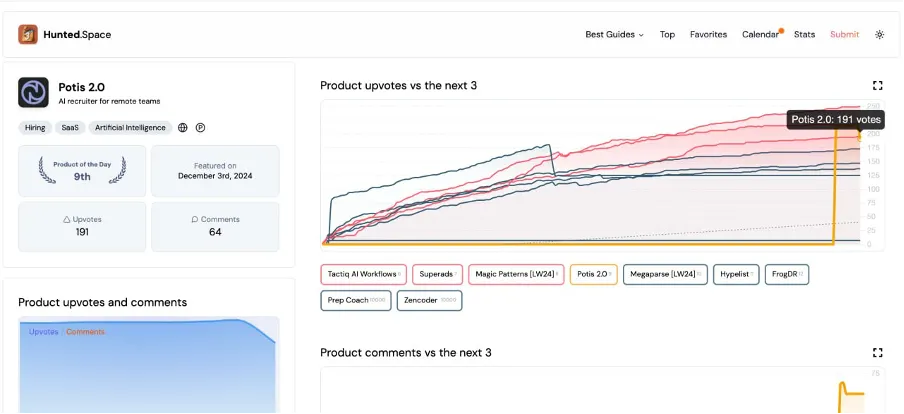
It’s like wanting to run a marathon and earn a medal, but they only let you start 15 hours late.
And now we have this result

Conclusion
- “Hunters”: They might be useful, but definitely not worth paying for, and don’t set unrealistic expectations
- “Shadow Community”: It seems many rely on it, but you need to be cautious and avoid scams
- Featuring: Keep pushing until you’re featured — without it, a launch is pointless
We still have a chance to climb the weekly leaderboard. I’d be grateful for your support!
https://www.producthunt.com/posts/potis-2-0/
Though honestly, after sharing this story, I wouldn’t be surprised if we get banned on Product Hunt 😉
Appendix: A guide to reasons why you might not get featured
You won’t be featured on Product Hunt if:
-
It’s your first launch, and your product isn’t mature enough
-
It’s your second launch, but there aren’t enough updates
-
You found a hunter — that’s considered cheating
-
You didn’t find a hunter — that means you’re not building a community
-
You have too many comments — it looks like you’re faking engagement
-
You have too few comments — it looks like your product isn’t interesting
-
You’re not building an ‘AI comments’ product — it’s not innovative enough
-
Only new users upvote you — it looks like bot activity.
-
Only old users upvote you — it means your marketing isn’t good enough
-
Your video is too long
-
You didn’t make a video at all
