Product Prioritization Frameworks That Work for Enterprise Teams
Large product orgs run on competing requests. Sales wants one feature, support flags another, leadership pushes a third, and every team believes its ask comes first. Prioritization is where those pulls get settled, and a roadmap takes shape across product lines.
The five frameworks below hold up under that pressure, keeping each decision anchored to a clear enterprise product strategy and not to whoever argues loudest in the room.

RICE Scoring
RICE scores every initiative on reach, impact, confidence, and effort. Multiply the first three, divide by effort, and a single number sorts a long backlog from most to least worth building. For a team facing sixty open requests, that one figure cuts through opinion quickly.
Pros
Every input sits in the open, so anyone who disputes a ranking can point to the exact number they would change.
It settles roadmap arguments that used to drag on for weeks.
The score doubles as a paper trail when finance asks why a bet got funded.
It holds up across a long backlog where dozens of initiatives compete for the same engineers.
Cons
Reach and confidence become rough estimates when clean analytics aren't there to back them.
Effort numbers tend to slide once engineering opens the work.
Re-scoring dozens of items each planning cycle turns into a standing task, and the score quietly rots if nobody maintains it.
It rewards orgs that already track usage closely and exposes the ones running on gut feel.
Weighted Scoring
Weighted Scoring lets a team build its own criteria and hand each one a weight, so the final number reflects what the business truly values. A revenue quarter loads weight onto revenue. A retention push tips the balance toward stickiness. Each initiative gets rated against every criterion, and the weighted total sets the order.
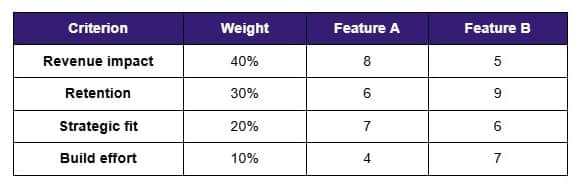
Run the math and Feature A edges ahead on revenue, B takes retention, and the weights break the tie. Drop the revenue weight a few points, and the ranking can flip, which is exactly the debate the model exists to surface.
Pros
Criteria and weights map prioritization straight onto what leadership values.
The reasoning shows fully, so the model survives executive review.
Weights flex by quarter, tilting toward revenue, retention, or strategic fit as goals move.
It stays consistent across product lines once teams agree on the criteria up front.
Cons
Setting weights can turn political, since whoever controls the weighting quietly controls the roadmap.
The output looks exact on top of soft inputs, lending false confidence to numbers that started as opinions.
It runs heavier than a quick grid, asking for agreement before any scoring begins.
Weighted Shortest Job First
WSJF sequences work by economic urgency. You estimate the cost of delaying an initiative, then divide by its size, so short high-value jobs climb to the top and expensive low-urgency ones drop. Cost of delay itself breaks into three parts: the business value at stake, how time-sensitive the work is, and the risk it removes or the future work it frees up.
Pros
It prices urgency, so missed market windows and contract dates carry real weight.
It fits regulatory deadlines and seasonal peaks where delay maps onto money lost.
Built for portfolio sequencing, it coordinates large epics across multiple teams.
Cons
Cost of delay leans on judgment and shifts with whoever does the scoring.
The risk component gets inflated fast, since rating it high lifts almost anything up the order.
The formula stays blind to dependencies, so a top-ranked job can hinge on something parked near the bottom.
It needs re-scoring each quarter to stay honest as deadlines move closer and estimates firm up.
The MoSCoW Method
MoSCoW sorts work into four buckets and earns its place when a release date is locked and scope needs guarding. The labels stay blunt on purpose.
Must have. The release fails without it.
Should have. Important and painful to drop, survivable for one cycle.
Could have. Welcome, if time allows, first to go under pressure.
Won't have. Explicitly parked for this round.
Pros
Non-technical stakeholders read it in seconds, which smooths scope talks with sales and leadership.
Dropping a could-have feels fair once everyone signed off on the label in advance.
It clarifies minimum viable scope and protects a fixed release date.
Cons
Must-have inflation creeps in until the top bucket means nothing and the release swells past its deadline.
It struggles to rank items inside a bucket, so it settles what ships and leaves the running order open.
Across a portfolio, each team defends its own must-haves, so a neutral owner has to police the top bucket for the labels to hold any weight.
The Kano Model
Kano brings the customer voice into prioritization by sorting features against satisfaction. Basics are the table stakes users expect without thanks, performance features move satisfaction in a straight line, and delighters surprise people in ways they never thought to request.
In B2B software, single sign-on reads as a basic nobody praises, faster report exports register as performance, and a smart default that removes a setup step can land as a delighter.
Pros
It keeps real sentiment in a conversation that scoring models tend to flatten into internal metrics.
It stops an enterprise from sinking quarters into polish nobody values.
It surfaces the basic gaps that quietly send people to competitors.
Cons
It depends on survey input, so a team without that discipline can't run it with any rigor.
Expectations drift, and yesterday's delighter becomes today's baseline, so classifications expire and need refreshing.
On its own Kano won't order a roadmap, so most teams pipe its results into RICE or Weighted Scoring as the customer-value signal.
How Do You Pick the Right Framework for Your Team?
No framework wins every call. The right one follows the decision in front of you. RICE and Weighted Scoring rank a crowded backlog. WSJF sequences a portfolio when delay carries a price. MoSCoW guards release scope. Kano keeps the customer in frame.
One habit pays off at scale. Run two frameworks against the same backlog and watch where they disagree, because those gaps expose the bias the team carried in. The framework counts for far less than applying one consistently and tracing every score back to the strategy it serves.

