Prompt Chaos Is the New Technical Debt and Developers Need a Real Workflow for Prompts
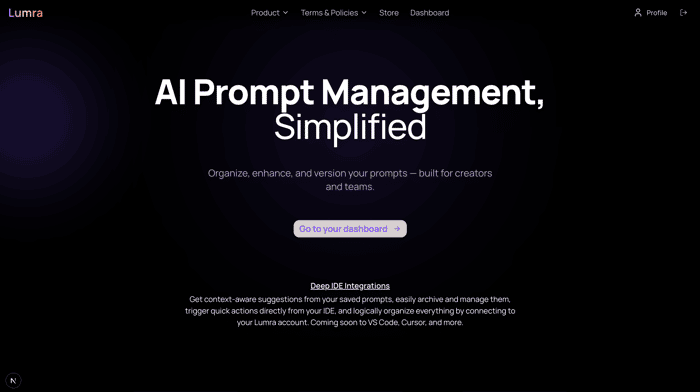
In today’s developer world, prompts are no longer just inputs.
They are logic.
They are behavior.
They are production-critical assets.
Yet most developers still manage prompts the same way we managed scripts before Git:
scattered notes, copied text blocks, renamed files like final_v3_really_final.txt.
This is the problem Lumra is trying to solve.
The Hidden Problem: Prompt Sprawl
As AI becomes embedded into real products, prompts start to multiply:
- System prompts
- Tool prompts
- Chain-of-thought variations
- UI-specific prompts
- Experiment vs production prompts
At first, it feels manageable.
Then suddenly:
- You don’t remember why a prompt works
- You’re afraid to change it
- Small edits break downstream behavior
- Team members copy prompts and diverge silently
This is prompt sprawl — and it quietly kills velocity.
Prompts Have Evolved — Our Tools Haven’t
We’ve already lived through similar shifts:
- Code → Git
- Design → Figma
- Infrastructure → IaC
- Content → CMS
AI workflows are following the same path.
The moment prompts move from experimentation into production,
they need:
- Versioning
- History
- Context
- Reusability
- Ownership
Treating prompts as “just text” doesn’t scale.
Lumra’s Core Idea: Prompts as Workflow Artifacts
Lumra is built around a simple but powerful idea:
Prompts should be managed like code, not notes.
Lumra helps developers:
- Organize prompts in a structured way
- Track versions and changes over time
- Understand why a prompt exists
- Reuse proven prompts across projects
- Iterate safely without fear of breaking production
Instead of asking “Which prompt was this?”,
you start asking “Which version should we use?”
That mindset shift changes everything.
Why This Matters for Developers
For solo developers and indie hackers:
- Faster iteration
- Less mental load
- Confidence to experiment
For teams:
- Shared understanding
- Fewer regressions
- Clear ownership of AI behavior
For products:
- More consistent outputs
- Easier debugging
- Scalable AI systems
Prompt engineering stops being magic — and becomes engineering.
The Future: Prompt Ops
We’re entering a world where:
- Prompts are reviewed
- Prompts are refactored
- Prompts have histories
- Prompts have impact
Just like code.
Lumra is an early step toward what you might call Prompt Ops —
a structured, developer-first approach to managing AI logic.
If you’re building with AI today, this problem will find you eventually.
Lumra exists so you’re ready when it does.
👉 Learn more: Lumra
Building with AI shouldn’t feel fragile.
Your prompts deserve the same respect as your code.
