Prompt Manager Chrome Extension: Keeping Prompt Engineering Inside the Flow
For developers and creators working with LLMs daily, the biggest friction point isn't writing the prompt—it's managing the workflow.
Most prompt engineering happens in a chaotic loop: moving between ChatGPT, Claude, text files, and Notion. This constant "Alt-Tab" dance breaks focus and turns valuable prompts into lost text.
Lumra is designed to solve exactly this problem by turning prompt management into a seamless part of the engineering workflow.
The Workflow Gap
The core philosophy behind Lumra is that prompts should be treated as durable assets, not temporary notes. However, a library is only useful if it is accessible right when you need it.
That is where the Lumra Chrome Extension changes the dynamic.
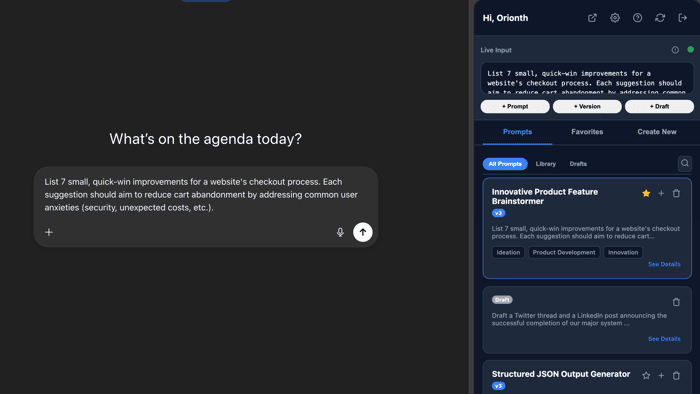
Instead of forcing users to leave their AI playground to find or save a prompt, Lumra brings the library directly to the browser.
Key Features for Workflow Continuity
- Capture in Context: Save successful prompts directly from the browser window without breaking flow.
- Instant Access: Pull up your entire prompt library as an overlay while interacting with AI tools.
- Organization: Tag, version, and structure prompts so they are easy to retrieve later.
Why it matters
When the friction of saving a prompt is removed, you naturally start building a better library. "Temporary" experiments become reusable templates.
Lumra combines a structured web dashboard for deep organization with an extension for speed, ensuring that your prompt infrastructure is always just one click away.
If you are looking to streamline your AI interactions and stop losing great prompts to chat history, Lumra is now open for use.
👉 Explore Lumra: https://lumra.orionthcomp.tech/explore

The "Alt-Tab dance" is such an accurate description of prompt workflow friction. Most tools treat prompts as inputs to be consumed, not assets to be managed. The extension approach is smart because it meets you where the work actually happens.
The "capture in context" feature is key. The moment you find a prompt that works is exactly when you have the least mental bandwidth to go save it somewhere else. By the time you switch tabs, you've already moved on.
Curious about the tagging system - do you find users develop consistent taxonomies over time, or does everyone's organization end up looking completely different? That tension between structure and flexibility seems like one of the harder UX problems in knowledge management tools.
Absolutely agree — the goal behind capture in context and the Chrome extension was exactly that.
In line with the original inspiration behind Lumra, we wanted prompt management to be as deeply integrated into the workflow as possible, without adding any extra cognitive or operational burden.
The idea was to let everything happen naturally, in the background, so prompts can become genuinely useful parts of daily work — not something you have to consciously “manage” as a separate task.
That’s why the extension is designed to meet you where the work actually happens. Especially with capture in context, we saw the same thing you described: the moment a prompt finally works is usually the moment you have the least mental bandwidth to switch tabs and organize it somewhere else. If saving it requires friction, it simply won’t happen.
On the tagging side, we intentionally leaned toward maximum flexibility.
Instead of enforcing a fixed taxonomy, Lumra allows every user to create their own tags freely — using any wording that fits their thinking. Users can see all of their tags, filter their library by them, and shape the system around their own mental model.
What we’re seeing (and expecting) is exactly that tension you mentioned: everyone’s organization ends up looking different — and that’s okay. The goal isn’t global consistency, but personal clarity. Each idea, workflow, or experiment can have its own tag without forcing users into predefined structures.
Balancing structure and flexibility is definitely one of the hardest problems in knowledge tools — Lumra’s approach is to provide strong primitives (versioning, capture, tags) and let users build their own system on top of them.
Appreciate the thoughtful questions — this kind of feedback directly shapes where Lumra evolves next.
The "personal clarity over global consistency" framing is exactly right. Knowledge management tools that force rigid structure often end up abandoned because they require too much upfront decision-making about categories that may not even make sense yet.
The primitives approach (versioning, capture, tags) is smart - it's essentially providing building blocks rather than a blueprint. Users who need structure can create it; users who prefer organic organization can let patterns emerge.
One thing I've seen with similar tools: power users often develop tag hierarchies or naming conventions after they have 50+ items. The system that works at 10 prompts often breaks at 100. Curious if you're seeing any natural "organization inflection points" where users start restructuring?
The feedback loop you've created here - watching how users actually organize, not how you think they should - is the kind of thing that compounds into product direction over time.
That’s a great observation, and we’re seeing something similar already.
Those restructuring points don’t happen at the same time for every user. For some, things start to shift at 20–30 prompts; for others, much later. Because of that, our responsibility with Lumra isn’t to decide when or how users should reorganize — it’s to give them enough flexibility and visibility so they can do it naturally, whenever they’re ready.
From the beginning, Lumra was designed around the idea that users shouldn’t be forced into a predefined structure. Different workflows, different mental models, different stages — one rigid taxonomy simply wouldn’t scale across that diversity.
More broadly, this is how we think SaaS products should evolve in general:
not by pushing users into a template, but by observing real behavior, listening closely to feedback, and letting the product grow in response to actual needs.
If Lumra does its job well, organization patterns will emerge from usage, not from rules — and our role is to support that evolution while keeping the experience clear and frictionless at every stage.
"Flexibility and visibility so they can do it naturally, whenever they're ready" - that's the key insight. Most tools try to predict the right moment for reorganization, but the variance you're seeing (some at 20-30, others much later) proves that's not predictable.
The SaaS evolution philosophy you described - observing real behavior rather than pushing templates - is rare and worth protecting. It's easy to ship opinionated features that feel productive ("we added folders!") but actually impose structure users don't need.
"Organization patterns will emerge from usage, not from rules" is a good north star. The risk with knowledge tools is that the product team eventually has enough data to see patterns, and the temptation is to codify those patterns as defaults. But what works for 60% of users might actively hurt the 40% who work differently.
This thread has been a great example of product thinking in public. Looking forward to seeing how Lumra evolves as usage data accumulates.