Quitting his job with no plan and hitting $14.5k MRR with a hybrid
agency

When ChatGPT dropped, Adithyan Ilangovan quit his job with no plan. He built a product and failed. Then, he built a tech-enabled service called AI Podcasting and hit $14.5k MRR.
He did that via a hybrid model that he says is underutilized.
Here's Adithyan with the details. 👇
Jumping on the AI bandwagon
I did my master's in Video Engineering. After my studies, I worked and built video engineering infrastructure at a couple of startups and then led product at Paramount Studios. So you could say I'm a research engineer with a product background.
I wasn't super happy with thecorporate grind, and I had always wanted to start a business. It was always on the back of my mind. I wanted to do something meaningful and have some more free time for myself — ha! What a trap that was!
Anyway, ChatGPT happened, and I knew immediately that something big was coming. Things were going to change.
So, like many others, I jumped on the AI bandwagon. I quit my job with no specific plans and struggled for the first six months.
I started by building a great technical product, but it was not a good business.
Eventually, I figured stuff out. I mean, it's still a struggle, but I have some revenue now.
Building a $14.5k MRR niche agency
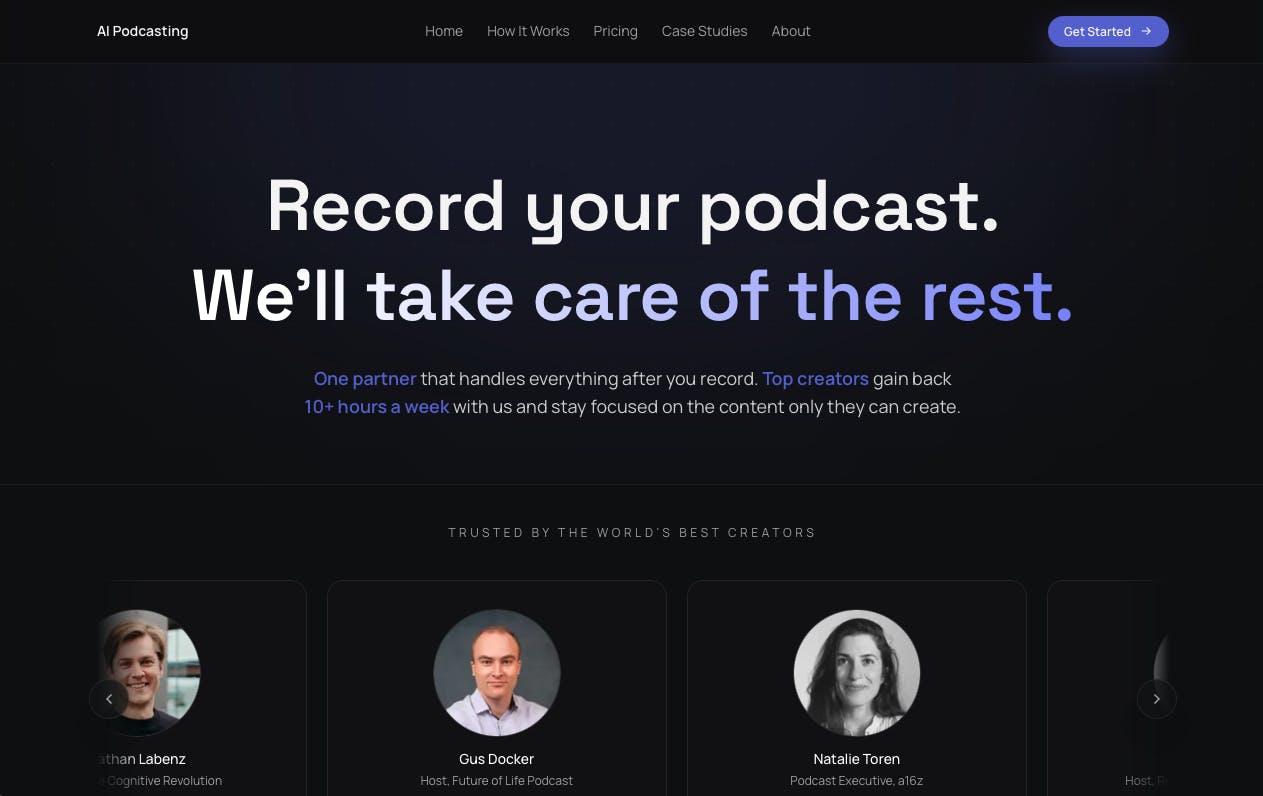
I run AI Podcasting (AIP), a podcast post-production agency.
Podcasters record their content, and we handle everything after that: editing, audio, notes, social, publishing, distribution, paid/organic promotion, and more.
Basically, our pitch is that you can focus on telling the story you want to tell to your audience, and we will help you deal with all the stuff that comes after clicking "finish recording."
We're at about $14.5k MRR.
Starting manually
We figured out which market to serve, then did a lot of work manually — we didn't build a product right away. We did the same things the creator or the podcaster would have done after recording their content.
Basically, we lived through their pain. And it was brutal.
We kept doing it for two to three months until we slowly started realizing what parts could be easily automated with AI and other tools.
Eventually, we were able to automate about 80% with AI. So that is basically our margin.
Our internal tool stack is:
Python for backend
NextJS for frontend
OpenAI APIs for AI workflows.
FFmpeg for media
MongoDB
Azure Infrastructure
Modal for a lot of scale for Python containers
Lots of custom automations
A hybrid model full of indie hacking opportunities
We use a done-for-you subscription model. Flat monthly pricing, usually $2.5k to $3k for 4 episodes per month, with add-on hours as needed. Revenue growth comes from expanding workflows with existing customers.
I think this is an important note: Not many people are exploring the hybrid model of heavy automation plus human polish. There is definitely a market premium and demand for that.
Everything that can be 100% automated will mean competition — and soon, it'll get sucked up by the frontier model providers.
But this hybrid model of running like an agency creates a moat. Especially with the personal relationships that you will build with the clients — and trying to understand their preferences and pains. It's hard to get in. But once you are in, you can lock in and keep increasing your margins with AI.
Things are moving rapidly, so I can't say for sure — but that's my take for now.
Organic growth
As far as growth, we could do much more — and much better.
We've grown mostly from referrals. Strong outcomes drive word of mouth. We also grow via inbound from the creator network.
We haven't done any paid ads so far.
If he could turn back time 🎵
If I had to startover, here's what I'd do:
I wouldn't start with B2C as I did with my original project. I'd start with B2B.
I wouldn't build a thing until I had a customer, or at least clearly understood the pain point (via The Mom Test).
I would charge early and charge high.
If you're going to overbuild, don't bother building
If you are a hacker, most likely you will love building; that's the easy part. But you need to get out and talk to real customers early and often.
Do not overbuild, or I would go as far as saying it's better not to build anything at all at the start.
And try to understand the market very clearly. If you think you already have a good understanding, stress-test your assumptions. The Mom Test is a very good book in that regard.
If I had done this properly, it would have saved me maybe six months of pain.
Here's a very good test: "Is this person willing to give their credit card information for my solution to the problem they say they have?" That's it. Simple.
And after that, if people are willing to stick around, you're on the right track.
What's next?
I want to scale the production engine while keeping quality high. Serve more high-value creators. Keep improving automation. And eventually, build a tooling layer for smaller creators.
Also, I am terrible at marketing and sales. I'd like to improve.
You can learn more at AIP. And you can find me on X, LinkedIn, Github, and my personal website.

Leave a Comment
The story is really good. The “do it manually first, automate it later” approach is extremely valuable because it saves a huge amount of time and effort that would otherwise be spent building something that is not yet fully proven. This way, the process and need are validated first, and only then do you invest in automation. Congratulations on the hybrid model now bringing in $14.5k MRR — that’s a serious achievement. The combination of built relationships with people and the use of AI creates a very solid competitive advantage and makes the model even harder to copy.
I also quit my job. So i kinda have done the first step right? :D
You're basically a millionaire already 🤣
hehe I wish u luck and patient and hope eventually you will reach the same MRR standard as Adithyan
Quitting a job without a clear plan can be risky, but with determination and strategy it can lead to success. In this case, building a hybrid agency allowed the entrepreneur to combine services and scalable products, creating multiple income streams. By focusing on client needs, effective marketing, and consistent delivery, the business gradually grew to $14.5k in monthly recurring revenue (MRR). It highlights how persistence, smart positioning, and value-driven services can turn uncertainty into sustainable growth.
Feels like a lot of these journeys get simplified in hindsight — the part where you’re figuring out what actually works is usually much messier.
Solid story. The "manual first, automate later" approach is gold—saves so much wasted building time. Congrats on the hybrid model pulling in $14.5k MRR; that moat from relationships + AI is smart.
Great story. The hybrid model makes a lot of sense — productized enough to scale, custom enough to charge premium. How did you handle the transition from "doing everything yourself" to having a team? That's the part I'm struggling with as a solo founder right now.
Really interesting take on the hybrid automation + human polish model.
I think a lot of builders underestimate how fast fully-automated tools get commoditized, especially in AI. The moat seems to come from workflow ownership + relationships, not just automation.
Curious, at what point did you feel confident enough in the manual process to start automating parts of it?
"We haven't done any paid ads so far..." - that's impressive, all organic referrals and inbound! Well done!
“Built a great technical product, but not a good business” is the line. When you switched from product-first to service-first, what changed most: the offer, the sales process, or your understanding of the customer pain?
Great idea and a bold move!! Truly inspiring
Can you go more into how you were able to generate inbound? I have been posting on social media here and there but getting little to no views/engagement purely from the business profiles. Are you using personal socials?
thanks for sharing the lessons learned. I'm currently in the process of The Mom Testing of the idea I have in mind.
A bold and motivating journey by James Fleischmann - quitting without a plan and achieving $14.5k MRR is inspiring. Business can be made more effective by combining smart strategy, consistency, and risk-taking.
Interesting idea. its inspirational for someone to take the risk of quitting the job.
If you're building support automation, one simple trick is using AI to draft replies first instead of sending automatically. That way the team can review before sending.
Interesting idea. It takes a lot of initiative and a leap of faith to quit a "safe" job and do something that truly inspires!
Interesting idea. How did you get your first users?
Very good example how you can find your way only when you have no way.
Really interesting idea! I like how you're solving this problem. I'm also building a small SaaS right now, so it's inspiring to see other founders sharing their progress. Thanks for sharing!
This story really hits home. Walking away from a job with no clear plan is terrifying, but seeing how you went from a failed product to a $14.5k MRR hybrid agency is incredibly encouraging. Your willingness to share the messy parts of the journey, not just the highlight reel, makes it feel much more realistic and actionable for people like me who are still on the fence about taking the leap.
Spot on advice about not overbuilding. Doing the manual work first is brutal but necessary to find the real friction. I am building an AI platform for user research right now and I completely agree with your approach. The hybrid model is definitely a smart moat. Great read Adithyan
Good story, but I think the “quit your job with no plan” framing gets romanticized a bit too much in founder circles.
That’s survivable advice if you have no kids, low financial pressure, and enough runway to absorb months of uncertainty. For founders with a family, rent, mortgage, or other real obligations, that kind of move is often less “bold” and more “dangerous.”
What’s actually valuable in this post is the part after that:
starting manually, living the workflow, understanding the pain firsthand, charging early, and only automating once the process is proven.
That lesson scales much better than the mythology of the dramatic leap.
Also fully agree on the hybrid model. In AI, whatever can be fully automated will get commoditized. The durable value is usually in the last layer — judgment, polish, consistency, and trust.
So to me the real takeaway isn’t “quit first, figure it out later.”
It’s more like :understand the customer deeply enough that you know what deserves to be built at all.
How has your master's in Video Engineering helped you so far?
interested
The last statement isn't true. The personality described in this case just looks for his own path in sales.
Really interesting journey. The part that stood out most to me is starting manually before building automation. A lot of founders jump straight into building tools without truly understanding the workflow or pain points. Doing the work yourself first gives you a much clearer picture of what actually needs to be automated and what still requires a human touch. The hybrid model of AI + human expertise also feels like a strong moat in a world where pure automation quickly becomes commoditized.
James Fleischmann quit his job without a backup plan and built a hybrid agency that generates $14.5k MRR. Throughout his career, he has demonstrated a willingness to take risks, a focus on execution, and the ability to build recurring revenue through smart service positioning.
Manual first, automate second, that's the order most skip. They build the tool, then look for the pain. You found the pain by feeling it. Now the automation is just leverage, not the product.
Really inspiring story. I’m also building small side projects and it’s motivating to see how taking a risk can lead to real traction. $14.5k MRR is a huge milestone.
Really interesting model. Handling the full post-production workflow for podcasters sounds like a huge time saver for creators who just want to focus on recording and storytelling.
This is such a refreshing counter-narrative to the "build a pure SaaS and retire" stories we usually see here.
The hybrid model (automation + human touch) is genuinely under-discussed. Everyone is racing toward 100% automation because it scales infinitely, but you've identified something important: the stuff that can be 100% automated eventually becomes a commodity.
The moat you've built isn't the AI—it's the relationship and the taste. Understanding a client's preferences, knowing what they'd hate even if they can't articulate it, being the quality gatekeeper before the final deliverable goes out—that's hard to replicate with an API call.
A few things that stood out to me:
"We did the work manually for 2-3 months first." This is painful but brilliant. So many founders (myself included) build a tool for a problem we assume exists. By doing the work yourself, you're not just validating the problem—you're documenting the exact workflow that needs to be automated. You basically built your product spec through sweat equity.
The agency trap vs. the hybrid upside. Traditional agencies struggle because they scale linearly with headcount. But if you've automated 80% of the work, you're essentially running a SaaS margin business disguised as an agency. That's a powerful place to be. You get the high-ticket, high-trust nature of services with the efficiency of software.
"If you're going to overbuild, don't bother building." This needs to be shouted from the rooftops. For technical founders, building is the comfort zone. It feels like progress. But overbuilding is often just sophisticated procrastination—avoiding the uncomfortable work of sales and validation.
Question for you: With the 80% automation rate, do you see yourself eventually productizing the tooling layer for smaller creators as a separate self-serve product? Or is the plan to keep the software internal as the engine for the agency?
Either way, impressive build. Thanks for sharing the real numbers and the real timeline.
The "hybrid = moat" thesis is worth unpacking a bit, because I think the real moat isn't the hybrid model itself — it's the taste calibration layer that accumulates on top of it. Any agency can run AI tools + human QA. What's actually hard to replicate is having learned a specific client's preferences deeply enough that your judgment call ("this AI-generated intro needs rewriting, this one doesn't") is consistently right. That's the lock-in. The automation just makes the economics of carrying that relationship sustainable.
The pricing structure also makes this work in a way that pure SaaS doesn't — $2.5-3k/mo per client on recurring episodes is a model where switching cost is high (new provider has to re-learn the client's voice) and the work compounds (each episode teaches you more about their style). That's a genuinely good business shape.
The B2C → B2B lesson is a painful one most people only absorb after living it. Curious what the original B2C project was and how long it took before you decided to pivot vs. keep pushing?
The hybrid model (productized service + software) is genuinely underrated — it gives you the unit economics of software while the service component handles sales objections that pure SaaS can't. Adithyan's path from failed product to $14.5k MRR via this approach is a great case study.
Quick operational note for anyone running retainer billing through Stripe at this scale: failed payments from clients are surprisingly common (expired cards, international declines) and easy to miss until a client churns. A Day1/Day3/Day7 automated email sequence catches most of them — tryrecoverkit.com/connect is a quick setup if you want to automate that. Congrats on the growth\!
Hello founders,
I represent a group of companies looking to invest in promising startups and scalable projects.
If your startup has growth potential, feel free to share a brief overview or message me directly.
+62 831-5298-7392
I think word of mouth is the most powerful marketing channel in the world :D
We spent 0$ on marketing and we reached 1.2M USD of annual revenues so far.
Yes, MOM test is the best point to start
1. Talk about their life, not your idea.
2. Ask about specifics in the past, not hypotheticals about the future.
3. Listen more, talk less.
Totally aligned and well said. I truely appreciate your startover points as well.
Through smart positioning and consistent client acquisition, James Fleischmann built a hybrid agency without a fixed plan. As a result of combining services and scalable systems, he achieved $14.5k in monthly recurring revenue.
The hybrid model insight is critical. At InnerSpark we're applying this same logic - building cashflow modules (DomainFlow, CashOS, 5472 Kit) that solve real founder problems while constructing the bigger OS vision.
Your point about 100% automation becoming commodity is spot-on. Everything that's fully automatable will race to zero margin. The moat is in that 20% human layer + relationship.
Question: When you automated 80% of the workflow, did you find certain tasks shouldn't be automated even if technically possible? We're documenting Indie Hackers patterns to identify which founder workflows need human judgment vs pure automation.
This is a really interesting path👏
The "live through the pain first before automating" approach is something I did instinctively building my own product. I was losing rentals because I saw listings too late . So I built a tool to solve my own problem. That manual validation phase is underrated. Most people want to build the product first and find the customer second. You did it the right way around.
$14.5k MRR with a hybrid agency is a solid model — the AI tools angle makes sense for keeping margins high. One thing I'd add from personal experience building in this space: the quality of your AI outputs scales directly with prompt structure, not just model choice.
I built flompt (https://flompt.dev) to solve this — a visual prompt builder that decomposes any instruction into 12 semantic blocks and compiles to optimized XML. Big difference in consistency when you're delivering client work.
A ⭐ on https://github.com/Nyrok/flompt would mean a lot — solo open-source founder here 🙏
The hybrid model point is really interesting. Automating the heavy lifting while keeping human polish feels like a strong moat compared to pure AI tools.
that was very brave descision
Now thats some motivating stuff
Parivahan Sewa complete guide portal is a digital platform provided by the Ministry of Road Transport and Highways (MoRTH) in India, Apply for driving license, vehicle registration, pay eChallan and access all RTO services online through official government portal.
Absolutely stunning and I loved wheen people aree consistent in actualizing their dreams that motivates mee too but then I hope to be like you
This hybrid model is exactly why I think the "pure SaaS vs pure agency" debate is the wrong framing.
I built DocuMind — a RAG-based platform that lets businesses upload their documents and get an embeddable AI chatbot with a single script tag. Pure SaaS, clean product, works on WordPress/Shopify/React/everything.
But honestly? The people getting the most value from it aren't the ones who self-serve. It's the agencies who pick it up, white-label it, and sell it as a done-for-you service to their clients — exactly what you're describing here.
The hybrid model wins because the software handles the scalable part (the AI, the infrastructure, the widget) while the human layer handles trust, onboarding, and the sale. Most SMB clients don't want to "figure out a tool" — they want someone to set it up and make it work.
I'm actually selling DocuMind as a whole project right now for this reason — I think it's worth way more in the hands of someone already running an agency than as a standalone SaaS. The hard technical part is done. The distribution problem is what someone with your model would already have solved.
If anyone here runs a web/marketing agency and wants to add an AI chatbot service to their stack — happy to chat. Full source code, docs, embeds for 8+ platforms.
Great story. The "no plan" part is underrated — plans are just assumptions anyway.
This is a really interesting path.
I like the hybrid agency + product approach. It seems like a great way to generate cash flow while also discovering real product opportunities from client work.
Curious — did most of your early clients come from your existing network, or did you rely on outbound/communities to get the first few?
Thanks for sharing the journey.
At what point did you realize the hybrid agency model was actually working and worth doubling down on?
The "do it manually first" approach is so underrated. I feel like everyone wants to jump straight to building the product but you learn so much more just doing the work yourself for a few months. We did something similar when building our project management tool — spent weeks just manually organizing tasks for teams before writing a single line of code. Completely changed what we ended up building.
Also that 80% automation margin is wild. Curious how much of that is prompt engineering vs custom code on top of the AI output?
The "starting manually" part really hit home for me. I'm building in the travel/crypto space and the temptation to automate everything from day one is so real. But you're right — doing things manually first teaches you what actually needs to be built vs what you just think needs to be built.
Also love the honesty about the first product failing. I think most founders on here have at least one failed attempt they don't talk about. The difference is whether you learn from it or just repeat the same mistakes with a shinier landing page.
The hybrid model is clever too. Pure product businesses take forever to get to revenue. Services get you cash flow while you figure out the product side. Smart way to stay alive long enough to find what works.
Totally aligned and well said. I truely appreciate your startover points as well. Here is what I want to say in polished words : In today’s AI-driven development world, the cost of building products is going down every day. What matters more now is not just the ability to build, but the ability to deeply understand the customer. And that is the KEY that AI cant replace.
At the core of any successful new product is identifying a pain point that is real and painful enough for customers to care about. That is the foundation of product-market fit.
So while AI makes development cheaper and faster, the real advantage comes from knowing your customer, understanding their struggles, and solving a problem that truly matters.
Your funnel doesn't fail because of design it fails because of messaging.
I combine marketing psychology, clear structure, and persuasive storytelling to create funnel copy that supports real business goals.
What I can write:
Landing pages
Sales pages
Lead magnet pages
Email funnel sequences
Upsell & checkout copy
to know more click below
This is such a refreshing take. Everyone thinks frontier models will automate 100% of the workflow overnight, but raw AI output is basically just an API call. The actual business is in that "hybrid model" margin.
Building an AI tool for tech creators right now and we hit the exact same wall. Base models hallucinate tech terms constantly, so we had to build out a custom validation layer (Zod schemas + dictionaries) just to make the output usable.
Also, heavily relate to charging early. I literally just spent my entire weekend fighting Merchant of Record (MoR) compliance just to get a paywall up and see if people will actually type in their credit card numbers.
Quick question on your stack: how are you liking Modal for FFmpeg? Curious if it handles heavy media workloads noticeably better at scale than just wrestling with standard AWS instances.
Quitting a job with no clear plan can be risky, but building a hybrid agency combining services with scalable products can create steady growth. Reaching $14.5k MRR (Monthly Recurring Revenue) often comes from focusing on a niche, offering high-value services, and gradually productizing repeatable work. Consistent client results, strong relationships, and recurring retainers help stabilize income. Over time, automation and digital products can reduce workload while increasing predictable monthly revenue.
I like the hybrid agency idea, but I’m always a bit skeptical of “quit with no plan” stories. In most cases there’s usually more preparation or experience behind the scenes than it sounds like.
This is really inspiring one
Overbuilding... Couldn't have been said better! Most of us as hackers think coding is the hardest thing to do. In reality, it is what happens during or after the build. Talking to people, getting feedback, marketing, is way harder in my opinion and most of us engineers have no idea how to do any of that until we put a product out and birds start chirping.
Another 9-5 quitter! Welcome to our world.
The "live through the pain first" approach before automating
is exactly right, and more people should do it. You can't know
what's worth automating until you've done it manually enough
times to feel where the real friction is.
The hybrid model insight is sharp too. Full automation is a
race to zero margin, whoever has the best model wins and
everyone else gets squeezed out. But "AI + human judgment +
client relationship" is a completely different product.
Clients aren't just buying output, they're buying trust and
consistency, which takes time to replicate.
Curious about the 80% automation number, is that by time
saved per episode, or by workflow steps? And where does the
remaining 20% human work tend to concentrate? I'd guess it's
in the judgment calls: knowing when audio is "good enough,"
matching tone for show notes to a host's voice, that kind of
thing.
The tooling layer for smaller creators sounds like the natural
next step. The agency builds the playbook, the tool
productizes it. Classic path.
This is a really inspiring journey. What stood out to me is the idea of using a hybrid agency model as both a revenue engine and a way to validate product ideas. Instead of chasing funding or waiting for the “perfect” SaaS idea, building services around real client problems creates immediate cash flow and constant feedback from the market.
It also shows how quitting without a detailed plan doesn’t always mean being reckless, it can mean committing fully to solving problems and iterating quickly until something works.
Stories like this highlight that sustainable growth often comes from staying close to customers and evolving the business model along the way, not just launching a product and hoping it takes off.
Awesome Story!!!
Interesting perspective. Many founders overbuild before validating demand. I learned that the hard way.
Great example of why starting with the customer matters more than building the perfect product. The hybrid model of automation + human service is really interesting — it creates both margins and a moat. Curious how much of the workflow you think can realistically reach 90–95% automation.
Great story!
Great story: starting manually to truly understand the customer pain before automating is such an underrated strategy. Impressive how you turned that insight into a hybrid AI + human service with real traction.
strong example of “manual first, automate later.”
doing the work yourself forces you to see where the real friction is. that’s usually where automation actually creates margin.
a lot of founders start by building the tool. you started by living the workflow.
The "no plan" leap resonates so much, and evolving into that successful hybrid model really highlights the power of iteration. It's like watching a rough sketch of a Cartoonperson gradually become a fully-formed character with a clear purpose.
ccoool
The "agency as testing ground" model is one of those things that sounds obvious after the fact but almost no one structures intentionally. Most people treat agency work as the thing they're trying to escape, not the thing that validates what to build next. Curious how long you ran the agency side before you felt confident enough to double down on the product?
Avec cette technologie , il suffit d'un peu de savoir faire pour sortir de la galère définitivement.
Very insightful story Thanks for sharing it
The 'Hybrid Model' is definitely the gold mine for 2026. Automation gets you 80% there, but that last 20% of 'human polish' is where the moat is. I’ve been analyzing the unit economics of exactly this—how much frontier models (GPT-4o) cost vs. the 'Retry Tax' of cheaper models like DeepSeek when you're trying to hit that 80% automation mark. Adithyan, did you find that switching to cheaper models for the initial 80% workflow significantly improved your margins, or does the loss in reasoning quality end up costing more in human 'polishing' time?
Very insightful story! Thanks for sharing it honestly.
Great story. It’s inspiring to see someone validate their idea and build something profitable step by step.
I too landed myself in the exact situation but unable to push myself out of the comfort zone. Hope i can make it like u someday
Really respect the journey here. Quitting without a clear plan and still pushing through the uncertainty takes courage most people don’t talk about. A lot of founders stop during that first phase where things don’t work yet, but that’s usually where the real learning happens.
What stood out to me most is the hybrid model you described — starting manually, understanding the real workflow pain, and then automating gradually. That approach feels much more sustainable than jumping straight into building a fully automated product without seeing how the work actually happens in real life.
I’m currently building a platform myself and one thing I’m realizing is that the market often rewards founders who stay close to the problem longer instead of rushing into building too much too early. Your story reinforces that.
Wishing you continued growth as you scale the production engine. It’s inspiring to see builders turning early struggles into a working system.
Nice project!
I'm a UI/UX and graphic designer. I help startups with landing pages, SaaS dashboards, and product UI. If you ever need design help, I'd love to collaborate.
Great story. It’s inspiring to see someone validate their idea and build something profitable step by step.
interesting that the pivot wasn't to a different product but to a service wrapper around the same space — what did the hybrid model actually look like in the early days before it was generating real revenue?
Great story. It’s inspiring to see someone validate their idea and build something profitable step by step.