Rapid mvp launch: AI-enhanced products for small businesses
Hey Indie Hackers!
Two months ago, I stumbled upon an exciting spot: there was huge potential to create affordable AI-powered products for small businesses, especially for those without large tech teams. I decided to harness the current AI hype wave and move quickly — aiming at launching a simple but valuable MVP (minimum viable product) within weeks, not months.
Today, I want to share my journey, the steps I followed, lessons learned, and how you can do the same (without coding a thing!).
Identifying the Opportunity 🎯
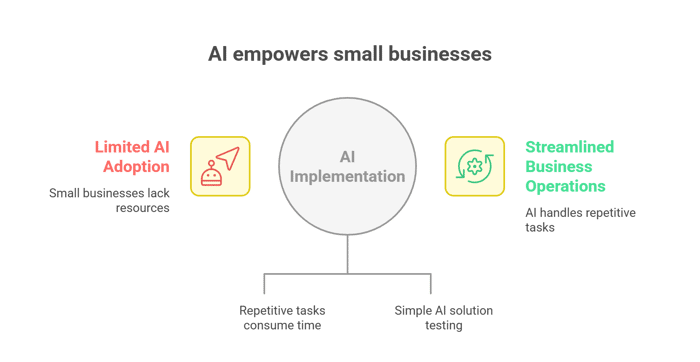
I've always believed in finding solutions for smaller businesses, the ones routinely overlooked due to modest budgets and limited in-house tech resources. These businesses face an interesting problem: they're aware of AI's potential but don't have the resources or time to build custom AI implementations. Opportunity spotted!
I set out to answer questions like —
- Which tasks do small businesses commonly wrestle with?
- Where could AI provide meaningful yet straightforward solutions?
- Could this be quickly validated with a simple, no-frills MVP?
I spoke directly with cafe owners, small marketing agencies, independent consulting firms, and online shopkeepers to validate my hunch. As it turned out, many of their pain points revolved around repetitive tasks (customer service responses, email marketing, content creation), exactly where today's powerful AI models offer huge benefits.
Defining My MVP ⚙️
Based on feedback from real customers, I decided my MVP would be simple:
- An easy-to-use AI content generation tool for email marketing and social media posts tailored specifically to small businesses.
- Essentially, a user-friendly wrapper around OpenAI's API, customized specifically to serve businesses in niche markets like cafés, fitness studios, and e-commerce entrepreneurs.
Building Fast… and Without Code 🛠️
Like many indie hackers, I'm not a polished coder (and time wasn't on my side!). Instead, I embraced the new world of no-code platforms to leverage AI quickly.
I picked Fuzen.io because it had exactly what I needed—a no-code toolkit that allowed me to rapidly build SaaS MVPs. Fuzen let me hook up OpenAI's GPT-4 API effortlessly, plug in Stripe for payment integration, and have user authentication ready out of the box. All I needed was to set up a sleek, intuitive frontend (which was quite straightforward too!).
Within days, a usable prototype was ready.
Planning Quick Validation 🚀
With a product live, the next hurdle was user validation. I followed a straightforward playbook:
- Pick a target customer group: cafes and restaurants active on social media.
- Reach out directly through emails and social platforms, offering personalized trials.
- Provide clear onboarding and support, closely collecting feedback.
Keeping it hyper-focused saved me a ton of time and hassle. I limited the initial MVP validation to a handful of users, ensuring I could respond to feedback immediately and iterate quickly.
Early Results, Iterations, and Learnings 📈
The results became apparent rapidly:
- First 10 signups: enthusiastic responses—users loved AI-generated drafts that saved them hours each week.
- Clear feature requests emerged early: integration with social scheduling tools, adjustable content tones, and industry-specific language customizations.
- Early price validation: users expressed willingness to pay around $15-30 monthly comfortably for unlimited content generation.
Armed with these insights, I quickly iterated—even improving UX, integrating deeper AI enhancements, and providing clearer guidelines that small businesses could leverage immediately.
What I learned (and what you can apply today) 💡
If you're inspired to rapidly launch an MVP, here's my hard-earned advice:
- Focus deeply on real problems: Verify your assumptions through interviews and real conversations early on.
- AI doesn't have to be complicated to add real value: Even simple prompts, customizable by industry, can drastically improve small businesses' workflows.
- Embrace the power of no-code platforms: They're now mature enough to quickly launch prototypes, validate ideas, and grow into a full-scale SaaS later.
- Keep your validations quick and narrow: A few dedicated early adopters giving actionable feedback is worth more than hundreds of vague responses.
The journey isn’t over—I’m still iterating and leveling up my product. But this rapid MVP experiment proved that AI-enablement for small businesses is both valuable and viable.
Thanks for reading—and I'm happy to answer any questions you have or hear about your own AI projects and MVP adventures in the comments! Let’s inspire each other. 🚀
