Red Teaming: Best Cybersecurity Exercise for Comprehensive Security
Most organisations believe their security controls work. Firewalls are in place. Alerts fire on time. Compliance reports look clean. Yet breaches still happen. Often, the problem is not missing tools but misplaced confidence.
This is where red teaming earns its value. Instead of testing controls in isolation, red teaming challenges the entire security posture under real pressure. It shows how attackers think, move and adapt when faced with defences that look solid on paper.
In this guide, we explain red teaming in clear terms. We explore what it is, how it works, and why leadership teams rely on it to expose blind spots that routine testing misses. If you are asking what is red teaming and whether it applies to your organisation, this article will help you decide.
What is red teaming?
Red teaming is a controlled security exercise that simulates real cyber attacks against an organisation. The goal is simple. Test how well people, processes and technology stand up to determined adversaries.
Unlike automated scans or checklist audits, red teaming focuses on outcomes. Can attackers gain access? Can they move laterally? Can they reach sensitive systems without being detected?
A red team acts like an external threat actor. They plan, adapt and exploit weaknesses using techniques seen in real incidents. Meanwhile, defenders respond as they would during an actual attack.
This makes red teaming one of the most realistic ways to measure true security readiness.
How red teaming differs from other security testing
Many organisations already run penetration tests or vulnerability scans. These are valuable. But red teaming serves a different purpose.
1. Penetration testing tests controls
Penetration tests focus on identifying technical weaknesses within a defined scope. They answer questions like which systems are vulnerable and how severe those flaws are.
The test usually ends once a vulnerability is proven.
2. Red teaming tests resilience
Red teaming focuses on whether an attacker can achieve their objective. That objective might be stealing data, disrupting operations, or gaining persistent access.
The red team does not stop at the first barrier. They pivot. They social engineer. They exploit gaps between teams and tools.
This is why red teaming delivers insight beyond technical findings. It reveals how the organisation behaves under sustained attack.
Why organisations invest in red teaming
Security leaders often ask why they should invest in red teaming when they already run regular testing. The answer lies in visibility.
Red teaming exposes hidden attack paths that combine small weaknesses across identity, endpoints, email and cloud services. It also tests whether detection and response processes work under real conditions.
More importantly, red teaming challenges assumptions. Controls that appear strong in reports may fail when attackers adapt.
For leadership teams, red teaming improves decision-making by linking security weaknesses to real business impact.
Common red teaming techniques
Red teaming exercises adapt based on objectives, industry and maturity. However, certain techniques appear often.
Initial access may involve phishing, credential abuse, exposed services, or supply chain weaknesses. Once inside, attackers focus on privilege escalation and lateral movement.
Red teams also simulate command-and-control activity to test whether stealthy communication is detected.
Each technique reflects real attacker behaviour rather than theoretical risk.
What red teaming is not
Red teaming is not a replacement for vulnerability management or compliance testing. It complements them by validating effectiveness.
It is also not about blaming teams. The goal is learning and improvement. The strongest outcomes occur when findings drive constructive change.
When should an organisation run red teaming?
Red teaming works best once basic security hygiene is established.
Organisations often consider red teaming when they want to test incident response readiness, operate in high-risk sectors, or manage complex cloud and hybrid environments.
It is also valuable after major changes such as mergers, identity platform upgrades, or infrastructure migrations.
Red teaming and leadership value
For senior leaders, red teaming replaces abstract risk scores with real scenarios.
Executives can see how attackers could disrupt operations or access sensitive systems. This clarity supports better investment decisions and clearer conversations at board level.
Measuring success in red teaming
Success is measured by insight, not by whether attackers succeed or fail.
Key outcomes include improved detection times, stronger coordination across teams, clearer risk prioritisation, and measurable security improvements.
Repeated exercises show progress and maturity over time.
Red teaming in modern environments
Modern red teaming increasingly focuses on identity, cloud permissions, and third-party access. Many organisations now adopt purple teaming approaches, where defenders and attackers collaborate to accelerate learning and strengthen controls faster.
How to choose the right red team vendor
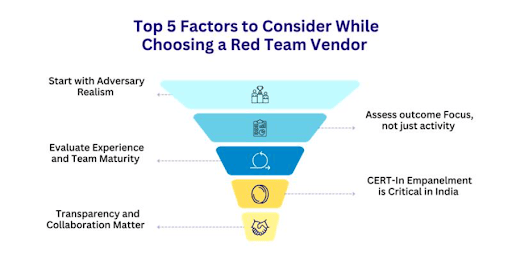
Selecting a Red Team vendor is a strategic decision, not a procurement exercise. The quality of a red teaming engagement depends far more on the team’s realism, discipline, and judgment than on the tools they use. To extract real value, organisations should evaluate vendors against several critical criteria.
1. Start with adversary realism
A credible Red Team vendor should demonstrate deep understanding of real-world attacker behaviour. This includes familiarity with current threat actor techniques across identity, cloud, endpoint, email, and hybrid environments. Ask how they design attack paths, adapt during engagements, and align scenarios to your industry’s threat landscape. Red teaming should never feel scripted.
2. Assess outcome focus, not just activity
Strong vendors frame engagements around business objectives—such as data access, operational disruption, or privilege abuse—rather than a checklist of techniques. Their reporting should clearly connect technical findings to operational and leadership-level risk, enabling informed decisions rather than raw technical noise.
3. Evaluate experience and team maturity
Red teaming requires senior practitioners who can exercise restraint, pivot intelligently, and operate safely in production environments. Look for teams with proven experience in complex enterprises, cloud-heavy architectures, and regulated sectors such as BFSI, healthcare, and SaaS.
4. CERT-In empanelment is critical in India
For Indian organisations, CERT-In empanelment is not just a credential—it is a trust signal. An empanelled vendor meets government-mandated standards for security testing, operational discipline, and reporting integrity. This becomes especially important when red teaming outputs are shared with regulators, auditors, boards, or customers. Empanelment also reduces legal and compliance risk during advanced attack simulations.
5. Transparency and collaboration matter
The best Red Team vendors operate with clear rules of engagement, strong communication channels, and post-exercise collaboration. Many offer purple teaming workshops to ensure findings translate into measurable improvements rather than static reports.
Ultimately, the right Red Team partner challenges your assumptions, respects your environment, and delivers insight leadership can act on. Choosing carefully ensures red teaming becomes a driver of resilience—not just another security exercise.
Conclusion
Red teaming provides a realistic view of security readiness. It shows how attackers think and how defences respond under pressure.
By simulating real threats, red teaming replaces assumptions with evidence. It strengthens resilience and helps organisations prepare for what actually happens during an attack.
If you want red teaming that goes beyond surface-level testing, CyberNX delivers adversary-led engagements designed for real-world impact. As a CERT-In empanelled security partner, CyberNX helps organisations validate true readiness across on-prem, cloud, and hybrid environments—while translating technical outcomes into clear leadership insight.

