Retail Theft Is Rising — Here's What Melbourne Store Owners Are Doing About It
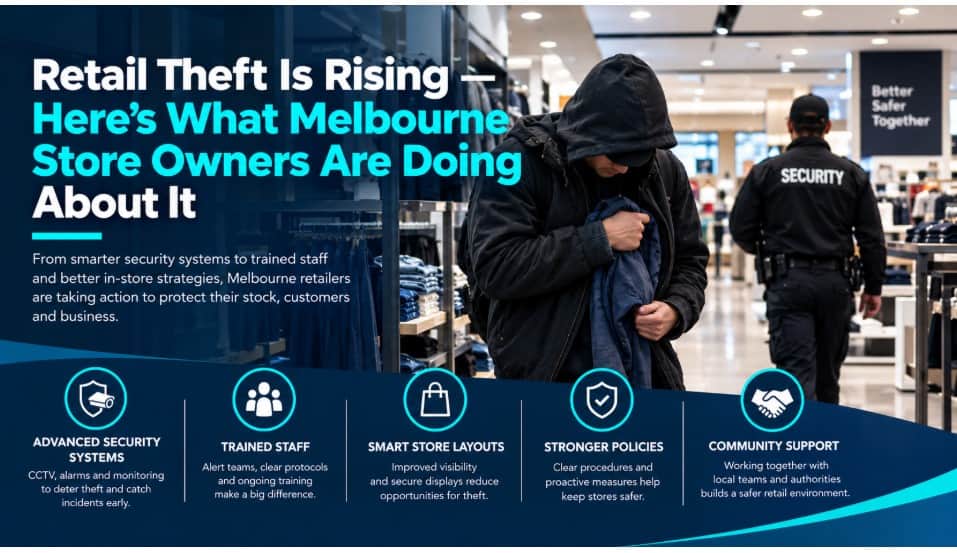
Retailers across Melbourne have been reporting a noticeable increase in theft over the past couple of years, and it's not limited to opportunistic shoplifting anymore. Organised theft groups, more brazen daytime incidents, and rising staff safety concerns have pushed many store owners to rethink security approaches that worked fine a decade ago but no longer match the scale of the problem.
Why the Numbers Are Climbing
A combination of cost-of-living pressure, organised resale networks for stolen goods, and short-staffed retail floors has created more opportunity for theft while reducing the number of staff available to notice it happening. Self-checkout expansion, while good for efficiency, has also removed a layer of natural deterrence that a staff used to provide.
Moving Beyond Basic CCTV
Cameras alone are no longer treated as sufficient by most retailers who've dealt with repeat incidents. Footage after the fact helps with police reports, but it doesn't stop the loss at the moment. More stores are pairing cameras with visible signage, better-positioned mirrors, and staff training focused specifically on early behavioural cues — the kind of loitering, concealment, or distraction techniques organised theft groups tend to use.
Bringing in Physical Security Presence
For higher-risk stores — those with high-value or easily resold stock, or locations that have already experienced repeat incidents — a visible security guard presence has become a common response. The deterrent effect of a uniformed guard near entry points is well documented, and for many retailers it's proven more cost-effective than the cumulative losses from ongoing theft.
Training Staff to De-escalate, Not Confront
One of the more significant shifts has been in staff training. Retailers are increasingly instructing staff not to physically confront suspected shoplifters, given the rise in aggressive and sometimes armed incidents. Instead, staff are trained to observe, alert security or management discreetly, and let trained personnel handle the situation. This protects staff safety first, while still creating a documented response to the incident.
Reviewing Store Layout
Loss prevention specialists often point to the store layout itself as a contributing factor. Blind spots created by tall shelving, poor sightlines from the till to the exits, and stockrooms with weak access control all make theft easier. Small layout changes — angled shelving, better mirror placement, clearer sightlines to exits — can meaningfully reduce opportunistic theft without any additional spend on guards or technology.
Coordinating With Other Local Retailers
In shopping strips and centres, some retailers have started sharing information informally about repeat offenders or organised theft patterns, which helps everyone respond faster. A few centres have gone further, coordinating with a single security provider across multiple tenancies so that patrols and guard presence cover the whole strip rather than each store handling it in isolation.
The Cost of Getting It Wrong
It's worth being blunt about what's at stake for retailers who delay addressing this. Beyond the direct cost of stolen stock, repeated incidents drive up insurance premiums, increase staff turnover as employees grow uncomfortable with unresolved safety risks, and in some cases lead to reduced trading hours or restricted product placement for high-theft items — all of which chip away at revenue in ways that are harder to see on a single line item than a stock loss report. Retailers who treat security spending as a cost to minimise often end up paying more in cumulative losses and staff disruption than a proper prevention strategy would have cost upfront.
Technology Retailers Are Adding Beyond Cameras
Alongside guards and better camera coverage, a growing number of Melbourne retailers are investing in electronic article surveillance tags on higher-value stock, smart shelving that flags unusual removal patterns, and integrated point-of-sale monitoring that flags discrepancies between scanned and observed transactions in near real time. None of these tools work as a complete solution on their own, but layered together with staff training and visible security presence, they close gaps that any single measure would leave open.
Seasonal and High-Risk Trading Periods
Theft patterns aren't constant throughout the year, and retailers who plan security around average conditions often get caught out during peak periods. The lead-up to Christmas, major sale events, and school holiday periods typically see a measurable spike in both opportunistic and organised theft, simply because stores are busier, staff are stretched thinner, and stock volumes are higher. Reviewing security coverage specifically for these periods — additional guard hours, temporary camera coverage of new stock displays, extra staff briefings — is one of the more cost-effective adjustments a retailer can make, since it targets spend at exactly the windows where risk is highest.
Building a Culture Where Staff Feel Safe Reporting Issues
Beyond physical measures, one of the more overlooked factors in retail loss prevention is whether staff actually feel comfortable flagging suspicious behaviour or safety concerns in the first place. Stores with a clear, simple reporting process — a discreet signal to alert a colleague or security without confrontation — tend to catch incidents earlier than stores relying on staff to make judgment calls under pressure with no clear procedure. This is a low-cost fix that pairs well with any of the physical measures above, and it often surfaces patterns management wouldn't otherwise notice.
Getting Professional Support
For store owners unsure where to start, a proper retail security assessment — reviewing layout, camera coverage, staff procedures, and guard requirements together — tends to be more effective than picking a single measure in isolation. Alfa Security works with retailers across Melbourne through its retail security services, combining guard presence, monitoring, and practical loss-prevention advice tailored to each store's specific risk profile.
Retail theft isn't going to reverse on its own, and store owners who treat security as a one-off camera installation are increasingly finding that's no longer enough. The retailers managing it best are the ones combining physical presence, staff training, and smarter store design rather than relying on any single fix.

