Revealed: The 5 Proven Subscriber Journeys That Amplified Growth for Me and My Clients (by almost 200%)
Hi Indie Hackers 👋🏻
I'm Neel , the founder of AlternativeAI, a one-stop AI Business Directory.
I might have stumbled my way to startups but by no means new to business! And I've surely learned the hard way that growing a business is no small feat, I didn’t start my journey and had overnight success either, instead, these tips and tricks for growing your email list to making your customers stick to your business are something I perfected over the years working for fortune 500 corporates (for 18+ years), to one person businesses and it works every time!
So today in this post, I’ll share the five subscriber journeys that have significantly boosted customer loyalty and amplified growth for both me and my clients (aka the corporate)
Here’s how the story unfolded — sometime back in 2015, I was part of a key product launch for a SAAS product making its debut in the US, being a key member of the marketing team I was under huge pressure to deliver -I used to spend nights staring at my screen, desperately trying to craft the perfect email sequence to engage the subscribers of the product and mind you it was before the time of all the mainstream AI-based automation or potent automation tools — I applied a scrappily pulled together email sequence and prayed to god! Fast forward a few months, and what I discovered through trial and error not only transformed the engagement for the product but also became a blueprint for my business and clients’ success.
Stick with me, and I’ll share five subscriber journeys that propelled the growth of the products that I worked on, including working on my small one-person business and doing the same for my clients. These journeys are not just theories; they have tested strategies that yield measurable growth.
- Onboarding Sequence — 7–10 Emails
The onboarding sequence is your first interaction with a subscriber. It’s an opportunity to make a lasting first impression and set the tone for long-term engagement.
This sequence was born from a 3 AM epiphany I had while launching a tech product. My goal was to convert trial users or subscribers into paying customers. I created a 7-email onboarding sequence that walked subscribers through the product’s features, shared success stories, and provided educational content. It required back-breaking work behind the scenes to get all the assets ready, but within three months, I saw a 240% increase in trial-to-paid conversions.
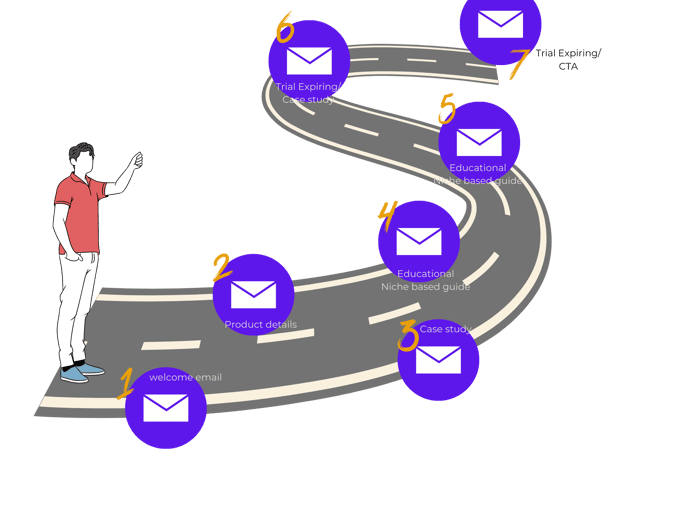
A well-crafted onboarding sequence should consist of 7–10 emails, each with a specific purpose:
Email 1: Welcome. Keep it casual. Share key features of your product or service and some brand information.
Email 2: How to use the product + Guided Tour (best if a person of authority could show. Get your best client to record it for you).
Email 3: Result-based Case Study (Give them hope that they could get there).
Email 4 & 5: Educational (Niche related Tip + product-related info).
Email 6: Trial Expiring notification + Case Study.
Email 7: Trial Expiring + Call to Action.
- Engagement Sequence
For the same product, I knew once it was launched I needed a strategy that would keep subscribers hooked and reduce churn rates. That’s when I implemented a structured engagement sequence.
Keeping your subscribers engaged with regular, value-packed content is key to reducing churn rates and increasing active participation.
I crafted a mix of content types to keep the audience engaged and interested. Here’s what worked for us:
Product Updates: Whenever a new feature was launched, I made sure to inform our subscribers. This kept them excited about the latest advancements and improvements.
Monthly Updates: I made these personal. I shared a steps by steps ups and downs on Twitter (now X), making our subscribers feel part of our journey.
Educational Content: At least twice a month, I send niche-related educational content. This added value to our subscribers and positioned us as thought leaders.
Customer Success Stories: Showcasing how other customers solved their problems using the product provided social proof and inspiration.
Feedback Requests: I regularly asked for feedback, testimonials, and even feature requests. This made our subscribers feel valued and heard.
Seasonal Campaigns: I tied in competitions, sales, or special offers with the season, adding a fun and timely element to our communications.
Over six months, the results were astounding. My client noticed a 30% increase in customer retention and significantly higher user engagement. Subscribers were more active, more invested in the brand, and more likely to convert into loyal customers. This engagement sequence not only kept the audience hooked but also built a community around the product, driving long-term success.
- Sales Sequence
Let’s dive into a pivotal moment in my career when I worked with an e-commerce client facing a major challenge: low conversion rates. Despite having a sizable subscriber list, they struggled to turn those engaged subscribers into paying customers. I knew I had to do something different, something that would effectively nudge subscribers toward making a purchase.
Converting engaged subscribers into paying customers is the ultimate goal. A dedicated sales sequence can effectively guide them towards a purchase.
I designed a 7-email sales sequence that combined educational content, social proof, and limited-time offers. Here’s the approach I took:
Email 1: Asset Delivery + Introduction: I started by delivering a valuable asset (like an ebook or a free trial) with a small introduction about what’s coming next.
Email 2: Education + Walkthrough: The next email provided educational content and a walkthrough of how to use the product or service.
Email 3: Education + Walkthrough + Social Proof: I added a customer success story to the educational content to build trust.
Email 4: Education + Personalized Walkthrough Invite: Another round of education, but this time with an invite for a personalized walkthrough.
Email 5: Limited Offer: I introduced a special, limited-time offer to create urgency.
Email 6: Objection Handling + Offer + Social Proof: Addressing common objections, I reinforced the offer with more social proof.
Email 7: Final Offer + Social Proof: The final email reiterated the offer and included additional social proof to convince those still on the fence.
Within two months of implementing this sequence, the client’s conversion rate jumped by 25%, leading to a significant boost in revenue. This approach didn’t just increase sales; it built a stronger relationship with the subscribers, turning many into loyal customers.
- Re-Engagement Sequence
Subscriber inactivity is a common issue, but it’s not something we can overcome. I remember working with a tech industry client who had a large number of inactive subscribers. I needed a strategy to revive their interest and bring them back into the fold.
I crafted a re-engagement sequence with personalized content and special offers. Here’s how I did it:
Email 1: Reminder of What They’re Missing: I reminded inactive subscribers of the valuable content and benefits they Ire missing out on.
Email 2: Special Offer or Discount: To incentivize them, I offered a special discount if they re-engaged.
Email 3: Personalized Content Based on Past Behavior: I tailored the content to their previous interactions and interests.
Email 4: Final Reminder with a Call to Action: The last email was a final nudge, urging them to take action and re-engage.
- Customer Feedback and Testimonial Sequence
Gathering feedback and testimonials is crucial for any business looking to improve and build trust. Often ignored by a stellar strategy, Sio I implemented a sequence designed to gather valuable feedback and glowing testimonials.
Importance: Gathering feedback helps improve your service, while testimonials build trust and credibility, leading to sustained growth.
Here’s how I structured our feedback and testimonial sequence:
Email 1: Request for Feedback via Surveys: I started by asking customers to fill out a brief survey.
Email 2: Follow-Up for Detailed Feedback: I followed up with those who responded, asking for more detailed feedback.
Email 3: Request for Testimonials: Once I had the feedback, I asked satisfied customers to provide testimonials.
Email 4: Use Testimonials in Marketing Materials: I showcased these testimonials on the client’s website and in their marketing materials.
As a result, the client not only improved their service offerings but also attracted more clients by showcasing the positive experiences of their existing customers. Testimonials added a layer of trust and credibility that is invaluable in the B2B space.
These five subscriber journeys — onboarding, engagement, sales, re-engagement, and customer feedback — have proven to be game-changers in boosting customer loyalty and driving growth. Implementing these structured sequences can transform your subscriber base into a loyal community and significantly amplify your business growth.
Additional Tips
Automation Tools: Consider using tools like Mailchimp, ConvertKit, or ActiveCampaign to automate these sequences and save time.
Metrics: Track key metrics like open rates, click-through rates, and conversion rates to measure the effectiveness of each journey.
Continuously refine these journeys based on data and feedback to ensure they remain effective and relevant.
By following these strategies, you’ll be well on your way to building a loyal subscriber base and driving significant growth for your business.
To follow my sequences - you can check out - https://alternativeai.io/!
